Your scooter’s display shows E7, usually in red, and the throttle is dead or the scooter will not go. The first thing to know is that E7 does not mean one thing: there is no universal E7 standard, and each brand defines the code its own way. On most scooters the likeliest causes are a motor hall sensor fault or a broken throttle, but on some models E7 means something else entirely. This guide, part of our Scooters hub, starts with the numbers, works through the causes in order of likelihood, and shows you how to tell a throttle fault from the rest — without treating one rider’s report as proof.
The numbers first: what E7 usually means
| Reading | What the E7 guides say | Share of cases |
|---|---|---|
| Motor hall sensor fault | The motor’s hall sensors stop reporting position, so the controller will not drive the motor | ~60% |
| Throttle failure | The throttle stops sending a clean signal, or sends none at all | ~20% |
| Controller communication error | The controller and display stop talking to each other properly | ~15% |
| Loose motor-to-controller wiring | A plug or wire between motor and controller works loose or breaks | ~5% |
| Overvoltage protection (Hover-1 Journey 2.0) | On this model E7 means overvoltage protection, not a throttle or sensor fault | Not published |
| Xiaomi / Ninebot | These brands do not use E7 at all | Not applicable |
Worked example. Take a rider whose display reads E7 and whose throttle does nothing. The quickest discriminating test is the throttle voltage: a working throttle reads about 0.8–1.0 volts at rest and rises smoothly to about 4.0–4.2 volts at full throttle. If the reading sits at 0 volts, sticks at 5 volts, or jumps about instead of rising smoothly, the throttle is the suspect — that is the ~20% case, and it is also the cheapest fix. If the throttle voltage moves cleanly from about 0.8 to about 4.2 volts and E7 is still there, the throttle is almost certainly fine, and the fault is in the hall sensor, the wiring, or the controller — the other ~80% of cases. One test, two very different next steps, which is why the numbers come first.
What causes E7, ranked
1. Motor hall sensor fault (~60%). The most common reading across the E7 guides. Hall sensors inside the motor tell the controller where the rotor is; when they fail, the controller refuses to drive the motor and shows E7. The scooter usually switches on normally and the display works — it is the drive that is missing.
2. Throttle failure (~20%). The throttle’s own sensor or wiring fails, so the controller gets no throttle signal or a signal outside the range it expects. This is the cause behind the widely shared story of a rider whose throttle broke and produced E7 — real, but only about one case in five.
3. Controller communication error (~15%). The controller and the display disagree, or the controller itself stops reading the motor and throttle inputs correctly. This is harder to prove at home than the first two, which is why it sits third in the fix order below.
4. Loose motor-to-controller wiring (~5%). A plug worked loose, a wire pinched at the folding joint, a connector corroded. The smallest share, but also the cheapest to check — which is why the wiring check comes early even though it ranks last.
5. Overvoltage protection — Hover-1 Journey 2.0 only. On this model E7 means the battery voltage is too high for the controller, a different fault with a different fix. If your scooter is a Hover-1 Journey 2.0, stop and read that model’s own guidance first; the steps below are built for the hall/throttle/wiring meanings of E7, not for overvoltage.
Why the generic claims are wrong
“E7 means the throttle is broken.” Wrong as a general rule. It is true about one time in five. The claim comes mostly from a single Facebook post by George Parker, dated 18 October 2025, showing a display reading E7 in red LED, where a commenter said their throttle broke and produced the same E7 code. That is one user’s report, and the author of the post had not repaired the scooter yet. One report is a lead, not proof — and the wider guides put throttle failure second, behind the hall sensor.
“E7 is the same on every scooter.” Wrong. There is no universal E7 standard. Each brand defines its own codes, which is why the same two characters can mean a hall sensor fault on one scooter, overvoltage protection on a Hover-1 Journey 2.0, and nothing at all on a Xiaomi or Ninebot — those brands do not use E7. Any guide that gives one fixed meaning for E7 without asking the brand first is guessing.
“A new throttle will fix it.” Only if the throttle is actually the fault. A new throttle on a scooter with a dead hall sensor changes nothing except the bill. That is the point of the voltage test in the worked example above: prove the throttle is bad before replacing it.

What to do, in order
1. Note the brand and model, and check its own manual first. Because E7 is brand-defined, the manual is the only source that can confirm what it means on your scooter. If the manual says overvoltage, or gives a different meaning, follow the manual, not this guide.
2. Test the throttle voltage. With a multimeter on the throttle signal wire, switch on and read the voltage with the throttle untouched, then twist or press it slowly to full. A healthy throttle reads about 0.8–1.0 volts at rest and rises smoothly to about 4.0–4.2 volts at full throttle. Stuck at 0, stuck high, or jumping around means the throttle is the suspect. Switch off before unplugging anything.
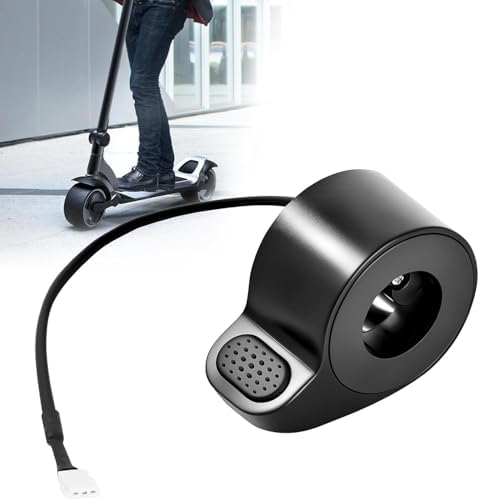
3. Check the throttle plug and wiring. Follow the throttle cable to its connector, unplug it, look for bent pins or corrosion, and push it fully home. A loose throttle plug gives the same dead-throttle symptoms as a broken throttle, and it costs nothing to fix.
4. Check the motor-to-controller wiring. Trace the motor cable from the wheel to the controller, looking for pinches at the folding joint, cuts, and loose plugs. Reseat the motor connector with the arrows lined up. This is the ~5% cause, but it is a five-minute check, so it earns its place early.
5. Check the hall sensor. If the throttle tests clean and the wiring is sound, the hall sensor is the likeliest fault. The sensor board sits inside the motor hub, so this step usually means opening the motor or taking the wheel to a shop. Do not open the motor unless you know what you are doing — the sensor is small, its wiring is fiddly, and a wrong reassembly costs more than the part.

6. Suspect the controller last. If the throttle, wiring, and hall sensor all test fine and E7 is still there, the controller is what is left. Controllers are model-specific — voltage, connectors, and hall wiring have to match the scooter — so check fit before buying anything, and treat a controller swap as a shop job unless you have done one before.

7. Stop and get help if E7 survives all of that. A fault that outlasts the throttle test, the wiring check, and the hall sensor check is not a home fix. A shop with the right tester can read the hall signals and the controller directly instead of guessing through parts.
How much does this actually affect you?
If it is the throttle, the fix is small: a replacement thumb throttle is about $8–10, and on most scooters it is a plug swap. That is the ~20% case, and the one to hope for. If it is the hall sensor, the part itself is cheap — a sensor board is about $7–10 — but fitting it means opening the motor hub, so the cost is mostly labour or a shop visit. If it is the controller, the part is about $47 for a 36V 500W kit, plus fitting, and only if the kit matches your scooter. A sensible buffer is to budget for the throttle first, then the sensor, and keep the controller as the last resort — replacing parts in the order of the ranked list above, not all at once. No universal repair cost is published for E7, because the code means different things on different brands; any figure that claims one is guessing.
Readers also ask
Does E7 always mean the throttle is broken?
No. Throttle failure is about 20% of E7 cases in the guides. The most common cause is a motor hall sensor fault, at about 60%, and on some models E7 means something else entirely.
How do I test if my throttle is the problem?
Measure the throttle signal voltage: about 0.8–1.0 volts at rest, rising smoothly to about 4.0–4.2 volts at full throttle. If it sticks, jumps, or reads 0, the throttle is the suspect. If it moves cleanly, the throttle is almost certainly fine.
My scooter is a Hover-1 Journey 2.0 and shows E7. Is it the throttle?
Probably not. On the Hover-1 Journey 2.0, E7 means overvoltage protection. Check the battery voltage and that model’s own guidance before touching the throttle.
Do Xiaomi and Ninebot scooters show E7?
No. Xiaomi and Ninebot do not use E7 at all, so if you ride one of those and see a code, it will be a different code with a different meaning.
Can I ride the scooter with E7 showing?
No. With E7 showing, the throttle is dead or the motor will not drive, and a scooter that can cut in or out without warning is not safe to ride. Fix it first, or walk it to a shop.
Additional Details
Name: Electric Scooter E7 Error: Is the Throttle Broken — or Something Else?
Description: Electric scooter E7 error — is the throttle broken? The code means different things by brand; our check tells throttle faults from hall sensor faults.
Published: 22 November 2026