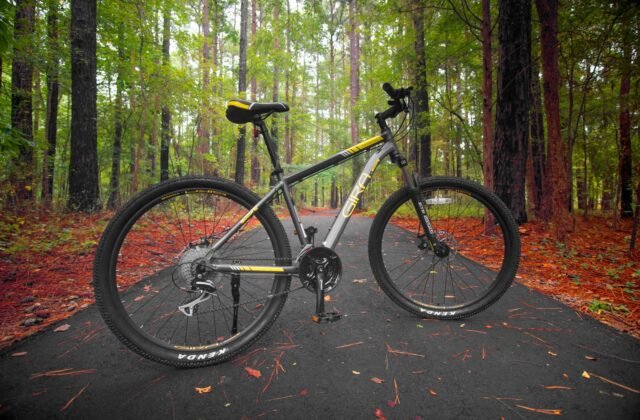
Part of our Mountain Bikes Hub.
Putting a 27.5+ wheel on a 29er fork sounds like a free upgrade: a fatter tyre, more grip, and a lower front end — or so the forums say. The reality is measured in millimetres, and the numbers do not always point the way riders expect. A 29-inch wheel can be shorter than a 27.5+ wheel, a gap of 3–4 mm can end the whole project, and the swap changes your bike’s geometry whether you want it to or not.
This guide corrects the eight myths riders repeat most about 27.5+ wheels on 29er forks, using the actual radius figures. No myth here is invented: each one is a claim that circulates in real discussions, and each correction comes from the measured numbers and the clearance, brake, and hub rules that decide whether the swap works.

Short Answer
Yes, a 27.5+ wheel can fit a 29er fork — but only when the fork and frame were designed for 27.5+ wheels, with clearance on all sides. The radius difference is small and tyre width decides it: a 27.5+ wheel with a 2.8-inch tyre (363.12 mm radius) is taller than a 29-inch wheel with a 2.0-inch tyre (361.8 mm). If the gap above the tyre at the fork arch is only 3–4 mm after fitting, abort the swap: debris can jam and block the wheel, which can throw you off. You also need disc brakes and a hub that matches your fork — thru-axle to thru-axle, quick-release to quick-release.
Myth 1: “A 29er wheel is always bigger than a 27.5+ wheel.”
The correction: Not always — tyre width decides, not the rim label. A 27.5+ wheel with a 2.8-inch tyre has a radius of 363.12 mm, while a 29-inch wheel with a slim 2.0-inch tyre has a radius of 361.8 mm: the 29er is 1.32 mm shorter. With a 1.9-inch tyre the 29-inch wheel is 359.26 mm, which is 3.86 mm shorter than the 27.5+ wheel. The typical radius difference between 29-inch and 27.5-inch wheels is about 19 mm, but that figure assumes comparable tyres — put a fat tyre on the smaller rim and a narrow tyre on the bigger one, and the order flips.
Tip: Compare radius figures for the exact tyre widths you will run, not the rim sizes on the box.
Myth 2: “27.5+ means any wide 27.5-inch tyre.”
The correction: 27.5+ has a specific meaning: tyres 2.8 inches or wider. A 2.6-inch tyre on a 27.5-inch rim is a wide 27.5-inch tyre, but it is not a 27.5+ tyre, and it will not give you the radius or the footprint the plus size is known for. The plus label starts at 2.8 inches.
Tip: Check the sidewall: if it does not read 2.8 inches or more, it is not a plus tyre.
Myth 3: “If it fits in the fork, it is safe to ride.”
The correction: Fitting is not the same as clearing. The conversion needs clearance on all sides, not just a tyre that squeezes past the arch. If the gap above the tyre at the fork arch is only 3–4 mm after fitting, abort the swap: mud, stones, and sticks can jam in that gap and block the wheel, which can throw you off the bike. A wheel that fits in the stand and jams on the trail is not a fit.
Tip: Measure the arch gap after fitting with the tyre inflated. At 3–4 mm, stop — do not ride it to see if it clears.

Myth 4: “Any 29er fork takes a 27.5+ wheel.”
The correction: The conversion works best when the fork and frame were designed for 27.5+ wheels. A fork built only for 29-inch wheels may not have the width or the arch height a 2.8-inch tyre needs, and the frame has to clear the bigger tyre too — the fork is only half the question. Check clearance on all sides, front and rear, before spending money.
Tip: Confirm the fork and the frame are both rated for 27.5+ before you buy anything.
Myth 5: “Rim brakes work fine after the swap.”
The correction: Rim-brake pads will not align with the larger rim after a wheel-size change, so rim brakes are the wrong choice for this conversion. Disc brakes are strongly recommended: the rotor sits in the same place regardless of rim size, so the brake keeps working. Adapters for rim brakes exist, but they are finicky and unsightly, and they are a workaround, not a solution.
Tip: If your bike has rim brakes, treat that as a reason not to do the swap — or budget for a disc-brake conversion first.
Myth 6: “Any hub fits any fork.”
The correction: The hub must match the fork. A thru-axle fork needs a thru-axle hub, and a quick-release fork needs a quick-release or nutted hub. The axle standard is part of the fit, and a wheel with the wrong hub will not mount at all — it is not a matter of adjustment. Check the axle type on both sides before ordering a wheelset.
Tip: Read the fork’s axle spec first, then buy a hub that matches it exactly.

Myth 7: “The swap only makes the front end taller.”
The correction: The height change is only the start. Take the worked example: swapping a 2.8-inch 27.5+ wheel (radius 363.12 mm) for a 2.4-inch 29-inch wheel (radius 371.95 mm) adds 8.82 mm, so the front rises about 9 mm. That rise slackens the head tube angle and the seat tube angle, and it raises the bottom bracket. One number changes, and three angles and a height move with it — the bike steers and sits differently, not just taller.
Tip: Work out the radius difference for your exact tyres before the swap, and expect the handling to change with it.
Myth 8: “A 29er conversion is always an upgrade.”
The correction: The swap has real downsides, and for recreational riders the overall benefit is questionable. Fitting the bigger wheel forces a narrower tyre, which hurts off-road grip — the very thing the plus tyre was giving you. The slacker seat tube angle and higher bottom bracket make the bike less stable and harder to reach the ground from. And the cheaper alternative is sitting in plain sight: fit a wider 27.5-inch tyre, and the radius gets close to a narrow 29-inch wheel with none of the compatibility problems. Compare the swap with a 29er mountain bike vs trail hardtail before deciding, and weigh it against a 27.5 mountain bike vs electric mountain bike if you are choosing a whole bike rather than a wheel.
Tip: Try the wider 27.5-inch tyre first. It is cheaper, it needs no new brakes or hub, and it gets you most of the radius gain.

Checklist: Before You Fit a 29er Wheel
Run through this list in order. Any “no” is a stop, not a warning:
- Fork and frame are both designed for 27.5+ wheels.
- Clearance on all sides after fitting, with the tyre inflated.
- Arch gap above the tyre is more than 3–4 mm — at 3–4 mm, abort.
- Disc brakes fitted — rim-brake pads will not align with the larger rim.
- Hub matches the fork: thru-axle to thru-axle, quick-release to quick-release or nutted.
- Radius difference worked out for your exact tyre widths — expect about 9 mm of front rise in the worked example, with slacker head tube and seat tube angles and a higher bottom bracket.
- A wider 27.5-inch tyre considered first — cheaper, and no compatibility problems.
Readers Also Ask
Will a 27.5+ wheel fit my 29er fork?
Only when the fork and frame were designed for 27.5+ wheels, with clearance on all sides. Measure the arch gap after fitting with the tyre inflated — at 3–4 mm, abort the swap.
Is a 29er wheel always bigger than a 27.5+ wheel?
No. A 29-inch wheel with a 2.0-inch tyre has a radius of 361.8 mm, shorter than a 27.5+ wheel with a 2.8-inch tyre at 363.12 mm. Tyre width decides.
Do I need new brakes for the swap?
Disc brakes are strongly recommended. Rim-brake pads will not align with the larger rim, and adapters are finicky and unsightly.
Will the swap change how my bike handles?
Yes. In the worked example the front rises about 9 mm, which slackens the head tube and seat tube angles and raises the bottom bracket — the bike steers and sits differently.
Is there a cheaper way to get close to a 29er?
Yes: fit a wider 27.5-inch tyre. The radius gets close to a narrow 29-inch wheel with none of the compatibility problems.
Conclusion
A 27.5+ wheel on a 29er fork is a millimetre problem, not a fashion choice. The radius numbers can flip the size order, a 3–4 mm arch gap is a reason to stop, and the swap moves your head tube angle, seat tube angle, and bottom bracket along with the front height. For most recreational riders, the wider 27.5-inch tyre is the better answer: most of the radius gain, none of the new brakes, hubs, or geometry trade-offs.
Additional Details
Name: 27.5 Plus Wheel on a 29er Fork: Clearance, Myths and the Real Numbers
Description: 27.5 plus wheel on 29er fork clearance: the real radius numbers, the 3–4 mm abort rule, disc brakes, hub matching, and the full geometry change explained.
Published: November 24, 2026