Part of our guide on E-Bikes
E31 on an Aventon display means the bike and the battery have stopped talking to each other. It is a battery communication error, and the fix follows a short sequence: power off, remove the battery, clean the metal contact terminals with a dry cloth, push the battery back into the frame mount until the latch clicks, then run the 60-second hard reset and power on with no foot on the pedals and no hand on the throttle. If the code clears, you are done. If it stays, work through the stages below in order.
Photo by cottonbro studio on Pexels. A dry cloth and the tools to remove the battery are all this fix needs.
The E31 flowchart: follow it top to bottom
| Step | Ask | Yes | No |
|---|---|---|---|
| 1 | Display shows E31? | Go to step 2 | Read the code you see — E28 and E30 need different fixes |
| 2 | Battery seated and latched? | Go to step 3 | Remove it, clean contacts with a dry cloth, reseat until the latch clicks |
| 3 | 60-second hard reset cleared it? | Ride — watch for it coming back | Go to step 4 |
| 4 | Battery holding charge normally? | Go to step 5 | The pack is the suspect — dealer or replacement |
| 5 | Powered on with no pedal or throttle pressure? | Error still there — take it to a dealer | Power on again the right way and check |
Stage 1 — Is the battery seated and latched?
The communication runs through the metal contact terminals where the battery meets the frame. If the battery sits a fraction loose, or the terminals carry dust, road grit or light corrosion, the bike cannot read the pack and the display throws E31. So stage 1 is mechanical: power off, release the latch, slide the pack out, and look at the terminals on the battery and in the frame mount. Check for dust, a dull film, green residue, or a bent or pushed-in terminal. Wipe the terminals with a dry cloth — do not wet it and do not spray anything into the mount, so no moisture is left on live terminals.
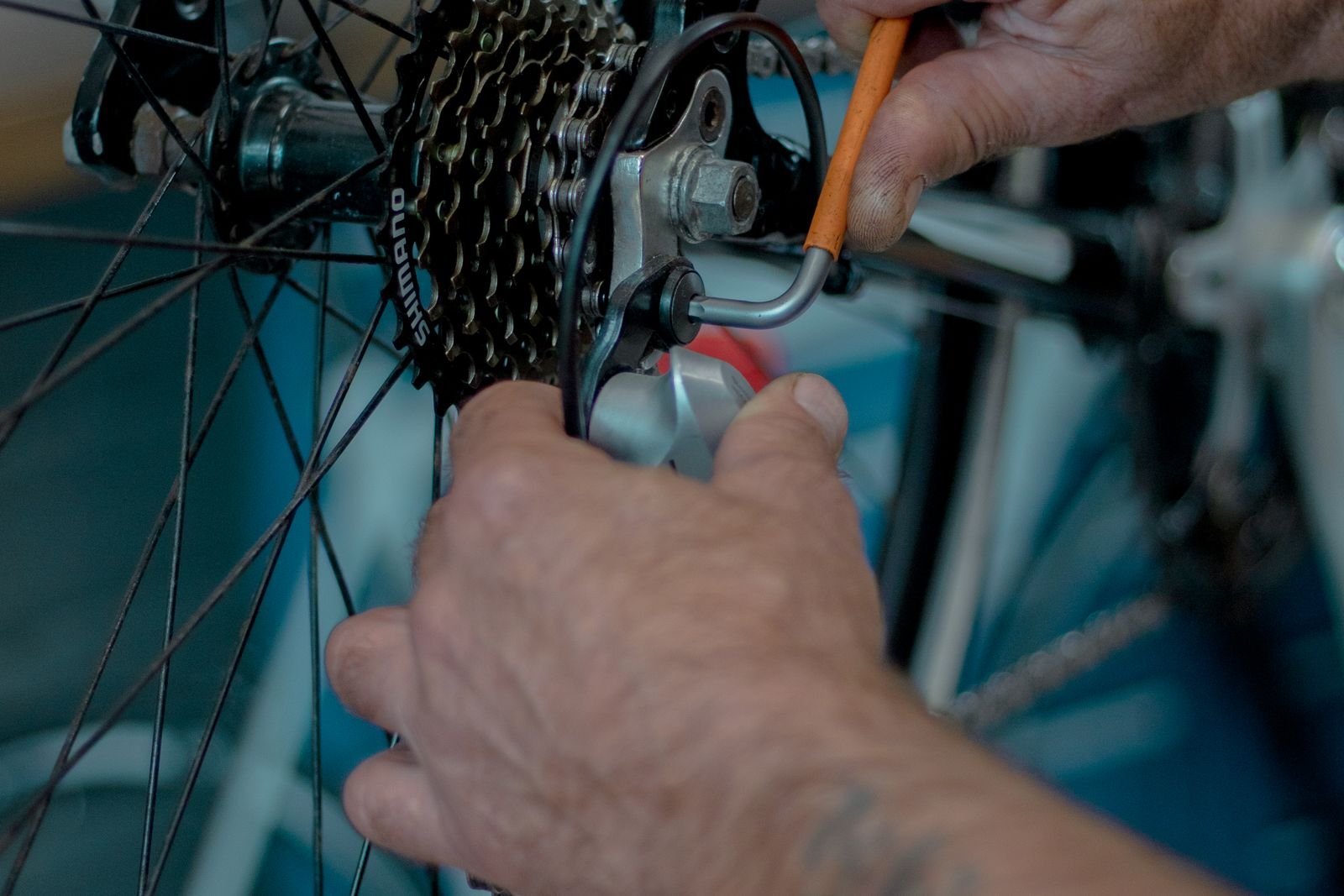
Photo by Rehook Bike on Pexels. Clean hands, dry cloth, no liquids on the terminals.
Push the battery back into the mount firmly until the latch clicks. That click is the only confirmation the pack is fully home and the terminals are pressed together as designed. A battery that looks seated but has not clicked is still loose, and it will throw E31 again on the first bump. Tug the pack gently after the click to confirm it is locked, then power on and read the display. If E31 is gone, the seating was the fix. If it is still there, move to stage 2 — do not keep removing and reseating the battery hoping for a different result.

Stage 2 — Does the error clear after the 60-second hard reset?
If clean contacts and a firm reseat did not clear E31, run the 60-second hard reset. This is not the same as turning the bike off and on again. A normal power-off leaves charge in the capacitors, so the controller can wake up in the same confused state it went to sleep in. The hard reset drains that charge and forces the controller and display to start from scratch.
Power off, remove the battery, then press and hold the display power button for ten seconds. Nothing will light up — that is expected, because there is no battery in the bike. Those ten seconds discharge the capacitors. Then reinstall the battery firmly until the latch clicks, and power on with no foot on a pedal and no hand on the throttle. The torque sensors calibrate at boot, and pressure during that moment can throw a false error. If the display comes up clean, ride — but watch it for the first few minutes. An E31 that clears and never returns was a one-off glitch. One that returns on the same ride means something is still wrong, so move to stage 3.
Stage 3 — Is the code really E31, or a different code?
Read the code on the display carefully before going further. E28 is the low-voltage code: the battery is too low to run, so the fix is to recharge the pack. If E28 shows up when the battery was recently charged and should still be high, that points at degraded cells rather than a charging mistake — a pack that reports low voltage on a high charge is not holding its charge the way it should.
E30 is the controller communication fault, a different conversation from the battery conversation. Where E31 is the bike failing to talk to the battery, E30 is the bike failing to talk to its own controller. The check for E30 is the main wiring harness behind the headlight and around the handlebars: look for a connector that has worked loose, a wire pinched by the bars, or a plug that is not fully seated. Cleaning battery contacts will not fix a loose harness plug, and checking the harness will not fix dirty terminals. If the display genuinely shows E31 and stages 1 and 2 did not clear it, the problem is on the battery side — stage 4.

Stage 4 — Is the battery itself worn out?
A battery that will not communicate can also be a battery that is worn out. The terminals can be spotless and the latch can click perfectly, and E31 can still stay if the pack can no longer hold the connection the bike expects. The clearest sign is charge behaviour: a healthy pack charges fully and holds it, while a tired pack drops off quickly, shows low voltage soon after charging, or throws an error and shuts the bike down under load. If E31 appeared with that behaviour — short range, sudden drops, E28 on a pack that should be full — the pack is the suspect, not the terminals.
Photo by Anastasia Shuraeva on Pexels. If the pack is the problem, no amount of cleaning will fix it.
There is no home fix for a worn-out pack. You cannot clean or reset degraded cells back to health, and opening a battery pack is not a job for a home workbench. A dealer can test the pack properly and tell you whether it is the pack or the bike, and a replacement battery is the answer only once the pack is confirmed as the problem. Do not buy a replacement to test a guess — a new battery will not fix a faulty mount, a damaged harness, or a controller that cannot talk to any pack. If the pack is confirmed worn out, the replacement must match the bike: the same voltage and the same mount. Check the model fit before ordering, and keep the original charger.

Stage 5 — Did you power on with pressure on the pedals?
This stage catches the error that is not an error at all. Aventon bikes calibrate their torque sensors at boot, in the first moments after you press power. The calibration assumes the bike is at rest: no foot on a pedal, no hand on the throttle. Power on with a foot on a pedal or a thumb on the throttle, and the sensor reads that pressure as its zero point — the bike can then throw an error or behave strangely until it is powered off and started properly.
The rule costs nothing: the Zero-Pressure Startup. Stand beside the bike, feet off the pedals, hands off the throttle, then press power. Wait for the display to finish booting before touching anything. If you have been powering on while sitting on the bike with a foot on a pedal — the natural way most people do it — try the standing start once and see whether E31 goes away with it. It is a habit fix, not a parts fix, and the easiest stage in the flowchart. It is also the one people skip, because it feels too simple — and then they replace parts to fix a startup habit.
Thinking it through: what E31 is, and what it is not
E31 is a conversation problem. The bike asks the battery who it is and how much charge it holds, and the battery does not answer, or the answer arrives garbled. That is why the fix starts with the terminals and the seating: the conversation travels through metal touching metal, and anything between those surfaces — dust, film, a loose fit — breaks it. It is also why the hard reset works when it works: a controller latched into a confused state needs its capacitors drained before it will listen again.
What E31 is not: a motor fault, and it does not mean the motor is damaged. It is not a brake fault either. The wheels, brakes and frame are all unaffected. But do not ride with E31 showing — a bike that cannot talk to its battery cannot manage power properly, and it may cut out, surge, or shut down without warning. Fix it first, then ride. Two safety notes: never force the battery latch — if the pack will not click home, something is in the way, and forcing it can bend a terminal. And never open the battery pack itself. The cells inside hold serious energy, and the pack is sealed for a reason. Terminals and reseating are owner jobs. Anything inside the pack is a dealer job.
In short
E31 means the bike lost contact with its battery. Power off, remove the pack, clean the metal terminals with a dry cloth, push the battery back until the latch clicks, then run the 60-second hard reset and power on with no foot on the pedals and no hand on the throttle. If the code clears, it was the seating or a one-off glitch. If it stays, check the code is really E31 and not E28 or E30, watch how the pack holds its charge, and take it to a dealer before buying parts.
Readers also ask
What does Aventon E31 mean?
E31 is a battery communication error. The bike cannot read the battery through the contact terminals, so the display shows E31 instead of the normal riding screen.
How do I fix Aventon E31 at home?
Power off, remove the battery, clean the metal contact terminals with a dry cloth, reseat the battery firmly until the latch clicks, then run the 60-second hard reset and power on with no pressure on the pedals or throttle.
What is the 60-second hard reset?
Power off, remove the battery, press and hold the display power button for ten seconds to discharge the capacitors, reinstall the battery firmly, and power on. The whole sequence takes about a minute.
Is E31 the same as E28 or E30?
No. E28 is low voltage — recharge, and suspect degraded cells if it appears on a high charge. E30 is a controller communication fault — check the wiring harness behind the headlight and handlebars.
Can I ride with E31 showing?
No. The bike cannot manage its power properly while it cannot talk to the battery, and it may cut out or shut down without warning. Fix it first, then ride.
Additional Details
Name: Aventon E31 Battery Communication Error: Clean Contacts or Dead Battery?
Description: Aventon E31 battery communication error means the bike lost contact with the pack. Clean the terminals, reseat the battery, and run the 60-second reset.
Published: November 22, 2026