
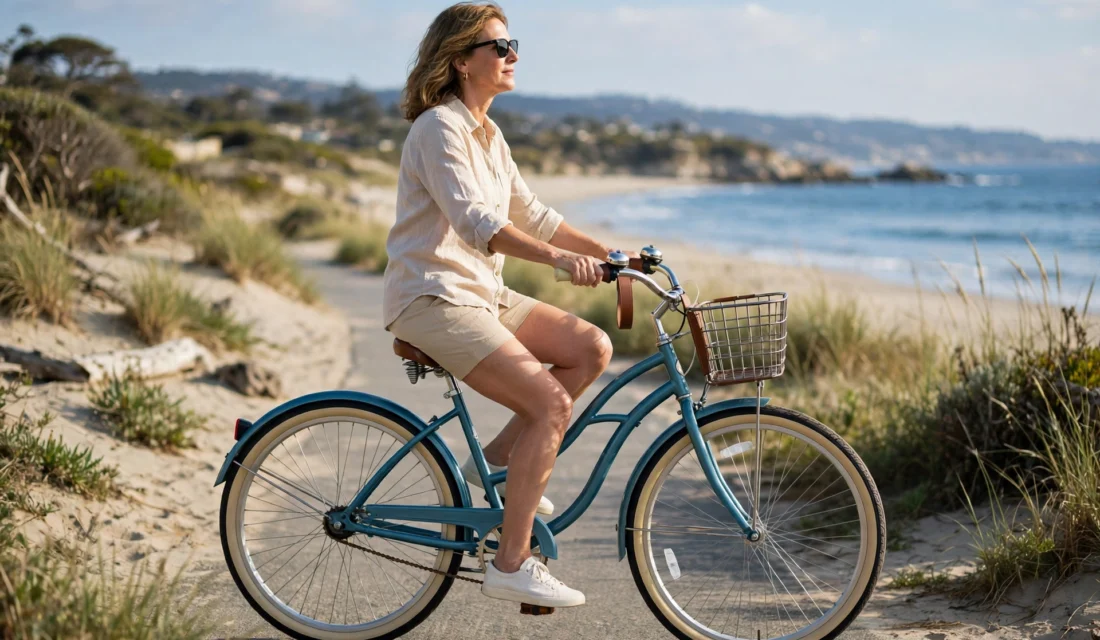
Short answer: Start with a classic or 3-speed cruiser in the right size, with wide tyres, an upright position and a comfortable saddle. Add gears only if you face hills, and add electric assist only if you ride farther or carry more.
Introduction
Cruisers are built for relaxed riding. You sit upright, your hands rest naturally on swept-back bars, and wide tyres smooth out boardwalks, park paths and quiet streets.
That comfort is the point. A cruiser is not a race bike, and it should not be judged like one. Judge it by how easy it feels to start, stop and enjoy a short ride.
This cruiser bike guide for beginners compares cruiser types, sizes and brakes, then walks through a simple buying and first-ride checklist so you can choose with confidence.

Cruiser types compared
Most beginners need only three choices: single-speed for flat ground, geared for gentle hills, or electric for longer rides. Fat tyres add grip on sand and loose paths, but also add weight.
| Cruiser type | Gears | Typical weight | Best for |
|---|---|---|---|
| Classic single-speed | 1 | 14–17 kg | Flat beach and town rides |
| 3-speed or 7-speed | 3 or 7 | 16–19 kg | Gentle hills and mixed routes |
| Electric cruiser | 7 plus motor assist | 24–30 kg | Longer rides, loads and headwinds |
| Fat-tyre cruiser | 1–7 | 20–27 kg | Sand, loose gravel and soft paths |
Wheel size guide: Most adult cruisers use 26-inch wheels, which roll smoothly and feel stable. Smaller riders may prefer 24-inch wheels, which lower standover height and make stopping easier.
| Rider height | Frame size | Wheel size |
|---|---|---|
| 152–163 cm | 15–16 in | 24–26 in |
| 163–178 cm | 17–18 in | 26 in |
| 178–193 cm | 19–20 in | 26 in |
Safety first: You should be able to put at least one foot flat on the ground at a stop, reach the brakes without stretching, and step off the saddle easily. If not, the bike is too large.
Brakes, gears and comfort features
Cruiser brakes are simple, but they change how the bike feels. Coaster brakes stop when you pedal backwards, which is intuitive on flat ground. Hand brakes give finer control on hills and in traffic, and are worth choosing if you ride mixed routes.
- Coaster brake: Low maintenance, clean look, easy for beginners. Less precise in wet or steep conditions.
- Hand brakes: Better control and stopping power. Check that levers are easy to reach with small hands.
- Both: Some cruisers pair a coaster brake with a front hand brake for extra safety. This is a good beginner choice.
- Gears: Internal hub gears are protected from weather and need little care. Derailleur gears offer a wider range, but need more cleaning.
- Saddle: A wide, sprung saddle suits short, relaxed rides. If it feels too soft or too wide, it can cause chafing on longer rides.
- Bars: Swept-back bars keep wrists neutral. Upright bars with a slight rise suit most beginners.

Comfort checklist: Sit on the bike and check that your back is upright, your elbows are slightly bent, and your knees do not hit the bars. Your feet should reach the ground at stops without sliding off the saddle.
Also check practical details: a chain guard keeps clothes clean, mudguards help in wet weather, and a rear rack is useful for a bag or beach gear. A kickstand that holds the bike on soft ground is worth more than it sounds.

Electric Bikes for Adults, 1000W Peak Electric City Cruiser 25Mph Step-Thru Electric Bicycle, 48V 696Wh/36V 450Wh Removable Battery, 26-inch
A step-through electric cruiser for longer, relaxed rides.
What you will need
| Item | What it is for |
|---|---|
| Helmet | Head protection on every ride |
| Pump and tyre gauge | Keeping wide tyres at the right pressure |
| Lock | Securing the bike at cafes and beaches |
| Lights | Visibility at dusk and in shade |
| Water bottle and holder | Comfort on warm, longer rides |
Choose and ride, step by step
1. Match the bike to your route
Write down your three most common rides: distance, surface and hills. If all three are flat and under 5 km, a single-speed cruiser is enough. If one includes a hill or a 10 km round trip, this cruiser bike guide for beginners suggests choosing gears. If you ride 15 km or more, consider electric assist.
Test the route in your head, not just the shop floor. A bike that feels fine for two minutes can feel heavy after 20 minutes, especially a fat-tyre or electric model.
2. Check size and stopping in the shop
Stand over the frame, sit on the saddle and roll forward slowly. Brake gently, then firmly, from walking speed. You should stop smoothly without the front wheel skidding or the bike pulling to one side.
Adjust the saddle so your leg has a slight bend at the bottom of the pedal stroke. On a cruiser, a slightly lower saddle is acceptable for easy stops, but not so low that your knees rise high.
3. Set tyre pressure for comfort and control
Wide cruiser tyres usually run at 30 to 50 psi, but always follow the pressure printed on the tyre sidewall. Lower pressure gives a softer ride on rough paths, while higher pressure rolls faster on smooth tarmac.
Check pressure weekly, because wide tyres can look full while actually being soft. Under-inflated tyres feel sluggish, wear faster and make steering vague.
4. Take a proper first ride
Start with a 20 to 30 minute ride on flat ground. Practise starting, stopping, turning and looking behind you before you try a busy path. Keep your speed low until braking feels natural.
Notice any discomfort early: numb hands, a sore lower back or knees that ache after 15 minutes. Small saddle and bar adjustments often fix these, but a bike that feels wrong in three places is probably the wrong size.
5. Learn simple weekly care
Cruisers are low maintenance, but not no maintenance. Wipe the frame, check tyre pressure, spin the wheels to check for wobbles, and test both brakes before a longer ride. Oil the chain lightly every few weeks, or after rain.
Store the bike under cover where possible. Sun and salt air fade paint and dry out tyres, especially near the beach. A simple cover or shed space extends the bike’s life noticeably.
6. Ride safely with others
- Stay predictable: Signal turns, keep to your side of the path, and pass walkers slowly with a bell or voice warning.
- Watch the surface: Sand, wet boardwalk planks and painted lines can be slippery. Slow down and keep the bike upright.
- Be visible: Bright clothing and lights help, even in daylight under trees or in tunnels.
- Carry a basic kit: A pump, a spare tube or patches, and a multi-tool handle most flat-tyre stops.

Funhang Electric Bike for Adults, 26-inch 1000W Peak City Cruiser Ebike, 21.7MPH 50 Miles Commuter Electric Bicycle with 48V Removable Li-ion Battery, Adjustable Stem, Rear Rack, 7-Speed, UL 2849 Certified
A geared electric cruiser with a rack for town and longer rides.
Beginner buying checklist
| Check | Pass mark |
|---|---|
| Standover and stops | Foot flat on the ground, easy step-off |
| Riding position | Upright back, relaxed shoulders |
| Brakes | Smooth stop from walking speed |
| Gears (if fitted) | Shift cleanly without slipping |
| Tyres | Correct pressure, no cracks or bulges |
Common beginner mistakes
- Buying for looks alone: Colour and style matter, but size and brakes matter more.
- Choosing too many gears: Extra gears add weight and maintenance if your routes are flat.
- Ignoring weight: If you must carry the bike up steps or onto a rack, test lifting it first.
- Skipping a helmet: Comfort riding still needs head protection, on every trip.
- Forgetting the lock: A cruiser left unlocked at a beach or cafe is an easy target.
- Riding with soft tyres: Low pressure makes a cruiser feel heavy and hard to steer.
Frequently asked questions
Are cruiser bikes good for beginners?
Yes. Their upright position, wide tyres and simple controls make them one of the easiest bikes to learn on, especially for flat, relaxed riding, which is why this cruiser bike guide for beginners starts here.
Can I ride a cruiser on hills?
Gentle hills are fine, especially with 3 or 7 gears. Steep or long hills are hard on a single-speed cruiser, and an electric cruiser is a better choice there.
What is the difference between a cruiser and a hybrid bike?
Cruisers prioritise comfort and an upright position, with wide tyres and swept-back bars. Hybrids are lighter and faster, with a more forward position for mixed road and path riding.
Are electric cruisers heavy?
Yes, usually 24 to 30 kg, because of the motor and battery. Test lifting and moving one before you buy, and check whether the battery removes easily for charging.
How fast can a cruiser go?
Most beginners ride comfortably at 12 to 20 km/h. Electric cruisers can assist up to about 25 mph where allowed, but speed should always match the path and other users.
Do cruisers work on sand?
Only with wide or fat tyres, and even then soft, deep sand is hard work. Firm, packed sand near the waterline is much easier than loose, dry sand.
Related guides
Explore the Gravel, Folding and Cruiser Bikes Hub and browse more posts in the Cruiser Bike category. For electric cruiser options, see Cruiser Adult Electric Bike. For fit help, read How to Adjust Bike Saddle Height and Position, Step by Step, and for roadside repairs see How to Fix a Flat Tyre on the Road.
