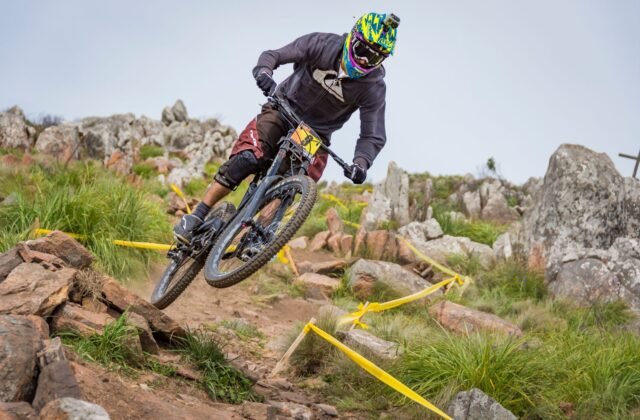
Straight answer: On rocks, a downhill mountain bike is usually the better choice. Its long-travel suspension and slack geometry keep both wheels on the ground over loose rock, so you stay in control where a hardtail bounces, skips and throws you off line.
A hardtail has a suspension fork and a rigid rear, so every hit at the back wheel goes straight into your legs. That is fine on smooth ground, but on a rock garden it costs grip, speed and confidence. The downhill bike costs more, weighs more and climbs worse – yet on steep, rocky descents it is faster and safer. Rocks first: pick downhill. Smooth trails and climbs: pick the hardtail.
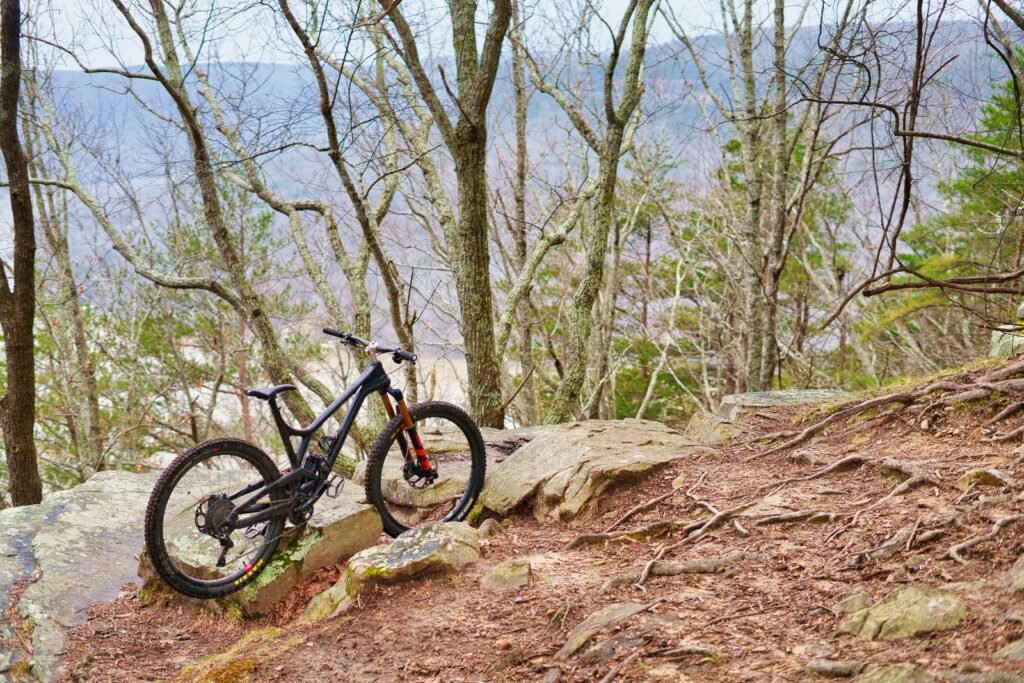
A hardtail and a downhill mountain bike can look alike in a shop: wide bars, knobby tyres and a suspension fork. The difference is what happens behind the saddle. A downhill bike adds a rear shock, much longer suspension travel and a slacker head angle for steep, rough ground. A hardtail keeps a rigid rear end and a steeper, more efficient position. That decides how each bike behaves the moment the trail turns rocky.
This article compares the two where it matters: rock gardens, loose descents, technical climbs and long days on rough trails. Both are part of our Mountain Bikes Hub. If your trails are rough but not steep, also see our Hardtail Mountain Bike vs Full Suspension Mountain Bike comparison.
The table below shows where each one wins.
Hardtail Mountain Bike vs Downhill Mountain Bike: The Core Comparison
Side by side on the same rocky trail, the two bikes trade grip and control for weight and simplicity.
| Attribute | Hardtail Mountain Bike | Downhill Mountain Bike | What to watch |
|---|---|---|---|
| Suspension | Fork only, rigid rear end | Long-travel fork and rear shock | Only helps if set up for your weight. |
| Grip on rocks | Rear wheel skips and bounces off rocks | Both wheels stay planted on loose rock | Grip keeps you upright on a rocky descent. |
| Descending | Fast on smooth trails, nervous on rocks | Faster and more confident on steep, rocky descents | Speed follows grip, not bravery. |
| Climbing | Direct power, efficient on climbs | Heavy and slow uphill, built for descending | Count the climbing on your loop first. |
| Control and braking | Braking on rocks can lock the rear wheel | Stable under braking, even on loose rock | A skipping wheel cannot brake well. |
| Comfort on rough trails | Bumps reach your legs, hands and back | Suspension absorbs rocks and drops | A hardtail wears you out on long rocky rides. |
| Weight | Lighter, easier to carry and climb | Heavier frame, shock and long-travel fork | Weight matters most on climbs. |
| Maintenance and cost | Fewer moving parts, lower upkeep and price | Shock, fork and pivots need regular service | Budget for suspension servicing. |
| Best for | Smooth singletrack, climbs, mixed trails | Steep, rocky and fast downhill trails | Buy for your hardest descent. |

When the Answer Changes: The Variables That Decide It
Your rocks: loose and steep, or small and scattered?
A few small rocks suit the hardtail: lighter, cheaper, and every pedal stroke counts. Add loose, fist-sized rocks and drops, and the downhill bike takes over, because its suspension keeps the wheels down where a hardtail starts to bounce.
Your skill: new rider or experienced?
A new rider usually goes faster on a downhill bike on rocks, because it forgives late braking and bad line choices. An experienced rider can pick a smooth line on a hardtail, but suspension still does work no rider can do.
Your route: ride up, or shuttle and lift?
If you pedal to the top, the hardtail earns its place: a downhill bike is heavy and slow on climbs. If you ride a lift or shuttle up and only descend, the downhill bike has no climbing penalty to pay.
Your budget: one bike or better parts?
At the same price, a hardtail comes with better forks, brakes and wheels, because none of the money goes to a rear shock. If your budget is tight and your rocks are mild, the hardtail gives you more bike for the money.
Test Both Bikes on the Same Rocky Trail: A 20-Minute Decision Ride
Try both on your own trail, not in a car park.
- Pick your usual trail loop, about 3-5 miles, with one climb and one rocky descent.
- Set the tyre pressure the same on both bikes, and set the saddle height to match.
- Ride the loop on the hardtail and note your time and how you feel.
- On the rockiest descent, note whether the rear wheel skips or stays planted.
- Swap to the downhill bike and ride the same loop at the same effort.
- Keep the bike that was faster on your rockiest section.
What a fail looks like.
- Your hands and back ache after 20 minutes – the ride is too harsh – drop the tyre pressure a little, or pick a downhill bike for rocky ground.
- The rear wheel hops on rocks and skips under braking – no rear grip – a rear shock would keep the wheel down; on a hardtail, slow down and stand on the pedals.
- You brake early on every descent – the bike feels nervous – the geometry or suspension is wrong for the rocks; test a slacker, longer-travel bike.
Myth vs Fact:
Myth: “A hardtail is always slower on rocks.” Fact: On small rocks and smooth climbs a hardtail is often faster, because it is lighter and wastes no energy. Myth: “A downhill bike means you can ride any rocks.” Fact: Suspension helps grip, but it cannot fix poor tyres, bad brakes or a line that does not work.
Before you test: Wear a helmet, pump the tyres to the pressure on the sidewall, and check the brakes before you roll. Stand on the pedals on rough ground, keep your weight back on steep descents, and do not test a bike on a trail above your skill level.

How to Set Up Either Bike for Rocks
Either bike rides far better with a basic setup. Do this first.
What you will need
- A floor pump with a pressure gauge
- A multi-tool with Allen keys
- A shock pump, for a downhill bike
- Tyre pressure guidance: see our Mountain Bike Air Pressure guide
The method
- Set the saddle height so your leg is almost straight at the bottom of the pedal stroke.
- Set the tyre pressure for your weight and the trail: lower for grip on rocks, higher for speed.
- On a downhill bike, set the rear shock sag to about a quarter of its travel, and set the fork sag the same way.
- Check the brake levers reach your fingers, and test both brakes before the first descent.
- Ride a short rocky section, standing on the pedals with your weight back on steep parts.
- Ride your test loop again, changing one thing at a time.
A note about sag. Sag is how far the suspension sits into its travel with you on the bike. Too little sag and the bike feels harsh on rocks; too much and it bottoms out.
Warning: never ride down a steep, rocky descent with a hot, fading brake or a loose load. Stop at the top, check the brakes, and descend slowly with both brakes. If the brakes feel weak, walk the bike down.
When the Damage Is Already Done
Bought the wrong bike? Here is what fixes each case.
- I bought a hardtail, but my trails are rocky and rough. Fit wider, grippier tyres at lower pressure, and add a suspension seatpost. If that still beats you up, a downhill or full suspension bike is the fix.
- I bought a downhill bike, but my trails are mostly smooth. Lock out the rear shock on climbs and firm trails, and run the tyres at the top of their pressure range. On mostly smooth ground, a hardtail is lighter and cheaper to run.
- My downhill bike bobs when I pedal. Set the sag properly, use the lockout on smooth climbs, and check the shock is serviced – pedal bob is usually a setup problem, not a broken bike.
- My hardtail rattles me on every rock garden. Slow down, stand on the pedals, and pick smoother lines. If the same rocks beat you every ride, the bike, not your technique, is the limit.

The Safe Alternative: Start with a Hardtail
If you are not sure your rocks are rough enough for a downhill bike, a hardtail is the safe first mountain bike: it teaches line choice, costs less, and is easy to keep running. See our Fastest Downhill Mountain Bike Speed guide, and our Electric Mountain Bike vs Throttle E-Bike comparison if you are weighing an electric mountain bike too.
- Work out how rocky the roughest section you ride every week is.
- Buy the hardtail with the best fork and brakes your budget allows.
- Set the tyre pressure and saddle height, and ride it for a month on your real trails.
- If rocky descents still beat you up, your next bike is a downhill one.
What to Do Next, in Order
- List the trails you ride most, and name the rockiest section on each.
- Do the 20-minute test on that trail, on both bikes.
- Compare grip, weight, climbing and maintenance, not just suspension.
- Pick by your hardest descent first and your budget second.
- Buy, then set tyre pressure, sag and saddle height before your first ride.
Never Do This on Rocks
- Never buy on travel numbers alone. More travel does not mean a better bike for your trail.
- Never assume a downhill bike needs no skill. It forgives mistakes, but it cannot replace line choice.
- Never test a bike with the wrong tyre pressure. A few PSI changes grip, comfort and speed on rocks.
In Short
In short, a downhill mountain bike is usually better for rocks, because its long-travel suspension keeps both wheels gripping, so you descend faster and finish fresher. A hardtail wins on smooth trails and climbs, where it is lighter, cheaper and more efficient.
The Essentials
- A hardtail has a suspension fork and a rigid rear; a downhill bike adds a rear shock and longer travel.
- A downhill bike wins on steep, loose and rocky descents, where grip decides speed.
- A hardtail wins on smooth trails and climbs: lighter, cheaper and more efficient.
- Test both on your rockiest trail before you buy.
More Questions, Answered
Is a hardtail or a downhill bike better for beginners on rocks?
A downhill bike is more forgiving for a beginner on rocks, because it keeps both wheels gripping. A hardtail is the better first bike on smooth trails.
Are hardtail mountain bikes good for rocky trails?
Yes, on trails with small or scattered rocks. A hardtail is fast on singletrack and climbs well. On steep rock gardens the rear wheel can skip.
Do I need a downhill bike for mountain biking?
No, not for most trail riding. You need one when your descents are steep and rocky enough that the wheels lose grip. On smooth trails, a hardtail does the job.
Additional Details
Name: Hardtail Mountain Bike vs Downhill Mountain Bike: Which Is Better for Rocks?
Description: Hardtail mountain bike vs downhill mountain bike: compare grip, control, weight and cost on rocks, then test both on your roughest trail before you buy.
Word count: 1999
Published: November 10, 2026