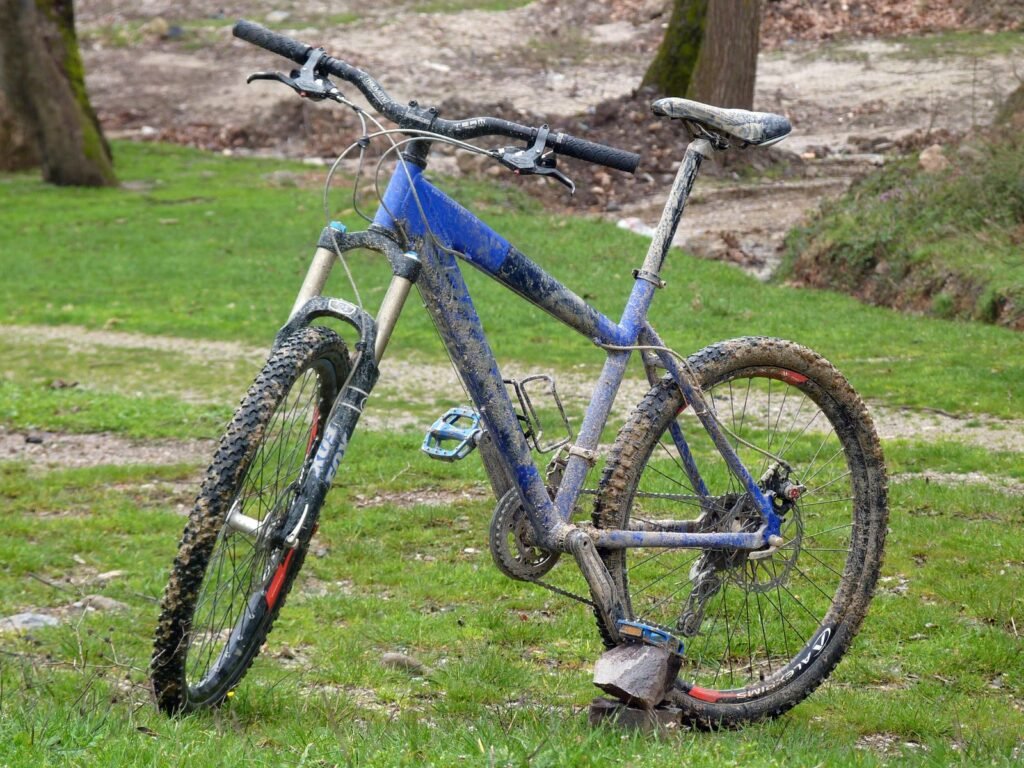
A mud-splattered blue mountain bike resting on a trail in daylight. Photo: Onur Kula / Pexels.
Straight answer: On muddy trails, a trail mountain bike is the better choice for most riders. Its rear suspension keeps the back tyre pressed into soft, rutted ground, so it grips and climbs where a hardtail skips and spins. A hardtail is lighter, simpler and easier to clean, and it wins on smooth, wet fire roads — but on rough singletrack, traction matters more than weight.
Introduction
Mud is the great leveller in mountain biking. A trail that feels fast and grippy in summer can turn into a slippery, rutted test of traction after rain, and the bike underneath you decides how much of that test you pass.
A hardtail mountain bike has suspension at the front only. The rear wheel is fixed to the frame, so the rear tyre can bounce off wet ground. A trail mountain bike is a full-suspension bike, with suspension front and rear, so the rear wheel can move and stay in contact with the ground. That one difference shapes everything that follows. New to the choice? Start with our best beginner trail bike guide and mountain bikes for beginners. This article sits in the Mountain Bikes Hub under Mountain Bike.
Hardtail Mountain Bike vs Trail Mountain Bike in Mud: The Comparison
| Attribute | Hardtail mountain bike | Trail mountain bike | What to watch in mud |
|---|---|---|---|
| What it is | Front suspension only; rigid rear end. | Full suspension, front and rear. | The rear wheel’s movement is the real difference. |
| Grip on wet roots and ruts | Rear tyre bounces off wet roots and loses grip. | Rear suspension keeps the tyre on the ground. | Watch the rear wheel on wet roots, not flat ground. |
| Climbing in mud | Power goes straight to the wheel, but it can spin. | The rear wheel stays planted, so climbs feel steadier. | A spinning rear wheel on every climb is the limit. |
| Riding feel | Harsher; you stand up more and pick smoother lines. | Smoother; you can sit and pedal through rough mud. | Comfort matters on a long, cold, wet ride. |
| Cleaning after mud | Quick to wash; no rear linkage to trap mud. | Mud packs into the linkage, pivots and shock seals. | Check the linkage and shock after every muddy ride. |
| Maintenance | Fewer moving parts; less to wear out. | More pivots, bearings and seals to service. | Budget time and money for suspension servicing. |
| Best for | Smooth, wet fire roads and short muddy sections. | Rough, rutted, muddy singletrack ridden weekly. | Match the bike to your muddiest regular trail. |
When the Answer Changes
The verdict above holds for a typical muddy singletrack, but four variables can flip it:
- How deep the mud is. In a thin, wet film the gap is small and a hardtail grips well. In deep, sticky mud and ruts, the trail bike’s rear suspension keeps the tyre in contact.
- Roots and rocks under the mud. On smooth mud, the hardtail’s direct pedalling wins. On roots and rocks hidden under mud, the trail bike soaks up the hits and keeps traction.
- Your skill and line choice. A skilled rider on a hardtail can pick smooth lines and keep speed. A newer rider gets more help from the trail bike’s forgiveness.
- Tyres and pressure. Tyres matter as much as suspension. A hardtail on open, mud-spiked tyres at a lower pressure can out-grip a trail bike on worn, tightly packed tyres. Read our guide to how to check and set bike tyre pressure before you judge either bike.
Test Both Bikes in Mud Before You Decide
Do not buy on paper. Run this test on both bikes, on the same trail, in the same conditions.
- Pick your real muddy trail. Choose the wettest, ruttiest section of your regular route.
- Ride both bikes the same way. Same tyres, same pressure, same line and same effort.
- Climb the muddy slope. Pedal steadily in a low gear and note whether the rear wheel spins.
- Descend a wet root section. Brake early, keep your weight back, and note which bike stays in control.
- Ride it for 30 minutes. Check your hands, back and knees, and how much mud each bike collects.
What a fail looks like
| Symptom | Cause | Fix |
|---|---|---|
| Rear wheel spins on every muddy climb | Rear tyre bouncing off the ground | Shift weight back, drop a gear, or choose the trail bike |
| Rear wheel skips sideways over wet roots | No rear suspension to absorb the hit | Slow down, pick a smoother line, or choose the trail bike |
| Bike clogs with mud and the wheels stop turning | Mud packed into frame, linkage and tyres | Stop and clear the mud; fit tyres with more clearance |
Myth: A hardtail is always faster in mud because it is lighter.
Fact: On rough mud the trail bike’s grip often makes it faster overall.
Myth: Full suspension is wasted in mud.
Fact: Mud hides roots and ruts — that is where rear suspension keeps the tyre in contact.
Before you test: Wear a helmet and test on a quiet trail, not a road. Walk the muddy section first if you cannot see what is under the mud.

How to Ride and Clean a Mountain Bike After Mud
A muddy ride is won in the cleaning as much as on the trail. The trail bike has more places for mud to hide.
What you will need
- A bucket of clean water, a sponge and a soft brush
- Bike wash or mild soap, chain lube and clean, dry rags
- A tyre pump with a pressure gauge
- Basic tools for removing wheels and checking bolts
The method
- Rinse the bike gently. Do not aim a jet of water at bearings, pivots or the shock.
- Wash from the top down with a sponge and soapy water, then rinse and dry the frame.
- Clean the drivetrain: brush the chain, cassette and derailleur until the grit is gone.
- Clean the suspension: wipe the fork legs and shock shaft, and check the seals for grit.
- Check the brakes: wipe the braking surfaces and look for worn pads.
- Dry the chain, lube it, and check the bolts and tyre pressure.
Do not use a pressure washer on bearings, pivots, the bottom bracket or suspension seals. A hard jet pushes water and grit into places it should never reach.
Note: On a trail bike, mud hides in the linkage. Move the rear suspension through its travel by hand after washing and watch for grit or stiffness.

When the Damage Is Already Done
Bought the wrong side? Both can be improved — up to a point.
- Hardtail spins on muddy climbs: Fit open, mud-spiked tyres, run a lower pressure, and shift your weight back. If it still spins, the bike is the limit.
- Trail bike clogs with mud: Clear mud from the linkage and frame after every ride, and check the shock seals for grit.
- Drivetrain worn by grit: Mud and grit wear chains and cassettes fast. Clean the chain after every muddy ride and replace it when worn.
- Brakes weak after mud: Clean the braking surface and check the pads for wear. If cleaning does not restore them, replace the pads — see our disc brake vs rim brake after rain guide.
If none of that fixes it, change the bike. Buy the side that matches your muddiest regular trail, not your driest one.

The Safe Alternative: A Trail Mountain Bike
If most of your riding is muddy singletrack, the trail bike is the full alternative to a hardtail. The closest verified mountain-style example from this site’s own products is the HOVERFLY OUREA 26 inch Electric Bike above — a fat-tyre mountain e-bike, and wide tyres are exactly what soft, muddy ground rewards.
- Check the rear suspension: make sure it moves freely and the seals are clean.
- Test it on your muddiest trail: climb and descend the worst section, and judge the grip.
- Check mud clearance: look at the gap between the tyre and the frame and fork.
- Plan the cleaning: accept the longer wash, and budget for pivot and suspension servicing.
What to Do Next, in Order
- Walk your muddiest regular trail and note where you lose grip.
- Check the tyre tread and pressure on your current bike.
- Test a hardtail and a trail bike on the same muddy section.
- Compare grip on climbs, control on descents and comfort after 30 minutes.
- Check how long each bike takes to clean.
- Buy the side that won your test.
Never Do These in Mud
- Never ride a muddy trail you have not walked first. Mud hides ruts, roots and holes that can stop a wheel dead.
- Never use a pressure washer on bearings, pivots or suspension seals. A hard jet pushes water and grit inside.
- Never keep riding with a clogged drivetrain. Mud-packed chains and cassettes wear out fast and can snap.
- Never brake hard with only the front brake on a muddy descent. The front wheel can wash out.
- Never leave a muddy bike to dry in the shed. Dried mud traps moisture against the frame and parts.
In short
In short, a trail mountain bike is usually better for mud because its rear suspension keeps the back tyre in contact with soft, rutted ground. A hardtail is lighter, simpler and quicker to clean, and it is the right pick for smooth, wet fire roads.
The essentials
- Trail bikes grip better on rough, muddy singletrack; hardtails win on smooth, wet ground.
- Rear suspension keeps the tyre in contact — that is the whole difference in mud.
- Tyres and pressure matter as much as suspension; worn tyres lose grip on any bike.
- Trail bikes take longer to clean — mud packs into the linkage and pivots.
- Never pressure-wash bearings, pivots or suspension seals.
More Questions, Answered
Which is better for mud, a hardtail or a trail mountain bike?
A trail mountain bike, for most riders on muddy singletrack. Its rear suspension keeps the back tyre pressed into soft, rutted ground, so it grips and climbs where a hardtail skips and spins. A hardtail is better on smooth, wet fire roads.
Is a hardtail good for muddy trails?
Yes, on smooth mud and short muddy sections. A hardtail is lighter, simpler and easier to clean, and with open, mud-spiked tyres at a lower pressure it grips well. On rough, rutted mud it loses traction sooner than a trail bike.
Are trail bikes harder to clean after mud?
Yes. Mud packs into the rear linkage, pivots and shock seals, so a trail bike takes longer to wash than a hardtail. Check the linkage and seals after every muddy ride.
Can I make a hardtail grip better in mud?
Yes, up to a point. Fit open, mud-spiked tyres, run a lower pressure than in dry weather, and shift your weight back on climbs. If the rear wheel still spins, no tyre change will give you what rear suspension does.
Additional Details
Name: Hardtail Mountain Bike vs Trail Mountain Bike: Which Is Better for Mud?
Description: Hardtail mountain bike vs trail mountain bike: which is better for mud? Compare grip, suspension, weight and cleaning, then test both on your muddy trail.
Published: November 10, 2026