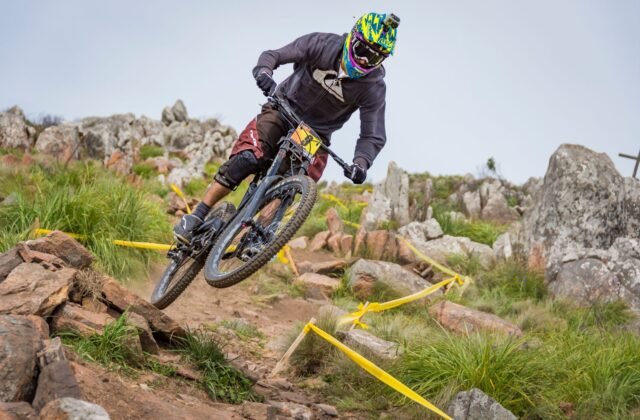
The straight answer: for rocks, a downhill mountain bike is better. Its long-travel suspension — typically around 200 mm front and rear — slack head angle and big knobbly tyres soak up square-edged rocks and keep the wheels on the ground. A dirt jump bike, with about 100 mm of travel or a rigid fork and smaller 26-inch wheels, is built to be flicked and landed, not to plough through rough ground.
Rocks punish the wrong bike faster than almost any other surface. A sharp, fixed rock cannot be rolled over: it stops a wheel, kicks the bars sideways and tests suspension, tyres, geometry and brakes at once.
A downhill mountain bike is built for steep, rough descents. A dirt jump bike is built for jumps, pump tracks and skatepark-style riding: short, stiff and light, with quick handling. This article compares the two on rocky ground only — see the Mountain Bikes Hub for the wider family.
Downhill Mountain Bike vs Dirt Jump Mountain Bike on Rocks
The difference is not speed or style. It is how much punishment the bike absorbs before the rider has to. On rocks, the downhill bike absorbs it; the dirt jump bike passes it on.
| Attribute | Downhill mountain bike | Dirt jump mountain bike | What to watch |
|---|---|---|---|
| Suspension | Long travel, around 200 mm front and rear | About 100 mm, or a rigid fork | More travel absorbs bigger rocks. |
| Wheel size | Usually 27.5-inch or 29-inch | Usually 26-inch | Bigger wheels roll over rocks. |
| Geometry | Slack head angle, long wheelbase | Steep head angle, short wheelbase | A long wheelbase stays calm. |
| Tyres | Wide, aggressive tread, soft rubber | Narrower, firmer tyres | Wide soft tyres grip wet rock. |
| Brakes | Large four-piston disc brakes | Smaller, lighter brakes | Weak brakes fade on descents. |
| Build | Heavy, strong, built for impacts | Light, stiff, built for jumps | Strong is good in a rock garden. |
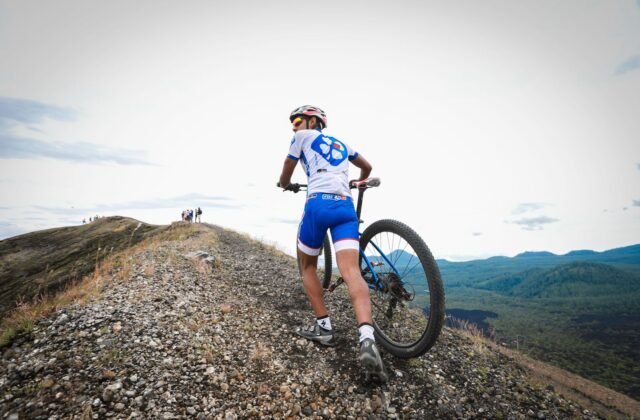
| Climbing | Poor; made to be lifted or shuttled | Easy on flat ground | Pedalling to the rocks is tiring on a downhill bike. |
| Best rocky use | Steep, loose rock gardens | Short, smooth rocky sections | Match the bike to the section. |
Every feature that helps on rocks — travel, wheel size, stability, grip and braking — favours the downhill bike. The dirt jump bike wins only where the trail is smooth, short or flat.

When the Answer Changes
The downhill bike wins on rocks, but five variables can close the gap. Tyre pressure is the cheapest of them: too much bounces the tyre off rocks, too little risks a rim strike, so check our guide to mountain bike air pressure for a safe starting point.
- Rock size. On small, rounded stones the dirt jump bike copes fine. On large, sharp rocks, it does not.
- Trail length. A 20-metre rocky patch is a line-choice exercise. A 500-metre rock garden is an endurance test.
- Wet rock. Wet rock is slippery. The downhill bike’s wider tyres give it far more grip, and the gap grows.
- Rider skill. An expert can ride a dirt jump bike through rocks a beginner cannot ride on a downhill bike — but skill does not erase the bike’s limits.
- Getting there. If the ride starts with a long climb, the downhill bike is a burden. If a shuttle or lift does the climbing, that disadvantage disappears. See also our downhill vs enduro and downhill vs fat mountain bike guides.
Test It Yourself: A Simple Rocky-Section Test
You do not need a bike park to settle this. One short rocky section, ridden the same way on both bikes, tells you what the table cannot.
- Pick a rocky section you can walk first, about 30 to 50 metres long.
- Walk it, mark your line, then ride it on the dirt jump bike at a slow, controlled speed.
- At the bottom, note the hard hits, whether the front wheel stopped or deflected, and how tired your hands are.
- Rest, then ride the same section, the same line, the same speed, on the downhill bike.
- Compare the notes. The bike with fewer hard hits and less arm fatigue is the better bike for rocks for you.
- Repeat once in the opposite order, so fatigue does not skew the result.
What a fail looks like
- Symptom: the front wheel stops dead and the bars twist. Cause: the wheel is too small and the fork too stiff. Fix: slow down, or use the bike with more travel.
- Symptom: the bike bounces sideways off rocks. Cause: tyre pressure is too high or the suspension too firm. Fix: lower pressure a little at a time.
- Symptom: your hands go numb halfway through. Cause: every hit reaches your hands. Fix: stand up, bend your elbows, and let the bike move under you.
Myth vs Fact: Myth — a lighter bike is always better on rocks. Fact — weight is secondary to suspension and wheel size. A light bike with no travel still transmits every hit.
Before you test: wear a helmet, gloves and eye protection. Check tyres, brakes, quick releases and headset on both bikes first. Ride a new rocky section slowly, and never test alone on a remote trail.
How to Ride Rocks on a Downhill Mountain Bike
What you will need
- A downhill mountain bike with working suspension and disc brakes
- A helmet, gloves and eye protection
- Tyres with good tread, set to a pressure suited to your weight
- A short rocky section you have walked first
The method
- Set suspension sag and tyre pressure first, and check the brakes.
- Stand on the pedals, knees and elbows bent, and look ahead to the exit — not at the rock in front of your wheel.
- Enter at a steady speed. Too slow and the wheels drop into gaps; too fast and you cannot react.
- Let the bike move under you. Keep your grip firm but your arms loose.
- Brake before the rocks, not on them, so the wheels keep rolling.
- Shift your weight back on steep drops, and forward again as the ground levels out.
- At the bottom, inspect the bike and tyres for damage before the next section.
Note: speed is a tool on rocks, not a goal. The right speed keeps the wheels rolling over rocks instead of falling into the gaps. If you are braking hard in the middle of a rock garden, you entered it too fast.

When the Damage Is Already Done
If you already bought a dirt jump bike and your local trails are rocky, you do not have to start again from zero. Work through this list in order, cheapest first. Small changes — tyres, pressure, grips — can make it survivable, but they cannot turn it into a downhill bike.
- Dented or cracked rim: stop riding on it. A bent rim can fail suddenly, so have a shop check it.
- Repeated pinch flats: check tyre pressure and width. Wider tyres at a slightly lower pressure help.
- Sore hands and wrists: the bike transmits too much impact. Wider, softer grips can help, but they cannot replace suspension travel.
- Fork bottoming out: if the fork hits its limit on every rock, it is too short or too soft for the trail.
- You avoid rocky trails: that is the real cost. If the bike keeps you off the trails you want, the honest fix is a different bike.
The Safe Alternative: Use the Dirt Jump Bike Where It Belongs
The dirt jump bike is not a bad bike. It is a specialist. On jumps, pump tracks and smooth trails it is more fun and easier to control than a heavy downhill bike.
- Choose a pump track, jump line or smooth trail for the dirt jump bike, and save rocky descents for a downhill bike.
- Keep it for short, flat rides to the jumps, where its light weight and quick handling are an advantage.
- When a trail turns rocky, walk the worst section or take the smoother line around it.
- If you ride both styles, keep both bikes set up correctly, with the right tyre pressure for each.
- Rent or borrow a downhill bike for a rocky bike-park day before buying one.

What to Do Next, in Order
- Decide what your local trails really are: mostly rocky descents, or mostly jumps and smooth trails.
- Walk a rocky section on your local trail and judge it honestly against the table above.
- Run the one-afternoon test on both bikes, if you can borrow or rent the one you do not own.
- Set tyre pressure correctly before you judge either bike.
- If rocks dominate, choose the downhill bike; if jumps dominate, choose the dirt jump bike.
- Buy the bike that fits the trails you ride every week, not the trails you hope to ride one day.
- Ride the new bike slowly on rocks first, and build speed only when the line feels natural.
Never Do This on Rocks
- Never ride a rocky descent on a bike you have not checked first. A loose wheel or soft brakes turns a hard section into a dangerous one.
- Never grab both brakes hard in the middle of a rock garden. A locked wheel slides and stops — exactly what you do not want.
- Never stare at the rock you are afraid of. You will ride straight into it; look at the line past it.
- Never ride rocks alone without telling someone where you are. A fall on rock can leave you unable to walk out.
- Never force a dirt jump bike through a rock garden to prove a point. The bike will not suddenly grow suspension.
In Short
For rocks, the downhill mountain bike is the better choice: its long suspension, larger wheels and strong brakes are built for that ground, while the dirt jump bike is built for jumps and smooth trails.
The Essentials
- Downhill bikes win on rocks: more travel, bigger wheels, better grip and braking
- Dirt jump bikes win on jumps, pump tracks and smooth, flat riding
- Long, sharp and wet rock gardens widen the gap in favour of the downhill bike
- Test both bikes on the same rocky section, on the same line, at the same speed
- Tyre pressure and line choice matter, but they cannot replace suspension travel
More Questions, Answered
Can a dirt jump bike handle rocks at all? Yes, on short, smooth sections at low speed, with a good line. It struggles on long, sharp rock gardens.
Is a downhill bike too heavy for everyday riding? For flat trails and climbs, yes. It suits shuttle or lift-served riding best. See our trail vs 27.5 mountain bike guide.
Which is better for a beginner on rocky trails? The downhill bike. Its stability and suspension forgive beginners’ mistakes, while the dirt jump bike punishes them.
Can I change a dirt jump bike into a downhill bike? No. A longer fork and wider tyres can help a little, but the frame geometry and wheel size stay the same.
Additional Details
Name: Downhill Mountain Bike vs Dirt Jump Mountain Bike: Which Is Better for Rocks?
Description: Downhill mountain bike vs dirt jump mountain bike on rocky trails: which one handles rocks better, when the answer flips, and how to test both before you buy.
Published: November 10, 2026