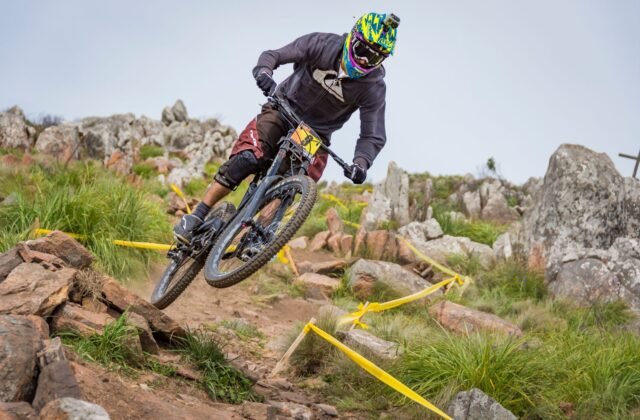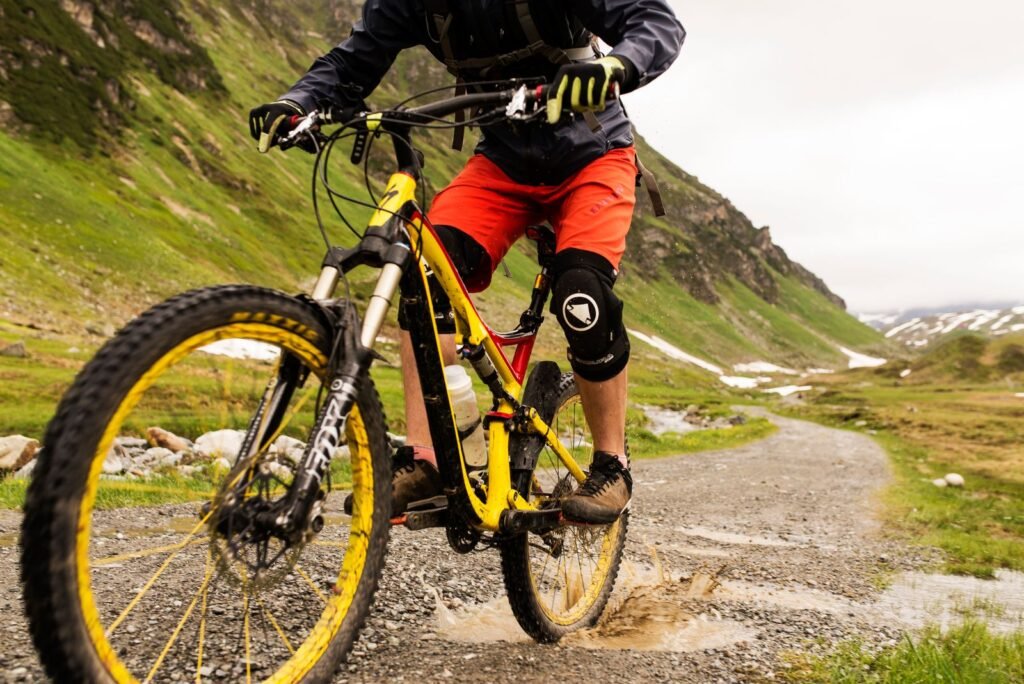
Straight answer: For most muddy riding, the electric mountain bike is the better choice. A muddy loop still needs climbing, and the motor keeps the rear wheel turning on steep, sticky climbs where a downhill bike stalls and has to be pushed. The downhill bike wins only on steep, rough, muddy descents, where its long travel (180–210 mm) and slack geometry keep the tyres planted.
Downhill Mountain Bike vs Electric Mountain Bike for Mud
Mud fills tread, adds weight to the wheels, slows the chain, and turns a firm climb into a slow spin. A bike that feels fast on dry dirt can feel stubborn on the same trail after a wet week, so the choice here is really about how you get through the sticky parts — and how you get back up them.
A downhill mountain bike is built for steep, rough descents, with long-travel suspension and wide tyres that clear mud well. An electric mountain bike is a trail bike with a motor: it adds torque for climbing, but its battery and motor add weight that matters most in soft, flat mud.
This guide compares them on the same ground: the core differences, the conditions that flip the result, a short test for your own trail, and a wash routine that keeps mud from costing you parts. It sits in the Mountain Bikes hub with the site’s other Mountain Bike comparisons.
Downhill vs Electric in Mud: The Core Comparison
Read the table by what mud punishes: grip on climbs, control on descents, and cleaning afterwards.
| Attribute | Downhill Mountain Bike | Electric Mountain Bike | What to watch |
|---|---|---|---|
| Climbing in mud | Slow — the rear wheel spins out on sticky climbs | Strong — motor torque keeps the wheel turning | Use low assist; full power spins the wheel |
| Descending in mud | Strong — 180–210 mm of travel keeps tyres planted | Good — but extra weight lengthens braking | Brake earlier; watch for front-wheel washout |
| Weight in soft mud | Heavy for a pedal bike, lighter than an e-bike | Heaviest — motor and battery sink in boggy flats | Carry speed through soft sections or walk |
| Tyres and clearance | Wide, open tread; generous mud clearance | Wide tread; clearance varies by model | Clear packed mud before it locks the wheel |
| Braking when wet | Strong disc brakes; stable long wheelbase | Strong disc brakes; longer stopping distances | Re-bed glazed pads on dry ground |
| Range and energy | No battery to drain; climbs cost more effort | Motor helps, but heavy mud drains the battery | Start a muddy loop with a full battery |
| Cleaning after mud | Simple — hose, brush and dry | Needs care — keep motor and battery contacts dry | Never pressure-wash either bike |
On a loop with climbs and descents, the e-bike’s climbing edge usually matters more, because descents are short and climbs are long.
When the Answer Changes
The straight answer holds for a normal muddy loop. Change the trail, and the winner changes with it.
- Steep, rough, lift-served descents: the downhill bike wins outright — no climb to pedal, and the e-bike’s motor is dead weight on the lift.
- Flat, boggy ground: neither is good, and the lighter downhill bike edges it. The e-bike’s weight pushes its tyres deeper into soft mud.
- Long, sticky climbs: the e-bike wins by the largest margin. This is what most often decides a muddy loop, because a stalled climb means pushing either bike.
- Very deep ruts: the downhill bike’s clearance and travel help it straddle ruts the e-bike drops into.
- Short shuttle or uplift rides: the downhill bike wins, because the climb is removed. A fat bike is better only where the mud is more like soft sand or snow.
Lift-served descents mean downhill bike. A loop you pedal from your door means e-bike.
Test It First: A Quick Mud Test
Do this on a short loop you already know, after rain, before you commit to either bike. It takes one ride.
- Pick the same loop. Use one short climb, one flat muddy stretch and one descent, and ride it on each bike on the same day.
- Climb in low assist. On the e-bike, use the lowest assist that keeps the wheel turning. On the downhill bike, climb seated and steady.
- Descend at the same pace. Brake early, and note where the front wheel washes out or the bike skips over ruts.
- Check the mud. Look at how much mud is packed around the tyres, chain and brakes, and how long each bike takes to clean.
- Decide by the weak point. The bike with the smaller weak point is the right one: one that cannot climb is a walk, one that descends badly is a risk.
What a Fail Looks Like
| Symptom | Cause | Fix |
|---|---|---|
| Rear wheel spins on a climb | Too much power | Drop to low assist; shift weight back |
| Front wheel washes out | Braking too late into the turn | Brake before the turn; keep weight centred |
| Mud locks the wheel | Clearance too tight | Clear it by hand; fit a more open tread |
| Brakes fade after a descent | Pads glazed by mud and heat | Clean rotors and pads; bed them in again |
Myth vs Fact
Myth: A motor makes an e-bike better in every kind of mud. Fact: The motor only helps where the tyre stays in contact with the ground. In flat, boggy mud, weight is the problem, and the motor adds weight.
Before you test: Wear a helmet and gloves, check both brakes before the first descent, and tell someone where you are riding. Do not test on a trail closed for wet weather.

How to Ride and Wash Mud on Either Bike
Setup and washing decide how long a muddy bike lasts.
What You Will Need
- A bucket, a soft brush and a hose (not a pressure washer)
- Chain lube for wet conditions and a rag
- A tyre pump and gauge — see mountain bike air pressure for your tyre width
- Gloves, and a dry place to store the bike after the wash
The Method
- Lower the pressure a little. Drop tyre pressure slightly from your dry setting, staying inside the sidewall range.
- Keep the chain moving. Shift often and pedal smoothly — stopping and restarting in mud is where wheels spin.
- Brake early. Disc brakes still work in the wet, but mud lengthens stopping distances. Brake before the turn, not in it.
- Wash the same day. Hose mud off the frame, fork, wheels and chain, and dry the chain before storing the bike.
- Protect the electrics. On the e-bike, keep water away from the battery contacts, motor and display.
- Lube and check. Lube the chain, spin both wheels, and check the brakes and tyre clearance before the next ride.
Do not: leave a muddy e-bike standing wet overnight. Dried mud holds moisture against the chain, pivots and battery contacts.
Note: If the trail is badly rutted and water is pooling on it, ride elsewhere. A few more passes close it for weeks.

When the Damage Is Already Done
Bought the wrong bike for your muddy trails? Do not sell it first — most mud problems are setup problems, and they are cheaper than a new bike.
- Downhill bike stalls on every climb: fit a wider-range cassette and a more open mud tyre. If the route is mostly climbing, see the full-suspension vs electric comparison before buying again.
- E-bike sinks on flat mud: fit the widest mud tyres the frame clears, and carry speed through soft sections.
- Chain wears out fast: clean and lube it after every muddy ride, and replace it before it wears the cassette.
- Brakes feel weak after mud: clean the rotors, check the pads for glazing, and replace worn pads.
- Battery range has dropped: charge it fully and ride in low assist on climbs.
If two of these problems stay after the fixes, the bike is wrong for your trails, not badly set up.

The Safe Alternative: Start with the Downhill Mountain Bike
If the e-bike’s weight, battery and washing put you off, the downhill bike is the safe alternative — provided your riding is mostly downhill. It is simpler to own: no battery, no motor, nothing electrical to keep dry.
How to Switch to It
- Check your trails first. Use it where descents are steep and rough, and where you reach the top by lift or shuttle — not by pedalling up a muddy climb.
- Fit mud tyres. Choose a wide, open tread that sheds mud, and set pressure from the sidewall range.
- Learn the brakes. Practise braking early and staying off the front brake on slick ground.
- Keep the wash simple. Hose, brush, dry and lube after every ride — with no electrics, the wash is fast.
Keep it as a second bike if you can: right for muddy descents, wrong for a muddy loop that climbs.
What to Do Next, in Order
- Ride the test loop on both bikes, or on the closest bikes you can borrow.
- Choose by the climb-to-descent mix of your usual trails.
- Fit mud tyres and set pressure from the sidewall range.
- Wash and lube the bike the same day, every muddy ride.
- Re-check brakes, chain and battery after the first month of wet riding.
Never Do This in Mud
- Never use a pressure washer on either bike — it drives water into bearings and the motor.
- Never ride a closed wet trail — ruts made in wet mud stay for the season.
- Never start a muddy climb in full assist — full power spins the rear wheel.
- Never descend on glazed or worn pads — wet mud already lengthens stopping distances.
- Never leave a muddy bike wet overnight — dried mud holds moisture against the chain and pivots.
In Short
For most muddy riding, the electric mountain bike is the better choice: muddy trails still need climbing, and the motor keeps the bike moving where a downhill bike stalls. The downhill bike wins only on steep, rough, muddy descents. Match the bike to your trail, fit mud tyres, and wash it the same day.
The Essentials
- Downhill bike: best on steep, rough, muddy descents; weak on climbs.
- Electric mountain bike: best on muddy climbs and loops; heavy on flat, soft mud.
- Mud tyres and slightly lower pressure help both bikes most.
- Wash the same day, dry the chain, keep water off the e-bike’s electrics.
- Never pressure-wash either bike; never ride a closed wet trail.
More Questions, Answered
Is an electric mountain bike good in mud?
Yes, on climbs and mixed loops. The motor helps on steep, sticky climbs, but the bike’s weight works against it in flat, boggy mud.
Is a downhill mountain bike good in mud?
Yes, on descents. Its long travel, slack geometry and wide tyres keep it planted on rough, muddy descents. It is a poor choice for a loop that climbs.
Which bike is easier to clean after mud?
The downhill bike. It has no motor, battery or display to protect, so it can be hosed, brushed and dried quickly.
Do I need mud tyres for either bike?
Yes, if you ride mud often. A wide, open tread sheds mud instead of packing it. Check the clearance between tyre and frame before buying wider tyres.
Additional Details
Name: Downhill Mountain Bike vs Electric Mountain Bike: Which Is Better for Mud?
Description: Downhill mountain bike vs electric mountain bike in mud: which climbs, descends and washes clean better? Compare weight, torque, tyres and upkeep before buying.
Published: November 10, 2026