Part of our guide on Scooters.
An electric scooter for rugged terrain fails in a different way from a city scooter: it breaks on the ground it was supposed to handle, not on a flat road. A small solid tyre rattles apart on gravel, a weak motor stalls on a grass slope, and no suspension turns every pothole into a jolt.
This guide shows how to choose an electric scooter for rugged terrain in a safe order, from the ground you ride to the parts that decide whether it lasts. If your scooter will not start at all, read Electric Scooter Won’t Charge; to compare a scooter with an e-bike, read Scooter vs E-Bike for Commuting; and for the full scooter section, see the Scooters hub.
Quick facts
| Fact | What it means for your ride |
|---|---|
| Problem this guide fixes | Choosing a scooter that handles gravel, dirt and hills without breaking |
| Check first | Your ground, your weight, and your steepest slope |
| Most important parts | Big pneumatic tyres, real suspension, enough motor torque, and disc brakes |
| Range on rough ground | Rough ground and hills use far more battery than a flat ride |
| Stop and get help | A cracked deck or stem, a swollen battery, or brakes that do not stop |
| Related guides | Scooters hub, Electric Scooter Won’t Charge, Scooter vs E-Bike for Commuting |
Quick recap
- Buy for the ground you ride most, not the top speed.
- Pneumatic tyres of 10 inches or more, with tread, come first.
- Suspension matters as much as the motor.
- Rough ground cuts real range well below the maker’s figure.
- Never ride with a cracked stem or deck, a swollen battery, or brakes that do not hold.
The short answer: buy for the ground, not the top speed
The straight answer is that the right electric scooter for rugged terrain is the one whose tyres, suspension and motor match the ground you ride every week. A scooter with 10-inch pneumatic tyres, front and rear suspension, and a motor that holds speed on your steepest slope will outlast a faster scooter.
That order matters because the parts depend on each other. Big tyres soak up small bumps before the suspension has to work, suspension keeps the tyres on the ground so the motor can keep pulling, and a motor strong enough for your weight and hills keeps the scooter moving instead of stalling halfway up.
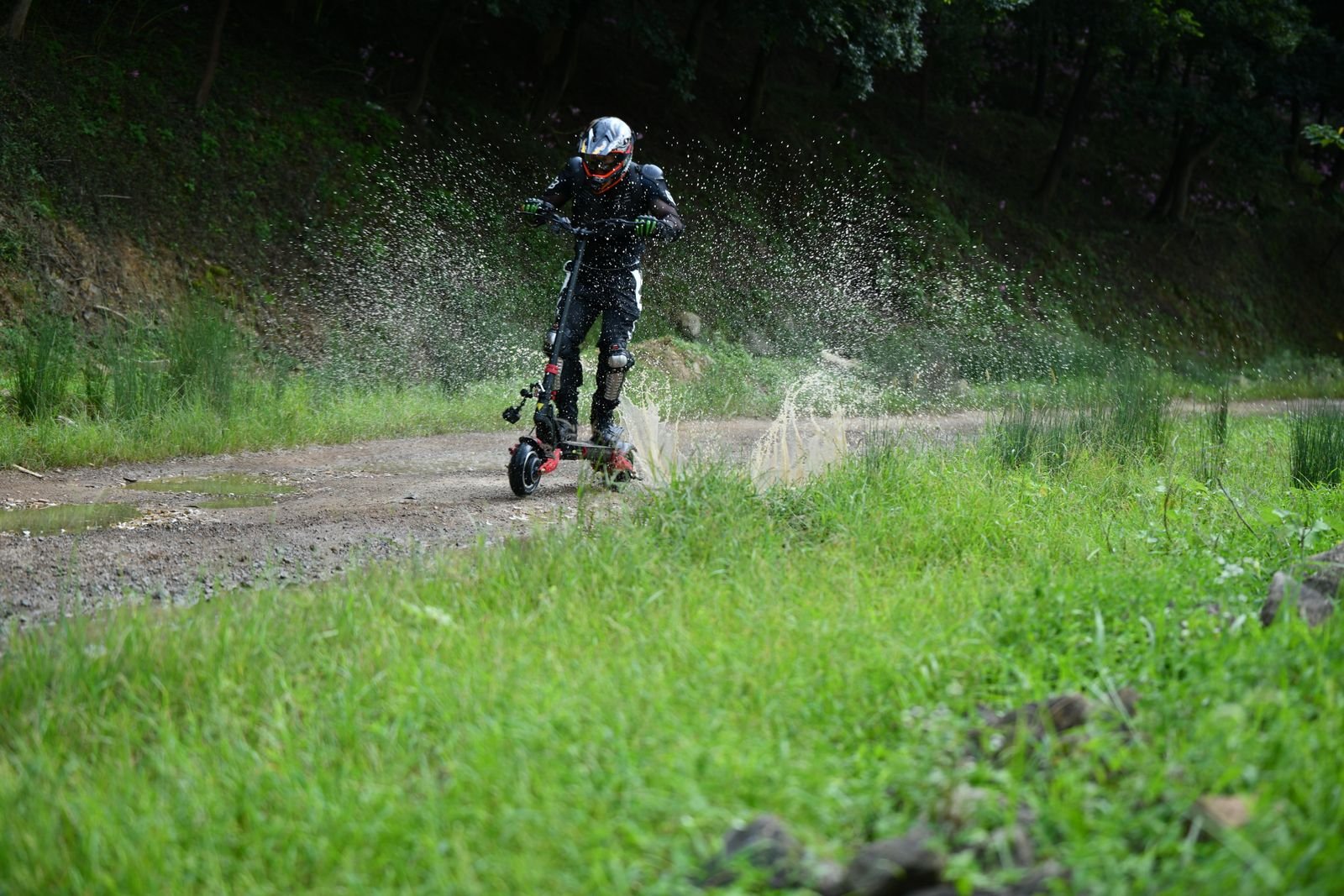
Photo by Varla Scooter on Pexels.
Rule of thumb: If the scooter cannot roll over your worst regular surface — gravel, grass or a potholed lane — without rattling or stalling, it is not a rugged-terrain scooter, whatever the box says.
The rest of this guide follows that rule: diagnosis first, then the ground-by-ground reference, then weight, weather and settings.
How to choose an electric scooter for rugged terrain, step by step
Work through these steps in order, and note what you find: the ground you ride, your weight with any load, and your steepest slope.
Check this first: ride your worst regular surface first. A scooter that feels fine on pavement can still rattle or stall on gravel or grass.
- Walk your worst ground. Note whether it is gravel, dirt, grass, mud or broken pavement.
- Check the tyres. Look for pneumatic tyres of 10 inches or more, with tread.
- Check the suspension. Look for suspension at both ends, and press the deck down to feel it move.
- Check the motor against your weight and hills. Read the maker’s motor figure and weight limit against your weight.
- Check the brakes. Look for disc brakes, and test that they stop the scooter firmly from a slow roll on a slope.
- Check the deck, stem and folding lock. Look for a wide deck, a steady stem, and a lock that clicks shut.
If every step looks right and the scooter still feels wrong, ask a shop that sells rugged scooters to test it.
What you’ll need
- Your regular route and its surfaces
- Your weight, plus anything you usually carry
- A pump, because soft tyres waste range and grip
- A notebook to record the tyre size, suspension and motor of each scooter
- A helmet, because rough ground is where falls happen
One Amazon product in this section only: the off-road scooter below is the same kind of machine this guide describes — 800W motor and front and rear suspension.

What the ground usually means
Use this table to match the ground you ride with what to look for first.
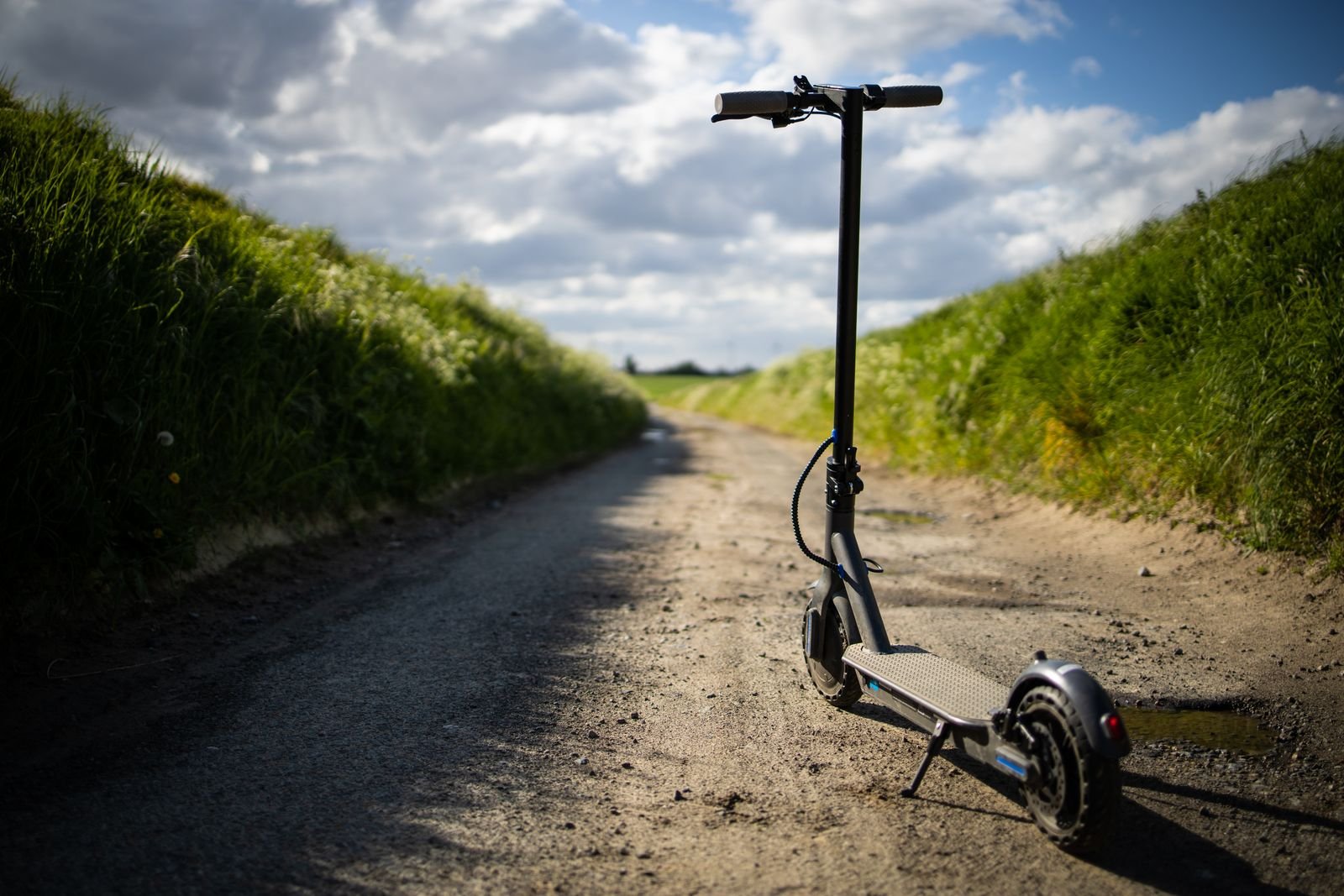
Photo by Fabien Burgue on Pexels.
| Situation | What you’ll notice | What to try |
|---|---|---|
| Gravel paths | Stones kick up and tyres slip | 10-inch or larger treaded tyres; keep speed low |
| Dirt and mud | Tyres clog, grip fades | Wide treaded tyres and mudguards |
| Grass and fields | Soft ground drags, range drops | A stronger motor and full tyre pressure |
| Broken pavement | Hard jolts through the deck and rattling | Front and rear suspension |
| Steep slopes | Speed falls, the motor strains | More motor torque |
| Wet ground | Longer stopping distances and slippery surfaces | Disc brakes and gentle braking |

How rider weight, weather and load change the answer
The same scooter can feel like a different machine with a heavier rider, a bag on the deck, or a wet road. Weight is the biggest change: a scooter that climbs easily with a light rider can stall on the same slope with a heavy rider and a loaded bag. That is why the maker’s weight limit matters more than the top speed.
Weather changes the answer too. Wet ground lengthens stopping distances and makes painted lines and wet leaves slippery. Cold shortens the range a battery gives, and mud clogs tyres and brakes.
What works
- Choose a scooter whose weight limit covers your weight plus your usual load
- Keep tyres at the maker’s pressure
- Slow down on wet, loose or steep ground
- Clean mud and grit off after a dirty ride
What to watch
- A scooter above its weight limit feels slow on hills and wears faster
- Do not judge range from one flat, dry ride
- Do not ride through deep water
- Wet leaves and painted lines are slippery even on good tyres
Worth knowing: A scooter that loses range only on rough ground is usually telling you about the ground, not about a fault.
Ride modes, speed settings and the display
Before deciding a scooter is too slow or too weak, check the settings that decide how much of it you use. Ride mode is the biggest one: the fastest mode on a rough trail can empty a battery far sooner than the lowest mode. On rough ground, a lower speed setting often gets you further.
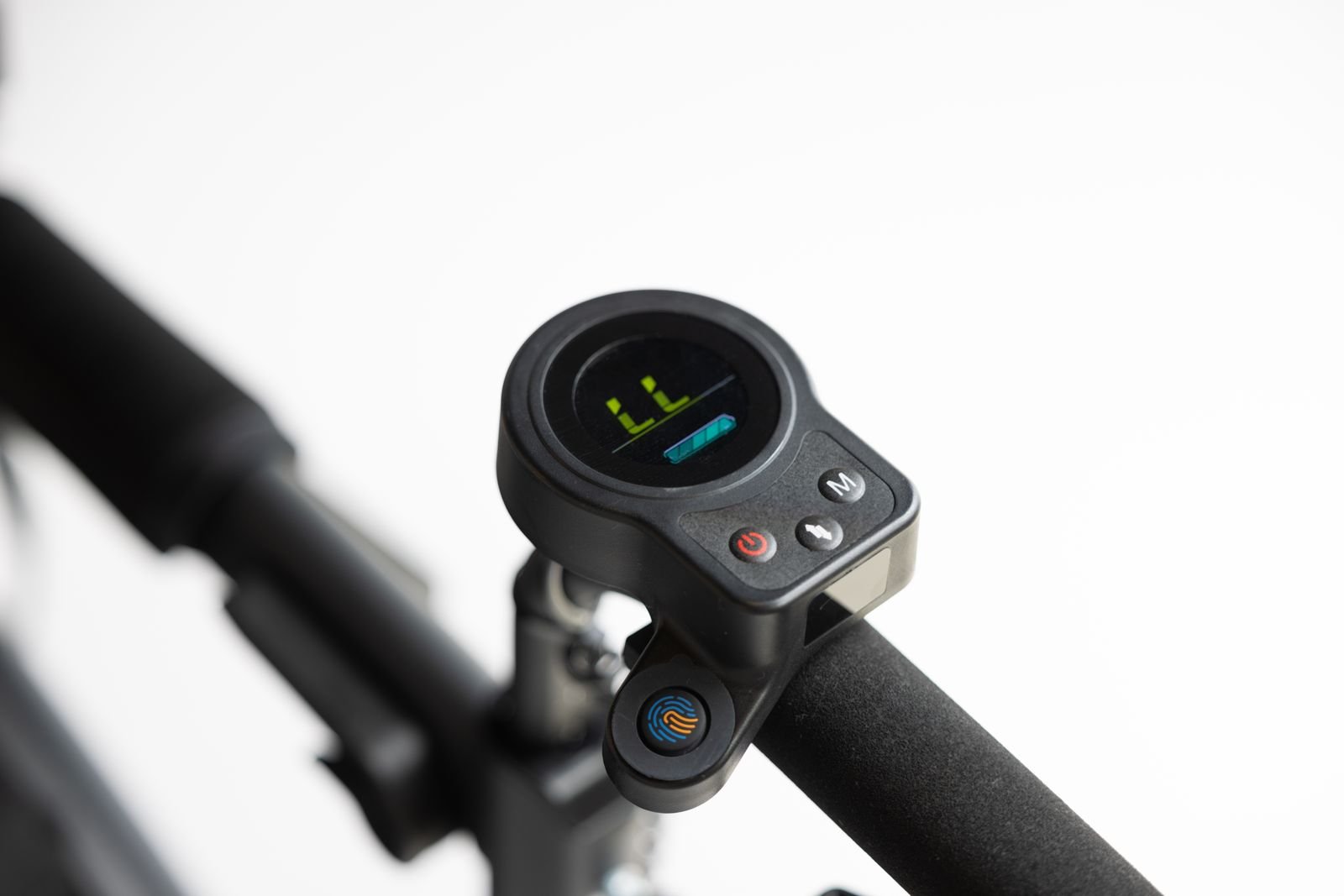
Photo by Rollz International on Pexels.
The display is part of the diagnosis too. Its battery bars measure charge, while a range estimate is only a guess based on recent riding. If the range estimate jumps around, trust the battery bars instead.
What works
- Use the lowest speed mode that keeps the ride comfortable
- Compare the battery bars on the same route instead of trusting one range estimate
- Start a ride at a known charge level
What to watch
- A display that drops from full to empty in minutes points to a fault, not to normal use
- A range estimate that changes wildly is a guess, not a measurement
- Do not ride with a display or control that sticks or resets by itself; get it checked
When a fix needs a part or a replacement
Some rough-ground problems have a simple fix, and some need a part. A soft tyre can be pumped up, a loose folding lock tightened, and a dirty brake cleaned. A cracked deck or stem cannot be fixed at home, and a battery that will not hold a charge is a job for a qualified shop.
| Fix | Best use | Limit |
|---|---|---|
| Pump the tyres to the maker’s pressure | Soft tyres, short range, vague steering | Only helps if the tyres hold air |
| Tighten the folding lock and stem | Rattling, wobble, a lock that does not click | Do not ride if the lock will not hold |
| Clean the brakes and tyres | Mud, grit and weak braking | Cleaning cannot fix worn pads or a bent disc |
| Replace worn brake pads | Brakes that fade or squeal on slopes | Match the pads to the brake model exactly |
| Replace a worn or damaged tyre | Cuts, cracks, or a tyre that will not hold air | Match the size, tread and valve |
| Ask a shop to test the battery | Range far below normal on every surface | A battery test comes before buying a replacement |
What works
- Keep the manual and labels with the scooter, so a replacement is matched from the label
- Ask a shop to test a battery that will not hold a charge before buying a replacement
- After any fix, start with a short, slow ride and check that the steering, brakes and power feel normal
What to watch
- A cheap tyre that only fits the wheel can slip off-road
- A second-hand battery with no history can carry the same fault
- Do not keep charging a battery that a shop has told you to stop using
The common mistake: buying a faster scooter because the range fell, when the real cause was soft tyres or a scooter never made for rough ground. Check the cheap causes first.
The scooter below is the same kind of all-terrain machine this guide describes.

The verdict
Most rugged-terrain scooter problems are fixed by choosing for the ground you ride — big tyres, real suspension and a motor that holds speed on your hills — not by buying the fastest scooter. When those checks fail, or the deck, stem or battery is damaged, a qualified shop test is the right next step.
Readers also ask
What tyre size is best for an electric scooter on rough terrain?
Look for pneumatic tyres of 10 inches or more, with tread. They soak up small bumps and grip loose ground.
How much motor power does a rugged-terrain scooter need?
It depends on your weight and your hills, not on a single number. Check the maker’s motor figure and weight limit against your weight plus your usual load.
Do I need suspension on an electric scooter for rough ground?
Yes, at both ends if you ride rough ground often. Suspension keeps the tyres on the ground, so the motor keeps pulling.
Why does my scooter lose range on rough ground?
Rough ground, hills and a heavy load all use more battery than a flat pavement ride, so the real range is always below the maker’s flat-road figure.
Can I ride my electric scooter in the rain or through mud?
Light rain is usually fine if the scooter is made for it, but do not ride through deep water. After a muddy ride, clean the tyres, brakes and folding lock.
Is a rugged-terrain electric scooter legal where I ride?
Speed limits, power limits and where scooters may be ridden all vary by country and by city. Check the local rules before you buy.
Affiliate Disclosure: We may earn a commission when you buy through links on this site, at no extra cost to you.
Additional Details
Name: Electric Scooters for Rugged Terrain: How to Choose One That Lasts
Description: Electric scooters for rugged terrain need big tyres, real suspension and enough motor power. Learn how to choose one that lasts on gravel, dirt and hills.
Published: November 17, 2026