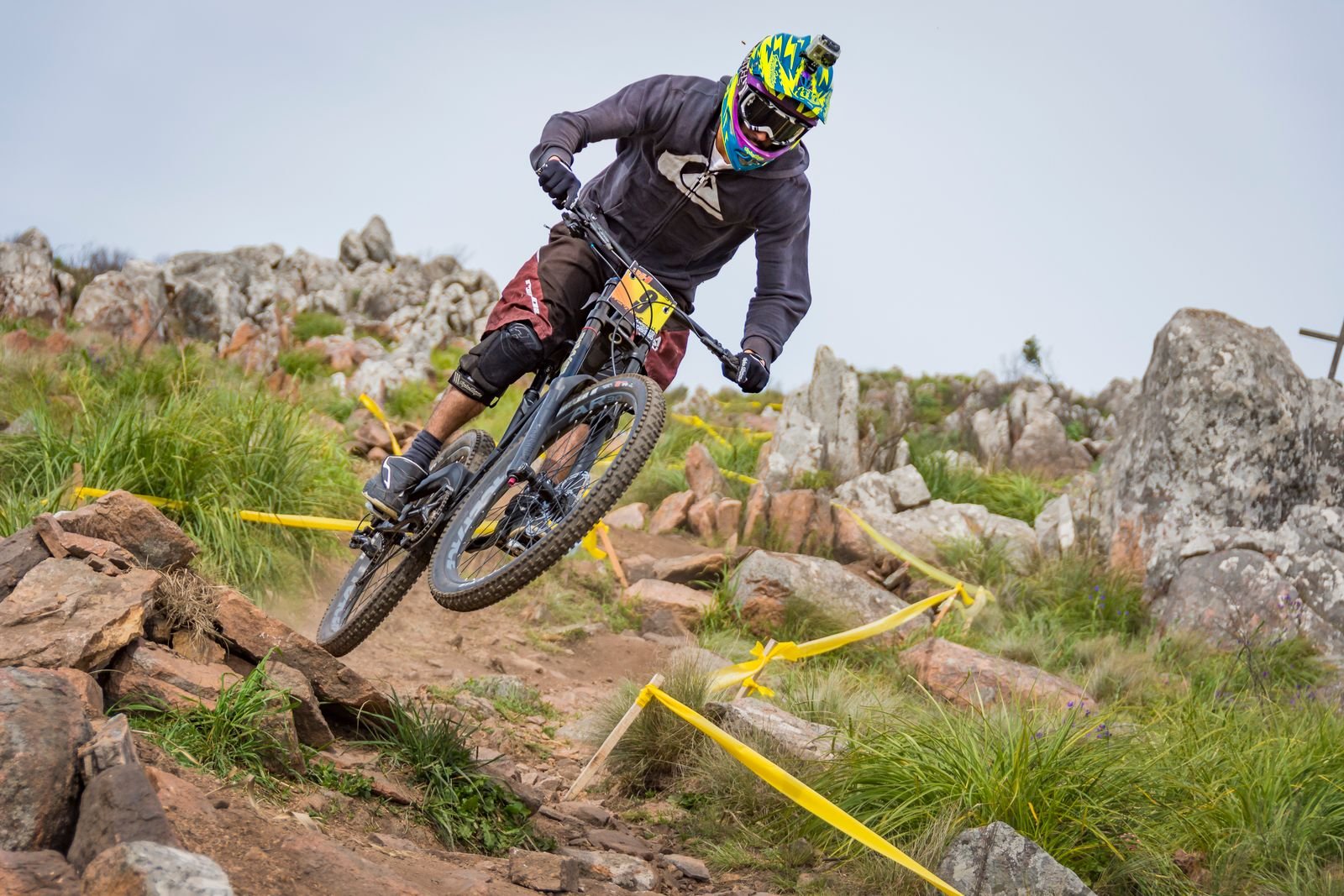
Straight answer: For rocks, the enduro mountain bike wins — on big, sustained rock gardens and long, rough descents. Its long-travel suspension and slack geometry keep both wheels on the ground where a hardtail gets kicked around. But the trail hardtail wins for most riders on rocky trails, because it is lighter, cheaper and far easier to pedal up the rocky climbs between the descents.
Key facts: Enduro bikes carry more suspension travel front and rear, with a slack head angle built for steep, rough descents. A trail hardtail has suspension only at the front; the rear wheel follows the ground with no help, so your legs do the work. On loose rock, the enduro’s rear suspension keeps the tyre in contact and the bike tracking, while the hardtail skips and deflects more — at the cost of speed, weight and money.
The nuance matters. Rocks are not one condition: a smooth slab, loose fist-sized stones and a staircase of rock steps behave nothing alike. The enduro wins when the rocks are big and the descent is long; the hardtail wins when the rocks are small, the trail mixes climbing and descending, and the rider is willing to stand and pick lines.
Introduction
Rocks change everything about a trail. A descent you roll easily on smooth dirt becomes hard hits, deflections and line changes when the ground is covered in stone. A climb you spin up in summer becomes a slipping, stalling scramble when the rear wheel has nothing to hold on to.
An enduro mountain bike is built for steep, rough descents, with long suspension travel and a slack head angle. A trail hardtail keeps things simpler: a suspension fork up front, a rigid rear end, less weight and a lower price. Both can ride rocks, but they ask different things of the rider. This comparison explains where each one wins, how to test both on the same rocky trail, and when the answer changes. See the Mountain Bikes Hub for more mountain bike comparisons.
Enduro Mountain Bike vs Trail Hardtail Bike for Rocks: The Comparison
| Attribute | Enduro mountain bike | Trail hardtail bike | What to watch |
|---|---|---|---|
| What it is | A long-travel full-suspension bike built for steep, rough descents. | A mid-travel bike with a suspension fork and a rigid rear end. | Check the travel, not the label. |
| Suspension travel | More travel front and rear, built to soak up big hits and rock steps. | Front travel only; the rear wheel follows the ground unaided. | Rear suspension matters most on long, rough descents. |
| Geometry | Slack head angle, long wheelbase; calm at speed. | Steeper head angle, shorter wheelbase; easier to steer. | Slack is calmer on steep, rocky descents. |
| Rocky grip | Rear suspension keeps the tyre in contact over loose stone. | The rear wheel skips and deflects; your legs absorb the hits. | Wide tyres at low pressure help either bike grip. |
| Rocky climbs | Heavy; the rear wheel can spin on loose, steep steps. | Lighter, so rocky climbs cost less effort — if you pick a good line. | Ride your rockiest climb on both. |
| Rocky descents | Very stable; the suspension tracks through rock gardens. | Quicker to steer but tiring; every hit reaches your hands and feet. | Ride your roughest rocky descent on both. |
When the Answer Changes
- Smooth, small rocks with short descents: The trail hardtail wins. Its lighter weight and quicker steering let you change line and carry speed where an enduro feels like too much bike.
- Long, steep rock gardens and big rock steps: The enduro wins by more. This is the ground the bike was built for: the slack geometry keeps the front wheel planted and the rear suspension keeps the tyre gripping.
- You ride rocks once or twice a year: The trail hardtail wins on value. Buying an enduro for two rocky weekends means carrying its weight and price all year. See the Trail Mountain Bike vs Dirt Jump Mountain Bike: Which Is Better for Rocks? comparison for how a short-travel bike handles the same ground.

Test Both Bikes on a Rocky Trail: A 20-Minute Decision Ride
Do not buy on travel numbers alone. The test below takes about 20 minutes on one rocky stretch. It shows which bike keeps its wheels on the ground and which one leaves you fighting it.
- Pick your rockiest local stretch — one loose rocky climb, one flat patch of loose stone and one rocky descent, all on a trail you know.
- Set both bikes to the same tyre pressure (see the mountain bike air pressure guide) and the same front suspension sag, so you compare bikes, not setups.
- Ride the climb on the trail hardtail first, then on the enduro. Note which one keeps the rear wheel gripping and which one spins out on loose steps.
- Ride the descent on each bike. Note which one tracks through the rock garden and which one needs more corrections.
- Stop in the loose stone and try a standing start on each bike. Note which one gets moving without the rear wheel spinning.
- Ride the same rocky corner on each bike at the same speed. Note which front wheel holds its line.
- Pick the bike that felt calmer on the descent and easier on the climb. If neither felt calm, fit wider tyres before you buy anything.
What a fail looks like
| Symptom | Cause | Fix |
|---|---|---|
| Front wheel deflects off rocks | Tyre too narrow or too hard, or head angle too steep for the speed | Fit wider tyres; run a little less pressure; slow down before the rocks |
| Rear wheel spins on loose, rocky climbs | Too much weight over the front, or tyre pressure too high | Move your weight back; drop pressure a little; use a lower gear |
| Hands and feet go numb on the descent | No rear suspension, or fork too stiff for the rocks | Stand more, bend your elbows and knees; soften the fork a little |
Myth: More suspension travel always wins on rocks. Fact: Travel helps in rock gardens, but tyre width, pressure and line choice decide grip.
Myth: A hardtail is always slower on rocky trails. Fact: On climbs and smooth sections, the lighter hardtail is often faster; it only loses on long, rough descents.
Myth: You need an enduro bike for any rocky trail. Fact: Most rocky trails are ridden faster on a trail hardtail — the enduro only pays off on big, sustained rocks.
Before you test: Wear a helmet and gloves, and test on a trail you know. Walk any section you have not ridden before. Avoid a rocky descent with a blind drop or loose slabs, and stop if a bolt is loose or a tyre will not hold air.
Set Up Either Bike for Rocks
What you will need
- Wide, grippy tyres, or the same all-round tyre on both bikes
- A floor pump and a pressure gauge
- A shock pump
- A multi-tool and a spare tube
The method
- Check both bikes and tighten anything loose first, so a rattling bolt does not skew the test.
- Fit the same wide, grippy tyre to both bikes. Do not compare a worn tyre with a new one.
- Set tyre pressure with the gauge, following the mountain bike air pressure guide. Write the numbers down.
- Set the suspension sag on both bikes to the manufacturer’s recommended setting for your weight. On the hardtail, that is the fork only.
- After the ride, check both bikes for pinch flats and loose spokes. Rocks punish wheels.
If the rocks are so big that the front wheel stops dead on the steps, stop and walk the line first. No bike setup fixes a line you cannot see.

When the Damage Is Already Done
- Fit wider tyres first. Tyres are the cheapest big change. A pair of wide, grippy tyres transforms either bike on loose rock.
- Drop the pressure a little and check it with a gauge, following the mountain bike air pressure guide.
- Learn to stand and pick lines. On a hardtail, your legs are the rear suspension — stand through rock gardens and let your knees absorb the hits.
- Protect the rims. Fit tyre inserts or run a little more pressure if you keep pinching tubes on sharp rocks.
- Only then think about a swap. If the bike still deflects off every rock after wider tyres and a proper setup, ride the test loop on the other style of bike and compare the result. See Hardtail Mountain Bike vs Full Suspension Mountain Bike for how rear suspension changes the same choice.

The Safe Alternative: Choose the Trail Hardtail Bike
If the enduro bike feels like too much bike — too heavy, too slack, or too much money for the rocks you ride — the trail hardtail is the safe choice. It is simpler to own, cheaper to run and easier to pedal, and it handles most rocky trails well.
The method
- Choose a trail hardtail with room for wide tyres.
- Fit wide, grippy tyres for rocky months and keep your faster tyres for smooth trails.
- Set the pressure with the mountain bike air pressure guide and write it down.
- Ride your rockiest loop and note where the front wheel deflected, if anywhere.
- If it deflected on steep descents only, slow down earlier and brake before the rocks, not in them.
- Check the wheels after every rocky ride for loose spokes and pinch flats.
If the trail hardtail beats you up on your longest descents after wider tyres and a proper setup, test an enduro on the loop before you buy one.
What to Do Next, in Order
- Ride the test loop on your current bike.
- Fit wider tyres and set the pressure with a gauge.
- If the front wheel still deflects on descents, try the other style of bike.
Never Do These on a Rocky Trail
- Never ride a rocky descent you have not walked first. A hidden step can stop a wheel dead.
- Never brake hard in the middle of loose rocks. Slow down before the section, then roll through.
- Never buy on travel numbers alone. Ride the test loop first.
In short
For big rock gardens on steep ground, the enduro wins; everywhere else, the lighter trail hardtail is the better bike for most riders.
The essentials
- Enduro wins big, rough rock gardens.
- Trail hardtail wins climbs and mixed rocky trails.
- Wide tyres and pressure decide grip.
- Test both bikes on your own rocky loop.
More Questions, Answered
Do wider tyres matter more than the bike?
Yes, for grip. A wide tyre at the right pressure changes either bike far more than swapping frames. Set the pressure with the mountain bike air pressure guide.
Which bike should a beginner choose for rocky trails?
The trail hardtail. It is lighter, easier to pedal out of trouble and cheaper to run. See Trail Mountain Bike vs Enduro Mountain Bike: Which Is Better for Beginners?.
Does more suspension travel always win on rocks?
No. Travel helps in rock gardens, but tyre width, pressure and line choice decide grip.
Is a hardtail always slower on rocky trails?
No. On climbs and smooth sections the lighter hardtail is often faster; it only loses on long, rough descents.
Additional Details
Name: Enduro Mountain Bike vs Trail Hardtail Bike: Which Is Better for Rocks?
Description: Enduro mountain bike vs trail hardtail bike for rocks: the enduro wins big rock gardens, but the lighter hardtail suits most rocky trails. Test both first.
Published: November 10, 2026