Straight answer: On rocks, a trail mountain bike is better than a dirt jump mountain bike in almost every case. Its longer suspension, wider tyres and slacker steering keep the front wheel in contact over loose stone, while a dirt jump bike’s short travel and 26-inch wheels skip and stall on the same sections.
That gap is not small. A trail bike can hold speed through a rock garden that forces a dirt jump bike to slow to walking pace. The dirt jump bike only wins when the rocks are smooth, short and followed by a jump — in other words, when the trail stops being rocky.
Introduction
A trail mountain bike is built for long, rough rides: climbs, descents and everything between. A dirt jump mountain bike is built for short bursts: jumps and pump tracks, where the rider does most of the work. On rocks, those two jobs pull in opposite directions.
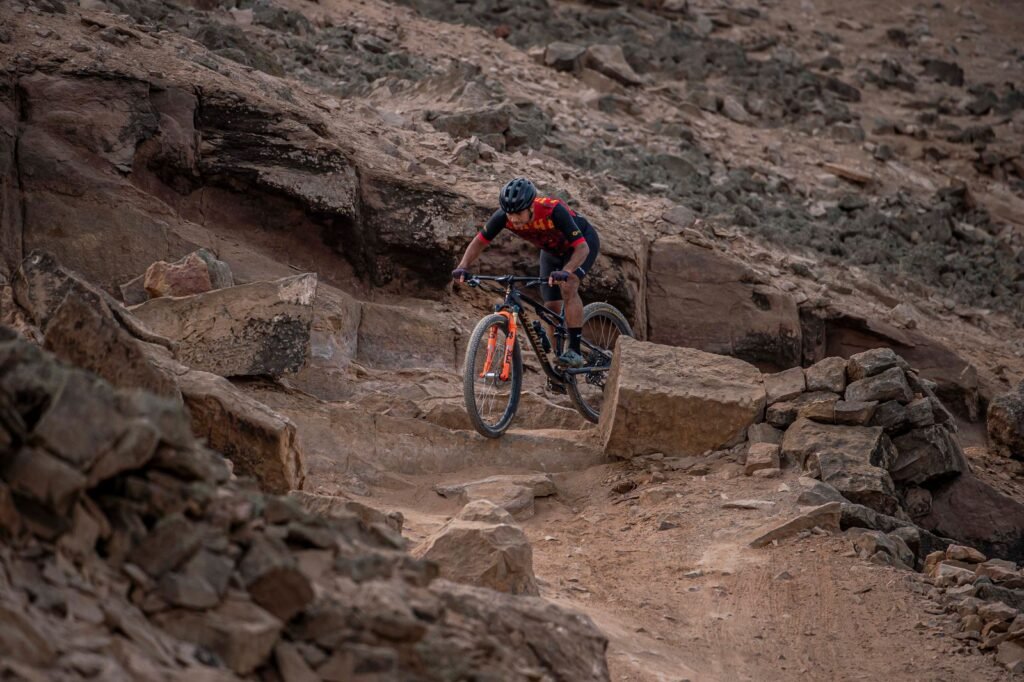
Rocky ground punishes stiff, short bikes. Every stone is a small impact, and a bike that cannot absorb it passes the hit to the rider’s hands and feet. That is why the same rider can feel confident on a trail bike and out of control on a dirt jump bike on the same rocky descent, even when both bikes are in good condition. If you are comparing several mountain bike types, start from the Mountain Bikes Hub.
Trail Mountain Bike vs Dirt Jump Mountain Bike on Rocks
The table below compares the two bikes on the features that matter most on rocks. Read the last column first if you are short on time: it says what to check on your own bike before you decide.
| Attribute | Trail Mountain Bike | Dirt Jump Mountain Bike | What to Watch |
|---|---|---|---|
| Suspension travel | About 120 to 140 mm, front and often rear | About 80 to 100 mm up front, often rigid at the rear | On rocks, more travel means fewer hard hits reaching your hands. |
| Wheel size | 27.5 in or 29 in | 26 in | Smaller wheels drop into gaps between rocks more easily. |
| Tyres | 2.2 to 2.6 in wide, tall knobs | 2.0 to 2.3 in, firmer and smoother | Wide tyres at low pressure grip loose stone; narrow, hard tyres slide. |
| Geometry | Slack head angle, long reach, low centre of gravity | Short, steep and upright, with a low saddle | A slack front end stays stable when a rock pushes the wheel sideways. |
| Gears | Wide 1×12 range for steep, loose climbs | Single speed or very few gears | Rocky climbs need a low gear so you can keep pedalling slowly without stalling. |
When the Answer Changes
The verdict flips only when the rocks stop being the main problem. A dirt jump bike can match a trail bike on a short, smooth rock roll that leads straight into a jump, because its short, stiff frame is easier to lift and place.
It also closes the gap on a dry pump track with a few stones on the surface, and on a short, flat section where you can carry speed without pedalling. But as soon as the rocky section gets longer, steeper or looser, the trail bike wins again. The flip points are:
- Rock size: loose, fist-sized stones favour the trail bike.
- Length of the rocky section: a few bike lengths favour the dirt jump bike; a full descent favours the trail bike.
- Gradient: steep rock steps need suspension and a dropper post; flat rock rolls do not.
- Wet rock: wet stone is slippery for both, but the trail bike’s wider tyre and lower pressure give it more grip. For a closer look at wet rock, see our Trail Mountain Bike vs Downhill Mountain Bike comparison.
How to Decide on Rocky Trails: A Five-Step Test
Do this test on the same rocky section, in the same conditions, with both bikes set up as you would normally ride them. It takes about 20 minutes.
- Walk the section first. Note the largest rocks, the loosest patches and the exit line.
- Ride the trail bike through at a steady pace. Note where the wheels skip or the bike pulls off line.
- Ride the dirt jump bike through the same line. Note where you have to slow down, dab a foot or stop.
- Repeat each run once, slower. A bike that is right for the rocks will feel easier the second time, not harder.
- Compare the hard facts. Count dabs, stops and line changes. The bike with fewer is the better rocky-trail bike for you.
What a fail looks like
| Symptom | Likely Cause | Fix |
|---|---|---|
| Front wheel deflects off every rock | Tyre too narrow or too hard, fork too stiff | Drop pressure a little and let the tyre and fork work; check the Mountain Bike Air Pressure guide before you change anything large. |
| Rear wheel spins on loose, rocky climbs | Not enough gears to pedal slowly, or too little weight on the rear tyre | Use the trail bike’s low gear and stay seated longer on the climb. |
| You keep stopping mid-section | The bike stalls on rocks it cannot roll over | Choose a line with smaller steps, or switch to the bike with larger wheels. |
Myth versus Fact
Myth: A dirt jump bike is tougher, so it must handle rocks better.
Fact: Toughness and comfort on rocks are different things. A dirt jump frame is strong, but its short travel and small wheels still pass every hit to the rider.
Before You Test
Wear a helmet and gloves, and test only on a trail you already know. Walk any section you have not ridden before, and stop if the rocks are wet, the trail is busy or either bike has loose bolts or a tyre that will not hold air.

The Method: Set Up Both Bikes for a Fair Comparison
A fair test starts before you ride. If one bike has soft tyres and the other has hard ones, you are testing tyre pressure, not the bikes. Set both up the same way.
What You Will Need
- Both bikes, clean and in good working order
- A pump and a pressure gauge
- A multi-tool and a spare tube
- A helmet, gloves and water
- A phone timer and a notebook
The Method
- Set tyre pressure first. Use each bike’s normal rocky-trail pressure, and write it down.
- Check suspension and brakes. Set sag and rebound to your normal trail settings, and make sure both brakes stop cleanly.
- Lower the dropper post, or the saddle, on the trail bike. The point is to have the same freedom to move on both bikes.
- Ride the same line, in the same direction, at the same effort. Do not change the line between bikes.
- Write down the result after each run. Note dabs, stops and line changes. Memory after a rough descent is not reliable.
Note
Keep the test short. Two runs on each bike on one rocky section tell you more than a whole day of mixed trails.
Warning
Do not test on a section with a blind drop, a cliff edge or a loose rock slab. If a run feels wrong, stop and walk the bike out.

When the Damage Is Already Done
If you already bought the wrong bike for the rocks you ride, you do not have to start again. These fixes will not turn a dirt jump bike into a trail bike, but they will make rocky rides safer while you decide what to do next.
- Your dirt jump bike beats you up on rocks: fit the widest tyres your frame and fork will take, run them a little softer, and choose smoother lines.
- Your trail bike feels slow on jump lines: that is the trade-off. Keep it for rocky trails and borrow a dirt jump bike for jump days.
- Both bikes feel wrong: check the basics first. Worn tyres, a dry chain and brakes that drag will make any bike feel bad on rocks. Fix those first, then judge the bike.
The Safe Alternative: A Dirt Jump Mountain Bike
A dirt jump bike is the right bike when the ride is about air time, not rock time. On a jump line or a pump track, its short, stiff frame is a strength: it is easy to lift and place in the air. If rocks are only a short roll-in to the next jump, a dirt jump bike is a fair choice.
To ride one on rocks without hurting yourself, keep it simple:
- Pick short, smooth rock rolls only. If you cannot see the exit from the entry, walk it first.
- Stand, stay centred and keep your elbows soft. Let your arms and legs be the suspension.
- Slow down before the rocks, not in them. Brake on smooth ground, then roll through with no sudden steering.
For a direct look at the other side of this choice, see our Hardtail Mountain Bike vs Dirt Jump Mountain Bike comparison, and our Full Suspension Mountain Bike vs Dirt Jump Mountain Bike comparison.

What to Do Next, in Order
- Ride both bikes on the same rocky section and write down dabs, stops and line changes.
- Pick the bike with fewer dabs and stops, not the one you wanted to win.
- Set tyre pressure and suspension for rocks before you judge either bike.
- Keep the other bike for jump days, or plan the swap if your trails are mostly rocks.
Never Do This
- Never ride a rocky descent you have not walked first. A hidden step can stop a wheel dead.
- Never test with soft or flat tyres. A pinch flat on rocks ends the test and can bend a rim.
- Never brake hard in the middle of loose rocks. Slow down before the section, then roll through.
- Never buy on travel numbers alone. Travel, tyres and geometry only work together.
In Short
On rocks, a trail mountain bike is better than a dirt jump bike because its longer suspension, wider tyres and larger wheels keep it in contact with uneven stone. A dirt jump bike is better only for short, smooth rock rolls into jumps. Test both on the same section, count your dabs and stops, and let that decide.
The Essentials
- Trail bikes suit long, loose and steep rocky sections.
- Dirt jump bikes suit short rock rolls into jump lines.
- Tyre width and pressure matter as much as travel.
- Walk the section, then test both bikes on the same line.
More Questions, Answered
Can a dirt jump bike ride rocky trails at all?
Yes, on short, smooth sections at low speed, with soft arms and legs doing the suspension work. Long rock gardens are not its job.
Is a trail bike too heavy for jumps?
It is heavier and longer than a dirt jump bike, so it is harder to lift and place in the air. That is the price of its comfort on rocks.
What should I change first on a dirt jump bike for rocks?
Fit the widest tyres that will fit, run them a little softer and pick smoother lines. That helps, but it will not add travel or larger wheels.
Additional Details
- Name: Trail Mountain Bike vs Dirt Jump Mountain Bike: Which Is Better for Rocks?
- Description: Trail mountain bike vs dirt jump mountain bike — which is better for rocks? Compare travel, tyres and geometry, then run the five-step test to choose the bike.
- Published: November 10, 2026