Part of our guide on E-Bikes.
A folding e-bike tyre problem usually shows up at the worst moment: a slow puncture on the way to work, a sidewall bulge found the night before a ride, or tread worn smooth after a season of daily folding. Most are not bad luck. They are usually low pressure, a missed cut, or a storage habit that wore the rubber down.
This guide shows how to care for folding e-bike tyres, from the two-minute checks to the point where a replacement is the right answer. It covers the tyres fitted to folding e-bikes, which usually run on small 14-inch, 16-inch or 20-inch wheels. For the rest of the bike, read How to Care for Commuter E-Bike Range and Make It Last and Commuter E-Bike Motor Care Guide for Beginners.
Quick facts
| Fact | What it means for your ride |
|---|---|
| Problem this guide fixes | Tyres that lose pressure, puncture often, wear unevenly, or bulge |
| Check first | Pressure, tread, sidewall cracks, embedded glass or thorns, and the valve |
| Most common causes | Low pressure, sharp debris, kerb knocks, and storage in sun or heat |
| Tools you need | A pump with a gauge, tyre levers, a matching spare tube, and a patch kit |
| Stop and get help | A bulging sidewall, a cut showing casing threads, or a wheel not running true |
Quick recap
- Check pressure every week. Small tyres hold little air, so a loss shows fast.
- Look at the tread and both sidewalls, not just the part you can see.
- Soft tyres puncture easily, wear faster, and waste range.
- Match every replacement by the size on the sidewall, never by guessing.
- Store the folded bike out of sun and heat, and keep weight off the tyres.
- Replace a tyre with a bulge, a deep cut, or cracked sidewalls. Do not ride on it.
The short answer: pressure, tread and sidewalls, checked every week
Most folding e-bike tyre trouble comes down to pressure, damage, or age. The straight answer is that a tyre kept at the pressure printed on its sidewall, checked for cuts and cracks, and replaced when worn or damaged will last far longer than one only looked at when it goes flat.
That order matters because the symptoms overlap. A slow puncture can look like a faulty valve, and uneven wear can look like a bad tyre when the real cause is low pressure. A folding e-bike tyre also lives a harder life than a full-size tyre: it spins faster and is folded, carried and stored far more often.
The rest of this guide follows that rule: the diagnosis finds the fault, the reference section matches each symptom to a cause, and the later sections cover folding and storage.
How to check folding e-bike tyres, step by step
Work through these steps in order, noting which wheel is at fault.
- Check the pressure with a gauge. Pump each tyre to its sidewall range. One needing air every week has a slow leak.
- Spin each wheel and watch the tread. Look for a flat spot, a wobble, or tread smooth in the middle. A wobbling tyre is not seated.
- Look at both sidewalls. Check for cracks, cuts, bulges or perished rubber. A bulge means the casing is damaged: do not ride it.
- Pick out embedded debris. Run a cloth over the tread and pick out glass and thorns before they reach the tube.
- Check the valve. Make sure the cap is on and the valve is straight, with no air hissing out when pressed. A bent valve can mimic a puncture.
- Look at the rim and the fold. Check the tyre sits evenly on the rim, and nothing rubs it when folded.
If every step looks normal and the problem stays, get a qualified shop to check the wheel.
What you’ll need
- A pump with a pressure gauge
- Tyre levers, for removing the tyre safely
- A spare inner tube matching your sidewall size
- A patch kit and a cloth for roadside repairs
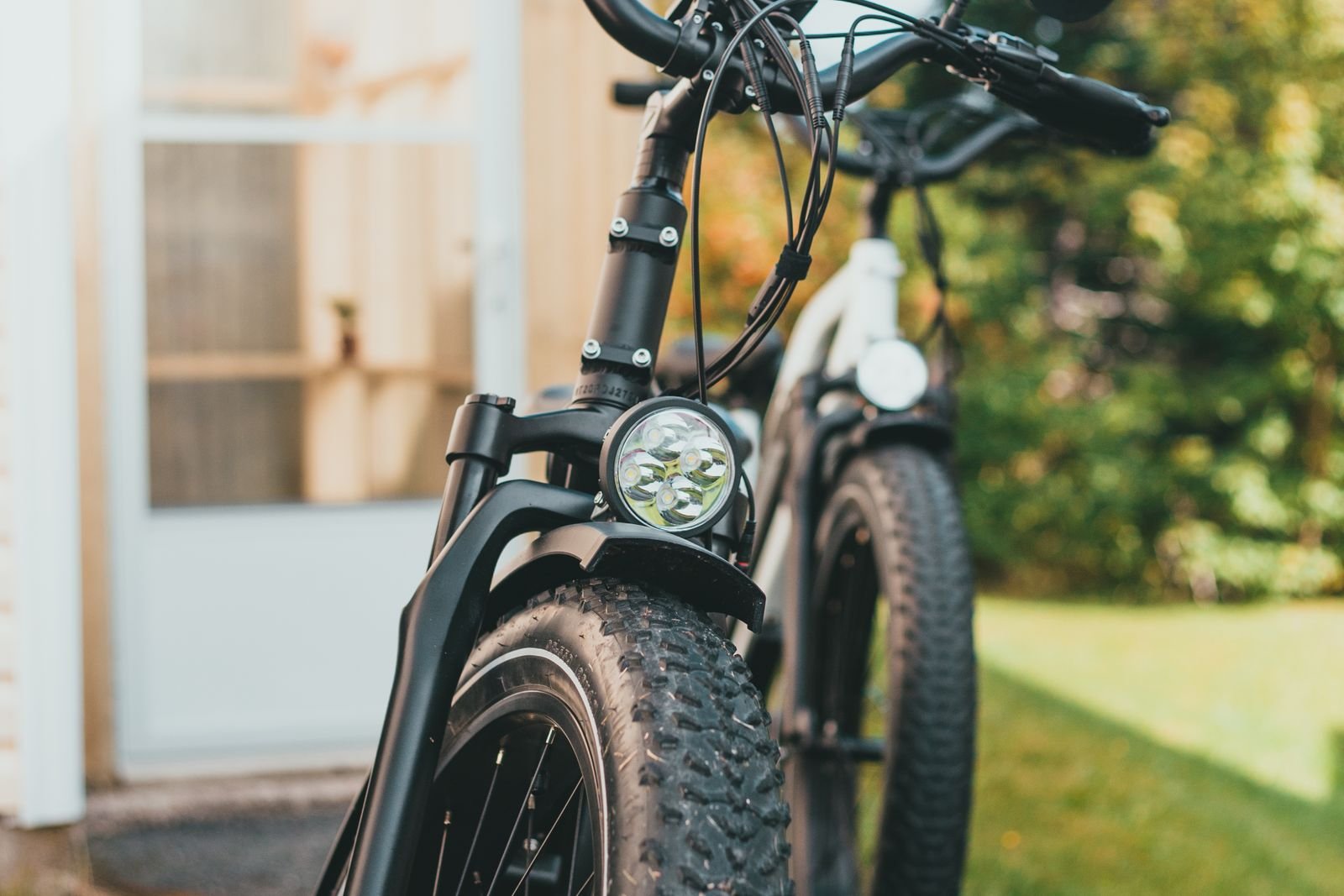
The folding fat tyre below is the same 20 x 4.0 size fitted to many folding e-bikes. Only use it if it matches your sidewall.

What the symptom usually means
Use this table to match what you notice with what to try first. If the tyre is damaged, skip it and replace it.
| Situation | What you’ll notice | What to try |
|---|---|---|
| Tyre feels soft every week | Thumb test feels soft, or the gauge reads low | Pump to the sidewall range, then check for a leak |
| Punctures keep happening | Flats on the same wheel, same place | Pick debris out of the tread, check the rim tape |
| Tread worn smooth in the middle | Centre tread is smooth, edges still look new | Check pressure, then plan a replacement |
| Sidewall cracks or bulge | Fine cracks, a soft lump, or an out-of-round tyre | Stop riding and replace it; a bulge means the casing has failed |
| Bike pulls to one side | Steering feels uneven, or one tyre wears faster | Check both pressures and that each tyre is seated evenly |
| Buzzing at speed | A hum or shake that grows with speed | Check the tyre is seated evenly and the wheel is true |

How folding, storage and weather change the answer
Heat is the most common surprise: a tyre left in direct sun or in a closed car ages faster, and the rubber can crack at the sidewall long before the tread wears out. Keep the folded bike indoors, out of sun and heat. Cold matters the other way: a cold tyre feels harder and grips less until it warms up, and pressure reads lower in the cold.
Folding adds wear too: every fold presses the tyres against the frame, so check for rubbing. For the full folding routine, read Gravel, Folding and Cruiser Bikes.
What works
- Store the folded bike indoors, out of sun and heat
- Pump the tyres to the sidewall range after cold storage
- Keep the folded bike upright, with no luggage resting on it
What to watch
- Do not leave a folded bike in a closed car on a hot day
- Do not judge wear from the tread alone; sidewalls age first
- Do not fold the bike with a flat tyre: the rim can pinch the tube
Settings and habits that affect tyre wear
Before deciding a tyre is worn out, check the habits that decide how fast it wears. Pressure is the biggest one: a tyre ridden soft flexes more with every turn, heating the rubber, wearing the shoulders, and making punctures more likely. Load and assist matter too: a heavy load works the rear tyre harder, while high assist scrubs the rear tread.
If the rear tyre always wears out first, that is normal, not a fault. A tyre that has hit a kerb hard should be checked for a bulge even if it holds air.
What works
- Keep both tyres at the sidewall range, and check weekly
- Spread the load across the bike, not all over the rear wheel
- Slow down for kerbs and potholes, and lift the front wheel over sharp edges where you can
What to watch
- A tyre worn smooth in the middle is often over-inflated; at the shoulders, under-inflated
- A rear tyre wearing twice as fast is normal; one wearing out in weeks is not
- Do not ride with a tyre that buzzes, wobbles or pulls after a kerb hit; get it checked
When a fix needs a part or a replacement
Some tyre problems have a simple fix, and some need a part. A slow leak can be patched and an unseated tyre refitted, but a bulging sidewall, a cut showing casing, or smooth tread cannot be fixed at home. Match every part to the size on your old tyre’s sidewall.
| Fix | Best use | Limit |
|---|---|---|
| Pump to the sidewall range | Soft tyres, vague handling | Will not help if the tyre or valve leaks |
| Patch or replace the tube | A single puncture, no tyre damage | Do not patch the same tube repeatedly |
| Refit the tyre on the rim | A tyre that wobbles or buzzes | Will not help if tyre or rim is damaged |
| Replacement tyre | Worn tread, cracked sidewalls, bulges, deep cuts | Must match the sidewall size; get a shop to fit it on a hub-motor wheel |
| Professional check | A wheel not running true, or a fault no check explains | Do not ride on a wheel a shop has told you to stop using |
What works
- Keep the old sidewall size with the bike, so a replacement matches the label
- Carry a spare tube, tyre levers and a pump on every ride
- After any fix, take a short, low-assist ride to check handling
What to watch
- A wrong-size tyre can rub the frame and wear through fast
- A second-hand tyre can carry the fault you are fixing
- Do not keep riding a tyre a shop has told you to replace

The verdict
Most folding e-bike tyre trouble is fixed by weekly pressure checks, picking debris out of the tread, and replacing a worn or damaged tyre, not by buying a new wheel. When it bulges or splits, a matched replacement is the right next step.
Readers also ask
How often should I check my folding e-bike tyre pressure?
Once a week with a gauge, plus a thumb squeeze before every ride.
Why does my folding e-bike tyre keep going flat?
Usually a thorn or glass still in the tread, a slow valve leak, or a wrong-size tube.
Can I use any tyre that fits my folding e-bike?
No. Use only the size printed on your old tyre’s sidewall.
How do I know if my folding e-bike tyre needs replacing?
When the tread is smooth, the sidewalls are cracked, the tyre bulges, or a cut shows casing.
Does folding the bike damage the tyres?
Not a healthy tyre, but every fold presses the tyres against the frame. Check for rubbing, and never fold with a flat tyre.
Why does my rear folding e-bike tyre wear out faster than the front?
It carries more weight and takes the drive force. That is normal, but one wearing out in weeks needs checking.
Affiliate Disclosure: We may earn a commission when you buy through links on this site, at no extra cost to you.
Additional Details
Name: How to Care for Folding E-Bike Tyres and Make It Last
Description: Learn how to care for folding e-bike tyres: weekly pressure checks, tread and sidewall inspection, puncture fixes, storage tips, and when to replace them.
Published: November 16, 2026