Part of our guide on E-Bikes.
A folding e-bike range problem usually shows up quietly: the same short commute that used to end with charge to spare now ends with the display flashing, or a cold morning takes miles off a battery that felt fine the day before. A folding e-bike is not a smaller copy of a full-size e-bike: its small wheels turn faster, its battery sits in a tight space, and its hinge and latch change how firmly the battery stays seated.
This guide shows how to care for folding e-bike range in a safe order, from the checks that take two minutes to the point where a part or a replacement is the right answer. For charging, read How to Make Your E-Bike Battery Last Longer and How to Charge an E-Bike Battery Safely; for chargers and storage, read E-Bike Battery Care Companion.
Quick facts
| Fact | What it means for your ride |
|---|---|
| Problem this guide fixes | A folding e-bike that runs out of range too soon, or loses range in cold weather or on hills |
| Check first | Tyre pressure, assist level, battery seating, the hinge and latch, and the charger |
| Most common causes | Soft tyres, high assist, a cold battery, a heavy load, and charging or storage habits |
| Tools you need | Your manual, the correct charger, a pump, and a dry cloth |
| Stop and get help | Swelling, heat, a strange smell, leaking, smoke, or a cracked case |
| Related guides | E-Bike Battery Care Companion, How to Charge an E-Bike Battery Safely, How to Make Your E-Bike Battery Last Longer |
Quick recap
- Start with tyre pressure, assist level, battery seating and the hinge latch.
- Small wheels and high assist use the battery faster than the same ride on a full-size e-bike.
- Shorter range in cold weather, with soft tyres, high assist or a heavy load is often normal.
- Only use the charger made for your battery, and charge indoors in a dry place.
- Stop at once if the battery swells, overheats, smells strange, leaks, or smokes.
- When a fix needs a part, match voltage, connector and maker approval exactly.
The short answer: measure your real range first, then fix the cheap drains
Most folding e-bike range problems are not a worn-out battery. The straight answer is that a folding e-bike that suddenly loses range is far more likely to have soft tyres, high assist, a battery that is not seated, a hinge latch that is not fully locked, or a cold battery than to have failed without warning.
That order matters because the symptoms overlap: a rattling battery can lose contact on bumps, high assist with soft tyres can lose miles, and cold weather can cut the range on a healthy battery.

If a step tells you to stop, stop. A damaged lithium battery is not a do-it-yourself repair.
How to check and care for folding e-bike range, step by step
Work through these steps in order.
- Pump the tyres to the pressure on the sidewall. Small wheels lose pressure fast, and soft tyres waste battery energy.
- Seat the battery again. Refit it until it locks; a rocking battery can lose contact on bumps.
- Check the hinge and latch. Open and close the hinge fully, lock the latch, and check nothing flexes.
- Read the charge level in two places. Compare the battery with the display; if they disagree, the display may be the fault.
- Ride a short test route on low assist. Note whether range falls only on hills, bumps, or a nearly empty battery.
- Check the charger and socket. Try a different socket, check the cable and plug, and watch the charger light.
- Note when it happens. Cold, heat, wet rides, load and a nearly empty battery all change what to expect.
If every step looks normal and the range stays short, get a qualified shop to test the battery and charger.
What you’ll need
- Your manual or battery label, for voltage and charger details
- The original charger, or an exact replacement
- A pump, a dry cloth, and a clean, dry place to charge
- A notebook to record charge level and tyre pressure
One Amazon product in this section only: the folding e-bike below is the same kind of compact folding commuter.

What your range is telling you
Use this table to match what you notice with what to try first.
| Situation | What you’ll notice | What to try |
|---|---|---|
| Range falls on every ride | The same commute needs a charge sooner than it used to | Check tyres, assist and load; compare a warm day with a cold day |
| Range falls only in cold weather | The morning ride is shorter, and range recovers in spring | Bring the battery indoors, warm it to room temperature, then charge it |
| Power cuts out on bumps | Assist stops on rough ground, or after folding and carrying | Refit and lock the battery, and close and lock the hinge latch |
| Battery charges very slowly | Hours on charge add little range, even with the right charger | Check the charger and socket, and charge indoors at room temperature |

How temperature, load and folding habits change the answer
The same battery can feel different on a cold morning, after a hot day, or at the end of a long commuting year. Cold is the most common surprise: a battery that spent the night in a cold garage gives less range and charges more slowly until it warms up.
Load matters more on a folding e-bike, because the motor and battery are smaller and the small wheels work harder. A heavy bag, a steep hill and the highest assist together can take miles off a short ride.
What works
- Warm the battery indoors to room temperature before charging on cold days
- Use a lower assist level on flat ground and save the highest level for hills
- Check the hinge latch and battery lock weekly if the bike is folded daily
What to watch
- Never charge a frozen, swollen, cracked, hot or damp battery
- Do not leave a battery in a closed car or in direct sun on a hot day
- Do not ride with a hinge latch that will not lock firmly; get it checked first
Settings and controls that affect range
Before deciding a battery is weak, check the settings that decide how much of it you use. Assist level is the biggest one: the highest assist on a flat commute can empty a small battery far sooner.

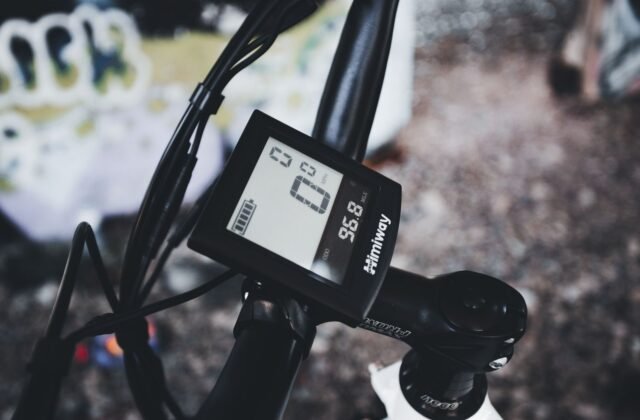
The display is part of the diagnosis too. Its battery bars measure charge, while a range estimate is only a guess based on recent riding. If it jumps around, trust the battery bars instead.
What works
- Use the lowest assist level that keeps the ride comfortable, and save the highest level for hills
- Compare the battery bars on the same route on similar days
- Check that the display and its cable are seated after any knock or wet ride
What to watch
- A display that drops from full to empty in minutes points to a connection or battery fault
- A range estimate that changes wildly is a guess, not a measurement
- Do not ride with a display or control that sticks, resets, or changes assist by itself
When a fix needs a part or a replacement
Some range problems have a simple fix, and some need a part. Soft tyres can be pumped, a loose battery can be refitted, and a wrong charger can be replaced. A swollen, cracked or leaking battery cannot be fixed at home, and a battery that will not hold a charge is a job for a qualified shop. When a part is needed, match it exactly.
| Fix | Best use | Limit |
|---|---|---|
| Pump tyres and lower assist | Range falls on every ride | Will not help if the battery itself is worn |
| Refit and lock the battery | Power cuts out on bumps, or the battery rattles | Will not help if the mount or lock is worn |
| Replacement charger | Charger light never comes on, or the charger is damaged | Must match voltage, connector and maker approval |
| Replacement battery | Range stays far below normal after all checks | Must match the bike and motor system |
What works
- Keep the manual and battery label with the bike, so a replacement is matched from the label
- Ask a qualified shop to test a battery that will not hold a charge before buying a replacement
What to watch
- A cheap charger that only fits the plug can damage the battery and the bike
- A second-hand battery with no history can carry the same fault
When the range stays short after every check, the answer may be a folding e-bike with a bigger battery. The foldable commuter below states 30–35 miles of pedal-assist range.

The verdict
Most folding e-bike range problems are fixed by pumping the tyres, lowering the assist, and refitting and locking the battery and hinge latch, not by buying a new battery. When those checks fail, or the battery is swollen, hot or damaged, a qualified shop test is the right next step.
Readers also ask
Why does my folding e-bike lose range in winter?
Cold reduces the range a battery gives, and a cold battery charges more slowly until it warms up. Bring it indoors and let it reach room temperature first.
Do small wheels use more battery?
Small wheels turn faster for the same speed, so a folding e-bike can use its battery faster than a full-size e-bike on the same route.
Why does my folding e-bike cut out after I unfold it?
It usually means the battery is not seated or locked, or the hinge latch is not fully closed. Unfold it fully, lock the latch, and refit the battery.
How do I know if my folding e-bike battery needs replacing?
When the range on a familiar route stays far below normal on warm days, after the checks above, and a shop test agrees.
Can I use any charger that fits my folding e-bike battery?
No. A plug that fits is not proof that a charger matches. Use only the maker charger or an exact maker-approved replacement.
Affiliate Disclosure: We may earn a commission when you buy through links on this site, at no extra cost to you.
Additional Details
Name: How to Care for Folding E-Bike Range and Make It Last
Description: Learn how to care for folding e-bike range: measure your real range, fix the cheap drains first, and keep your folding e-bike going further on every charge.
Published: November 15, 2026