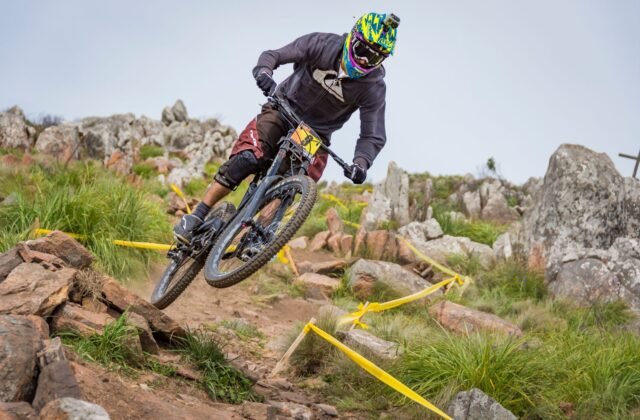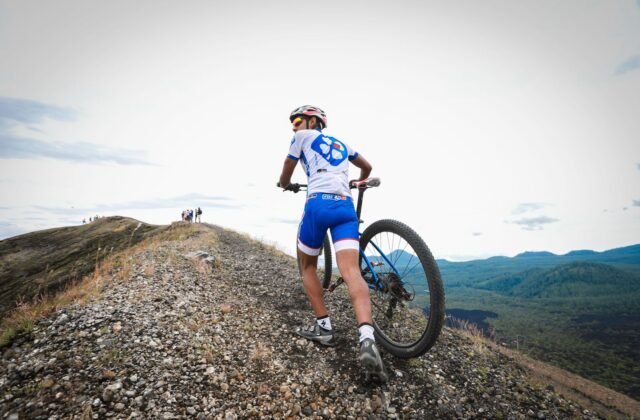
Straight answer: For most racing, a 29er mountain bike is faster. Its 29-inch wheels roll over roots and rocks with less speed loss and hold momentum on rough ground. A trail mountain bike, with 120–160 mm of travel, turns quicker in tight corners and is more fun on jumps — and on a short, twisty, jump-filled course it can win. On a typical race course with climbs, rough sections and open corners, the 29er takes the win. That is the short answer to the trail mountain bike vs 29er mountain bike question.
Many trail bikes also roll on 29-inch wheels. Here, “trail bike” means an agility-first bike with 120–160 mm of travel, and “29er” means a speed-first race setup on 29-inch wheels.
Introduction
Racing punishes the wrong bike choice fast. A course that looks quick on paper can feel slow when the wheels keep stalling on roots and rocks, while a bike that climbs well can lose everything in one tight section. The right choice depends on the course, not on the badge.
This guide compares the two in the Mountain Bikes Hub, under the Mountain Bike category, and gives you a 20-minute test that settles the question on your own race course. For the beginners’ version, read Full Suspension Mountain Bike vs 29er Mountain Bike: Which Is Better for Beginners?
Trail Mountain Bike vs 29er Mountain Bike for Racing: The Comparison
The table sets out the differences that matter on a race course. Set-up, tyres and the rider still decide most races.
| Attribute | Trail Mountain Bike | 29er Mountain Bike | What to watch |
|---|---|---|---|
| What it is | An agility-first bike for varied trails | A speed-first race setup around big wheels | Check travel and wheel size, not the label |
| Wheel size | 27.5-inch or 29-inch | 29-inch | The bigger wheel meets obstacles at a shallower angle |
| Suspension travel | 120–160 mm | Shorter travel than a trail bike | More travel helps on descents, not on smooth climbs |
| Climbing | Grips well on technical climbs | Holds speed over roots and steps | Watch for wheel stall on rough, steep pitches |
| Cornering and handling | Turns quickly in tight sections | Needs more room to turn | Tight corners favour the trail bike |
| Rough ground and momentum | Soaks up big hits, loses a little speed | Rolls over rough ground and keeps speed | Rocky, rooty sections favour the bigger wheel |
| Best for racing | Short, twisty, jump-filled courses | Longer courses with climbs and rough sections | Match the bike to the course |
When the Answer Changes
The 29er wins on most race courses, but five variables can flip the result:
- Course shape: Tight corners, switchbacks and jumps suit the trail bike. Open, flowing courses with long rough sections suit the 29er.
- Rider height: Shorter riders may find a 29er harder to manoeuvre and to get behind on steep drops; taller riders usually fit one naturally.
- Race length: The longer the race, the more the 29er’s momentum helps — every root you roll over instead of stalling on saves energy.
- Jumps and drops: On courses with regular jumps and drops, the trail bike’s extra travel and quicker handling matter more than wheel size.
- Ground conditions: In mud and on soft ground, grip and tyre tread matter more than wheel size. For wet-weather trail riding, see Trail Mountain Bike vs Downhill Mountain Bike: Which Is Better for Wet weather?

Test Both Bikes on Your Race Course: A 20-Minute Decision Ride
Reading about wheel sizes will not settle it. This 20-minute test uses your real race course, so the result applies to your racing, not to a review.
- Set both bikes up the same way: the tyre pressure you would race on, the same saddle height, and working brakes. See Mountain Bike Air Pressure for a starting point.
- Ride one timed lap on the trail bike. Use a loop with a climb, a rough section and a tight corner, ride at race effort, and note the time and how the bike felt.
- Ride the same lap on the 29er at the same effort, on the same line where you can hold it. Note the time and how the bike felt.
- Compare the hard parts, not just the time: which bike stalled on roots, which turned easily, and which left you fresher.
- Repeat the weaker lap. Ride once more on the bike that felt worse, to check whether the first lap was just a bad line.
What a fail looks like
| Symptom | Cause | Fix |
|---|---|---|
| Front wheel stalls on roots and rocks | The smaller wheel meets obstacles at a steeper angle | Try the 29er |
| You overshoot tight corners | The longer 29er wheelbase needs more room to turn | Try the trail bike |
| Hands and arms ache after one lap | Too much feedback reaching the bars | Check tyre pressure and suspension first |
Myth vs Fact
Myth: A 29er is always faster because the wheels are bigger.
Fact: Bigger wheels help on rough, open ground, but a trail bike wins on tight, twisty courses where turning matters more.
Myth: A trail bike is always slower because it has more suspension.
Fact: Extra travel only costs speed when it bobs on smooth ground; on rough descents it keeps the wheels down.
Before you test: Wear a helmet, gloves and eye protection, and check both bikes — brakes, quick releases and tyre pressure. Use a trail you know, ride within your limits, and never test a new bike at full speed on lap one.
How to Set Up a Trail Bike and a 29er for the Same Race
A fair comparison needs both bikes set up for the same job — a trail bike with soft tyres and a 29er with race tyres tells you about the tyres, not the bikes.
What you will need
- A pump with a gauge
- A multi-tool for saddle height
- A stopwatch or bike computer
- A short loop with a climb and a tight corner
The method
- Match the set-up. Set both bikes to the same tyre pressure and the same saddle height.
- Check the wear parts. A worn tyre on one bike will spoil the test.
- Warm up on the loop. Ride it once at an easy pace, so you know the lines.
- Time one lap on each bike at the same effort, with a short rest between laps.
- Write down what you felt: climbing, cornering, rough ground and how fresh you felt.
- Choose on the hard parts. Pick the bike that handled the hardest part best.
Do not test on a course you have never ridden. An unfamiliar trail tests your memory, not the bikes, and a surprise drop on a new bike is a bad place to learn its handling.
Note: Set-up changes can move the result more than wheel size can — fix worn chains, dragging brakes and different tyres first.

When the Damage Is Already Done
If you already bought the wrong bike for the courses you race, you do not have to start again:
- You bought a trail bike but race open, rough courses: Fit faster-rolling tyres, firm up the suspension on climbs, and carry speed through rough sections instead of braking for every root.
- You bought a 29er but race tight, twisty courses: Fit a shorter stem and wider bars if your fit allows, brake earlier and turn in two stages, and choose grippier tyres.
- Your bike feels slow everywhere: Check tyre pressure, chain wear and brake rub first — a dragging brake costs more speed than any wheel size.
- You cannot change the bike this season: Race the courses that suit it, and use the test above to learn where it loses time, so your next bike is the right one. For the 27.5-inch side, read Full Suspension Mountain Bike vs 27.5 Mountain Bike

The Safe Alternative: Start with a 29er
If you are buying your first race bike and can only choose one, the 29er is the safer choice for most riders. Its rolling speed forgives rough ground and tired legs. A trail bike is the better buy if your local courses are short, tight and full of jumps, or if you are a shorter rider who finds a 29er hard to manoeuvre.
The method
- Ride the course you race most, and judge the bike on that course.
- Check your fit first. If the reach feels too long, a smaller frame or shorter stem helps.
- Learn the cornering: brake before the corner, not in it, and look through to the exit.
- Give it three rides. A 29er feels big on the first ride and normal by the third — decide then, not before.
If the 29er still feels wrong after three rides on your usual course, the trail bike is your answer.
What to Do Next, in Order
- Walk your race course and mark its tight corners, rough sections and climbs.
- Borrow or test-ride both bikes with the same tyres and pressure.
- Run the 20-minute test above and write down the times.
- Check the set-up of the bike you already own first.
- Choose the bike that handles the hardest part best — then race it.
Never Do These When Racing
- Never race a bike you have not ridden on that course. Handling surprises at race speed cause crashes.
- Never set tyre pressure by guessing. Too soft rolls slowly and risks a pinch flat; too hard bounces off roots.
- Never ignore a rubbing brake or a slipping chain. Both cost more speed than any wheel size.
- Never choose a bike on looks alone. The fastest bike is the one that fits your course and your size.
In Short
For most racing, a 29er mountain bike is faster than a trail mountain bike: its 29-inch wheels roll over rough ground with less speed loss and hold momentum on climbs and open sections. A trail bike wins on short, tight, jump-filled courses where quick turning matters more. Test both on your own race course, match the set-up, and let the hardest part decide.
The essentials
- Trail bike: 120–160 mm of travel, quick to turn, best on tight courses
- 29er: 29-inch wheels, best on longer, rougher race courses
- Test both on the same loop, at the same effort and tyre pressure
- Match the bike to your course and your size
More Questions, Answered
Is a 29er always faster than a trail bike in a race?
No. A 29er is faster on most race courses, but a trail bike is faster on short, tight, jump-filled courses.
Can a trail bike have 29-inch wheels?
Yes — many modern trail bikes roll on 29-inch wheels. Then the difference is mainly travel and geometry, so test the bikes on your course.
Which bike is better for a shorter rider?
Shorter riders often find a trail bike easier to manoeuvre, because a 29er can feel long on steep drops. Test both before you buy.
What should I change first if my bike feels slow?
Check tyre pressure, chain wear and brake rub first — they cost more speed than any wheel size.
Additional Details
Name: Trail Mountain Bike vs 29er Mountain Bike: Which Is Better for Racing?
Description: Trail mountain bike vs 29er mountain bike: which is faster for racing? Compare wheel size, travel, climbing and cornering, then test both on your race course.
Published: November 10, 2026