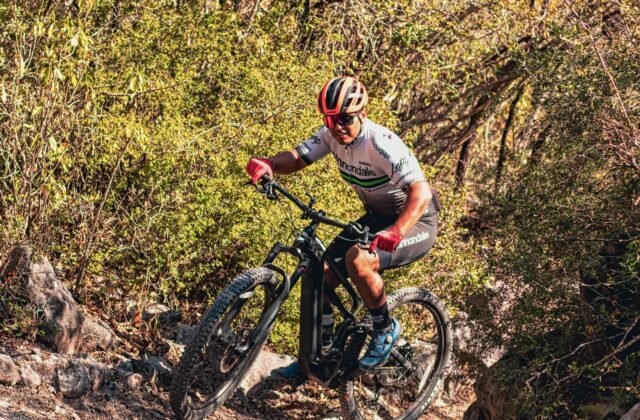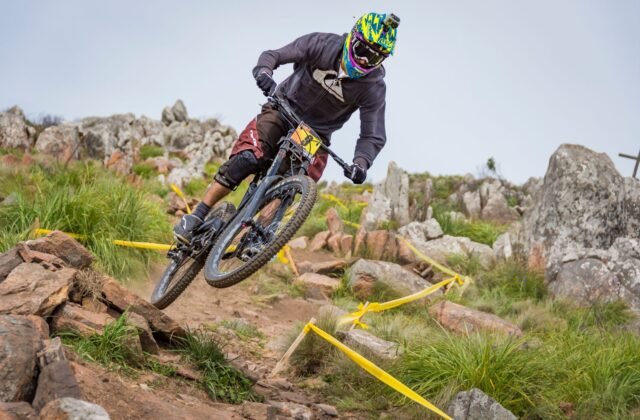
For racing, a full-suspension mountain bike is usually better on rough, rooty and rocky courses, because both wheels stay in contact with the ground. A 27.5 mountain bike is usually better on smooth, tight courses, where its smaller, lighter wheels change direction faster.
Those labels describe different things, so they can overlap: full suspension is a suspension type, and 27.5 is a wheel size. A full-suspension bike on 27.5-inch wheels is often the best single race bike for mixed courses.
A race is decided in the rough sections and in the tight turns, and those two places pull a bike in opposite directions. A full-suspension bike keeps its wheels on rocky ground, so you can brake later and hold speed. A 27.5 bike turns more quickly, so it gains time where the course is smooth and twisty.
That is why the labels confuse so many riders. You are not choosing between two kinds of bike. You are choosing between a suspension system and a wheel size, and the fastest race bike may be the one that has both. This article compares the two ideas side by side, so you can test both before you spend anything.
Full Suspension Mountain Bike vs 27.5 Mountain Bike: What the Labels Mean
A full-suspension mountain bike has a fork at the front and a shock at the rear, so both wheels move over bumps on their own. A 27.5 mountain bike is defined by its wheel size, and most 27.5 race bikes are hardtails, with no rear shock. The table below puts the two ideas side by side.
| Attribute | Full Suspension Mountain Bike | 27.5 Mountain Bike | What to watch |
|---|---|---|---|
| What it is | A suspension type: fork plus rear shock | A wheel size, usually on a hardtail | A bike can be both |
| Rough-track control | Both wheels stay down over roots and rocks | The rear wheel skips on rough ground | Watch the rear wheel on the roughest part |
| Speed on smooth ground | Slower to start; suspension absorbs effort | Quick to accelerate on smooth, rolling ground | Watch the first metres out of a slow corner |
| Tight turns | Steadier, but heavier to turn | Smaller wheels turn faster through switchbacks | Watch how much you slow before a turn |
| Climbing | Planted on rough climbs; less direct on smooth ones | Direct on smooth climbs; can slip on loose ones | Watch the loose, rocky climb |
| Weight and upkeep | Heavier; fork and shock to service | Lighter and simpler at the rear | Check the shock service schedule before buying |
| Best for racing | Rough, rocky courses and long races | Smooth, tight courses and short races | Match the bike to your most common course |
When the Answer Changes
First, look at the surface. On a rough course, with roots and rocks for most of the lap, the full-suspension bike will usually win, because it keeps both wheels working for you. On a mostly smooth course with many tight turns, the 27.5 bike will usually win, because it speeds up and turns more easily.
Second, look at the length. In a long race, a full-suspension bike saves energy over several laps, because you are not fighting it on every rough section. In a short, fast race, that saving matters less, and the lighter 27.5 bike gains more from every acceleration. Third, look at the rider: a taller rider may find a 27.5 bike cramped, while a shorter rider may find it fits better. Compare both ideas on the same course before you decide; our full-suspension vs 29er comparison shows the same trade-off from the other side, and the Mountain Bikes Hub has the rest of the guides.
A 20-Minute Test That Settles the Race Question
Use the same loop for both bikes, and change only the bike. Pick a short loop with a rough section and a tight section, and note where you gain and lose time. Keep the pressure, saddle height and line the same for both rides.
- Ride the loop once on the first bike, and time the rough section and the tight section separately.
- Ride the same loop on the second bike, and time the same two sections.
- Compare the two sections, not just the total time.
- Ride the loop again on the slower bike in its weak section, and try a different line or gear.
- Choose the bike that wins on the course you race most often.
What a fail looks like
| Symptom | Cause | Fix |
|---|---|---|
| Both bikes feel the same on the test loop | The loop has no rough or tight section | Pick a loop with both, and time them separately |
| One bike wins everywhere by a large amount | Something else changed between rides | Repeat it with the same pressure, saddle and line |
| You feel beaten up on the full-suspension bike | The suspension is too soft or too firm for you | Set the sag, then test again |
Myth vs Fact
Myth: A full-suspension bike is always faster in a race, because it has more suspension.
Fact: Suspension helps only where the track is rough enough to need it. On a smooth, tight course, a 27.5 bike can be faster, because it accelerates and turns more easily.
Before you test
Ride the test loop at a pace you can hold, not at full race speed. Check that both bikes have working brakes, tight wheels and tyres with no damage, and stop if anything feels wrong.

How to Set Up Either Bike the Same Way for a Race
What you will need
- A pump or a gauge, so both bikes run the same pressure
- A shock pump, if your bike has an air fork or shock
- A tape measure and a note of your saddle height
- A helmet and gloves, and somewhere to write times
- The same tyres on both bikes, if you can
The method
- Set the same saddle height on both bikes.
- Set the same tyre pressure on both bikes, with the gauge.
- Check the suspension: set the sag so it moves through its travel on a rough section.
- Check the brakes and the gears on both bikes.
- Ride the test loop in the order above, and write down your times.
Note
If you change one thing at a time, you will know what worked. Change two things together, and you will not know which one helped.
Warning
Do not ride a bike with loose wheels, worn brake pads or a damaged tyre, even for a short test.

When the Damage Is Already Done
If you have already bought the wrong bike for your races, you have not wasted the money yet. Start with the cheapest change, and check it on the same test loop before you spend more.
- Set the tyre pressure and the suspension first. The right pressure and sag can change how a bike feels.
- Fit tyres that suit your course. More grip helps on a loose climb, and a faster tyre helps on smooth ground.
- Change the gearing or handlebar position if the bike feels wrong on climbs or turns.
- If the bike still does not suit your course, sell it or trade it while it is in good condition.
A Safe Alternative: A 27.5 Mountain Bike
- Choose the right frame size first, so the bike fits you.
- Ride it on your most common race course, and note where it feels quick and where it feels harsh.
- Set the tyre pressure for that course, and check it before every ride, using our tyre pressure guide.
- Keep the bike simple: fewer parts means less to service, and more time to practise.
What to Do Next, in Order
- Pick your most common race course, and name its roughest section and its tightest turn.
- Run the 20-minute test on both bikes, and write down the times.
- Set up the winning bike the same way every time, using the method above.
- Practise the line through the rough section and the tight turn.
- Buy the bike that fits that course.
Never Do This on a Race Course
- Do not buy without a test ride: a bike can feel wrong on your course, and a test ride shows that before you pay.
- Do not change everything at once: change the tyres, the pressure and the suspension together and you will not know what worked.
- Do not ignore a loose part: a loose wheel or a worn brake pad can fail at race pace.
- Do not race on a bike you have not set up: check the saddle, the pressure and the brakes before the start.
- Do not choose by price alone: the cheapest bike that does not suit your course will cost more in the end.
In Short
In short, full suspension and 27.5 are not two bikes fighting for the same job. Full suspension keeps both wheels on rough ground, and 27.5 turns and accelerates easily on smooth ground. The best race bike is the one that wins on the course you race most often, and a full-suspension bike on 27.5-inch wheels can be the best of both on a mixed course.
The essentials
- Match the bike to your most common race course first.
- Test both ideas on the same loop, and time the rough and tight sections separately.
- Set the same saddle height and tyre pressure on both bikes.
- Choose the bike that wins on that course.
More Questions, Answered
Can a full-suspension bike have 27.5 wheels?
Yes, because full suspension is a suspension type and 27.5 is a wheel size. On a course that mixes rough ground with tight turns, that combination is often the best single choice.
Is a 27.5 bike slower than a full-suspension bike on a race course?
It depends on the course. A 27.5 bike is usually quicker on smooth, tight courses. A full-suspension bike is usually quicker on rough, rocky courses.
Which is better for a short, twisty race course?
A 27.5 bike is usually the better choice there, because it turns faster and gains time out of every slow corner. Set the same tyre pressure on both before you compare them.
Do I need full suspension for cross-country racing?
Not always. On a mostly smooth cross-country course, a 27.5 hardtail can be the faster bike. On a rough course, full suspension will usually help, and the comparison with a cross-country bike shows the same trade-off.
Additional Details
Name: Full Suspension Mountain Bike vs 27.5 Mountain Bike: Which Is Better for Racing?
Description: Full suspension mountain bike vs 27.5 mountain bike: which is better for racing? Compare control, speed, climbing and handling, then test both on your course.
Published: November 10, 2026