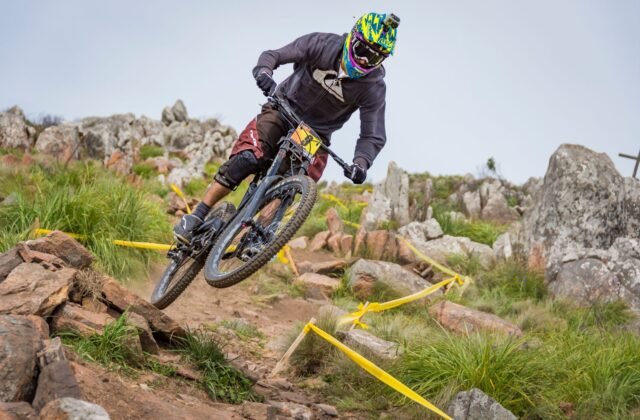
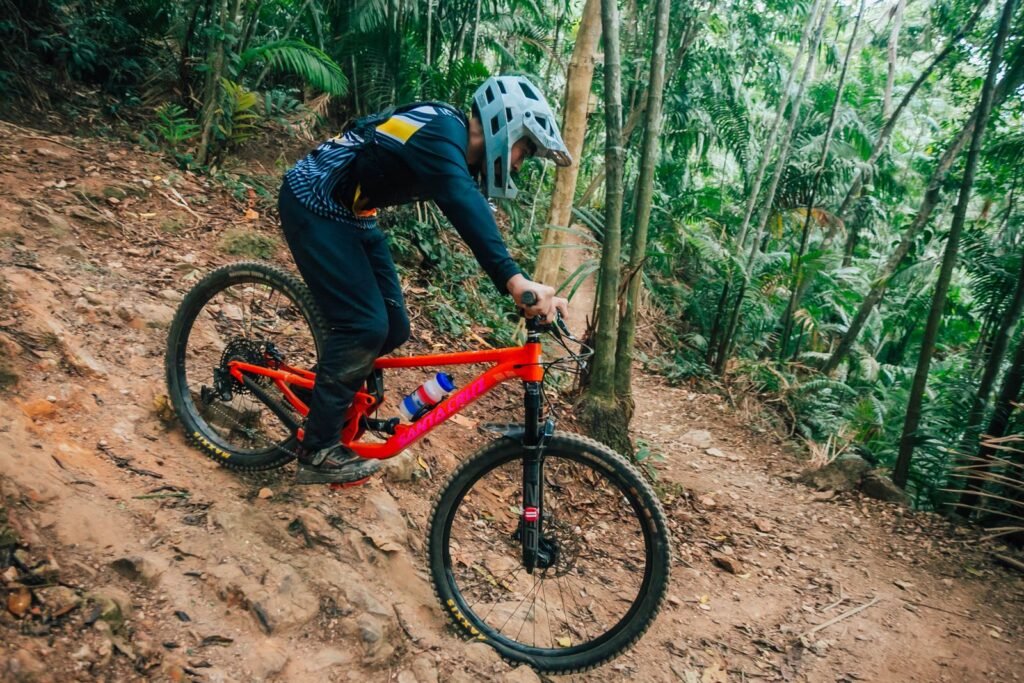
Straight answer: On steep descents, the trail mountain bike wins for most riders. Its gears, suspension and brakes keep the front wheel planted and give you room to move behind the saddle. A single speed can descend well, but it asks far more of your legs, line choice and nerve.
That gap is about control, not speed.
A trail mountain bike is built for rolling, mixed terrain, with wide gears, front and rear suspension and a dropper post. A single speed has one gear, no derailleur and no shifter. You stand, coast or walk.
Steep descents test control, not speed. The front wheel must stay planted, brakes must work in short pulls, and you must shift weight back. That is where gears, suspension and tyres matter.
For the wider family of trail bikes, see the Mountain Bikes hub. If your steep ground is rough and fast, also read Trail Mountain Bike vs Downhill Mountain Bike before you choose.
Trail Mountain Bike vs Single Speed Mountain Bike on Steep Descents: The Core Comparison
Most trail bikes have 120 to 160 mm of suspension, a wide cassette, hydraulic disc brakes and a dropper post. A single speed keeps one gear and, in most builds, a rigid or short-travel fork.
| Attribute | Trail Mountain Bike | Single Speed Mountain Bike | What to watch |
|---|---|---|---|
| Gearing | Wide range; shift down for slow rolls, up for fast ones | One gear; too high for slow climbs, too low for fast descents | Pick a gear you can restart on a steep pitch |
| Suspension | 120 to 160 mm of travel soaks up rocks | Little or no travel; your arms are the suspension | Rough rock gardens favour more travel |
| Braking control | Hydraulic disc brakes, larger rotors, one-finger control | Disc or rim brakes; control is limited by traction | Test braking on a loose surface first |
| Climbing back up | Low gears keep you pedalling after the descent | Standing starts are hard; many riders walk | A descent with a climb out punishes a single gear |
| Weight | Heavier, with suspension, gears and a dropper post | Lighter and easier to lift over obstacles | Weight matters less than grip once you are moving downhill |
| Tyres and grip | Wide, knobbly tyres and lower pressure spread the load | Often narrower tyres; grip depends more on line choice | Check your mountain bike air pressure before a steep run |
| Maintenance | More parts to adjust and clean after a ride | Very little to go wrong; a chain and brakes are the main jobs | A bent derailleur ends a geared ride fast |
| Best for | Long, rough, steep descents and mixed trails | Short, smooth descents and riders who value simplicity | Match the bike to your longest descent, not your shortest |
When the Answer Changes
Trail bikes win most steep descents, but the answer flips in a few clear cases: gradient, surface, length, fitness and the climb afterwards.
- Short and smooth: On a short, firm fire road, a single speed is fast and calm.
- Very rocky or rooty: The trail bike pulls further ahead. Suspension keeps the tyre in contact.
- Long and tiring: A long descent with a climb out favours gears.
- Wet or loose: Grip is the limit, not power. Wider tyres and lower pressure give the trail bike more margin. See Trail Mountain Bike vs Downhill Mountain Bike.
- Your gear ratio: Set low, it spins out fast. Set high, it is hard to start.
Test Before You Choose: A Short, Steep Descent Test
Do not buy on a spec sheet. Run the same short test on both bikes, on the same slope, in the same conditions. Two runs each — smooth ground first, then rough — tell you more than any list of parts.
- Pick a short, safe slope: Choose a slope you can walk back up, with a clear run-out. Dry, firm ground first.
- Set up both bikes: Check brakes, tyres and chain. Lower the saddle, or use the dropper. Set the same mountain bike air pressure on both.
- Ride it slowly first: Roll down at walking pace, both brakes covered, heels down and weight back.
- Ride it at trail speed: Repeat at normal speed, with one short, firm brake pull before each corner.
- Climb back up: Ride back up. If you walk the single speed up while you pedal the trail bike up, that climb is part of your answer.
What a fail looks like
- Front wheel locks and skids → Too much front brake, or too little weight on the front tyre. Fix: Brake earlier and more lightly, hips back.
- Legs spin out with no speed → The single gear is too low. Fix: Coast with feet level, or choose a higher gear ratio.
- Arms and hands tire fast → Little or no suspension, or a stiff tyre. Fix: Lower pressure slightly and take a shorter run.
- You walk the climb out → The gear is too high to start again. Fix: Plan rides with a rideable climb out.
Myth vs Fact
Myth: A single speed is always safer downhill because there is less to go wrong.
Fact: Fewer parts do not mean more control. A trail bike gives you more ways to slow down safely.
Myth: A lighter bike is always better on a steep descent.
Fact: A lighter bike is easier to lift, but grip and braking decide a descent.
Before you test
Wear a helmet, gloves and closed shoes. Check both brakes, and walk the slope first if you have not ridden it. Stop if the brakes fade.
How to Ride a Steep Descent on Each Bike
This is the method to use once you have chosen a bike. The steps are the same for both bikes. The difference is how much the bike helps you.
What you will need
- A helmet, gloves and closed shoes
- A trail you know, with a clear run-out
- A pump and a way to check mountain bike air pressure
- Water and a phone
- A friend to ride with
The method
- Drop the saddle: Use the dropper on the trail bike; lower it on a single speed.
- Set your position: Stand heels down, knees soft, elbows out. Weight back as it steepens.
- Cover both brakes: Keep a finger on each lever. Brake in short pulls before a corner.
- Look ahead: Look to the exit of the rough section, not at the rock in front of your wheel.
- Pick a smooth line: Choose the line with the fewest loose rocks.
- Check and repeat: After the run, check brake feel and tyre pressure. If the front wheel skipped, slow down earlier.
Note: A dropper post changes a steep descent more than any other single part. If your trail bike has one, use it every time. If it does not, lower the saddle by hand before the run, and raise it again for the climb out.
Warning: Do not drag both brakes for the whole descent. Long, steady braking heats the brakes and fades them, which leaves you with less stopping power at the steepest point. Brake hard and short, then let the brakes cool between pulls.
When the Damage Is Already Done
If you already bought the wrong bike for your steepest trail, you do not have to start again. Most of the gap can be closed with a few changes.
- Bought a single speed and the descents are too fast: Fit the widest tyres that fit, lower the pressure, and use a lower gear ratio.
- Bought a trail bike that feels heavy: Keep the suspension working, not locked out, and lower the saddle on descents.
- Regret after one bad descent: Do not judge the bike on a slope you would not ride twice.
- Money is already spent: If neither bike fits your longest descent, sell or swap the bike that fits your rides least.
Choosing a Single Speed as a Safe Alternative
A single speed is a good alternative when your trails are short, smooth and close to home, and you want the simplest bike you can own.
- Pick the right gear: Choose a gear you can start from a standstill on a steep pitch.
- Fit wide tyres: Wide, knobbly tyres and a firm grip matter more on a single speed.
- Learn to coast: Stand with feet level, heels down and weight back. Brake before the rough part, not in it.
- Plan the climb out: Choose loops with a rideable climb, or accept a short walk.
- Keep it simple: Clean the chain, check the brakes and ride.
For a closer look at how suspension changes steep ground, see Hardtail Mountain Bike vs Full Suspension Mountain Bike.
What to Do Next, in Order
- Ride your longest descent on foot: Walk it first. Note the roughest patch and the climb out.
- Test both bikes on the same slope: Use the test above, slow first and then at trail speed.
- Check the climb out: If you walk the single speed up while you pedal the trail bike up, that is your answer.
- Set tyre pressure and saddle: Set pressure from the mountain bike air pressure guide, and lower the saddle on steep runs.
- Choose for your longest descent: Pick the bike that fits the longest, roughest descent you ride often.
Never Do This
- Never drag both brakes down a whole descent: The brakes fade, and you lose stopping power.
- Never ride a new steep slope at full speed first: Walk it, then ride it slowly.
- Never descend with a saddle that traps you: If you cannot move behind the saddle, lower it.
- Never pick a single speed by its flat-ground gear: A gear that feels fast on flat ground may leave you walking.
- Never test in the wet first: Pass the dry test first, then add wet ground in small steps.
- Never ride a steep descent alone without a plan: Tell someone where you are, and carry a phone.

In short
On steep descents, a trail bike is the better choice for most riders: gears, suspension and brakes keep you in control on rough, long slopes. A single speed can be right on short, smooth descents.
The essentials
- Trail bike: wide gears, 120 to 160 mm of suspension, hydraulic disc brakes and a dropper post
- Single speed: one gear, lighter, simpler, with little or no suspension
- Steep ground rewards control and grip, not just speed
- Test both bikes on the same slope before you buy
- Choose for your longest descent, not your shortest
More Questions, Answered
Is a single speed mountain bike good for steep descents?
It can be good on short, smooth descents. It is a poor choice for long, rough descents.
Do I need suspension for steep descents?
Not for a short, smooth slope, but suspension helps on rough ground. It keeps the tyre in contact.
What gear should a single speed use for steep descents?
Choose a gear you can start from a standstill on a steep pitch.
Is a trail mountain bike heavier than a single speed?
Yes, usually. A trail bike carries suspension, gears and a dropper post. Weight matters less than grip.
Additional Details
Name: Trail Mountain Bike vs Single Speed Mountain Bike: Which Is Better for Steep descents?
Description: Trail mountain bike vs single speed mountain bike on steep descents: compare gears, suspension, braking and control, then test both on your own slope.
Published: November 10, 2026