Short answer: Choose frame size from your inseam and reach, not just your height, and choose material from your riding style and budget. For most riders, an aluminium frame in the correct size beats a carbon frame in the wrong size every time.
Introduction
Frame size decides how a bike feels in the first five minutes. Too large, and you stretch for the bars and feel unsteady at stops. Too small, and your knees crowd the bars and your back complains on longer rides.
Material changes weight, comfort, durability and price, but it cannot rescue a poor fit. This bike frame size and material guide keeps both decisions in the right order: size first, material second.
You will find height and inseam tables, a clear material comparison, a short measuring routine and a test-ride checklist. Use them before you buy, not after.

Frame size at a glance
Road frames are usually measured in centimetres, mountain bike frames in inches, and hybrid frames in either unit. Always check the maker’s chart, because one brand’s 54 cm can feel like another brand’s 56 cm.
| Rider height | Road frame | Hybrid frame | Mountain bike |
|---|---|---|---|
| 152–163 cm (5 ft 0 in–5 ft 4 in) | 48–50 cm | 15–16 in | 14–16 in |
| 163–173 cm (5 ft 4 in–5 ft 8 in) | 51–54 cm | 17–18 in | 17–18 in |
| 173–183 cm (5 ft 8 in–6 ft 0 in) | 55–57 cm | 19–20 in | 19–20 in |
| 183–193 cm (6 ft 0 in–6 ft 4 in) | 58–61 cm | 21–22 in | 21–22 in |
Height alone is only a starting point. Two riders at 178 cm can need different sizes if one has longer legs and a shorter torso. That is why inseam and reach matter more than a single height number.
Standover clearance: the safety check
Stand over the top tube in flat shoes. You need room to stop safely without the tube pressing into you.
| Bike type | Minimum clearance | Why it matters |
|---|---|---|
| Road bike | 2.5–5 cm (1–2 in) | Safe stops on tarmac |
| Hybrid or city bike | 5 cm (2 in) or more | Easy, frequent stops in traffic |
| Mountain bike | 7.5–10 cm (3–4 in) | Room to move on rough ground |
Safety first: If you cannot get both feet flat on the ground while standing over the frame, the frame is too large for safe everyday use, however good the price looks.
Frame materials compared
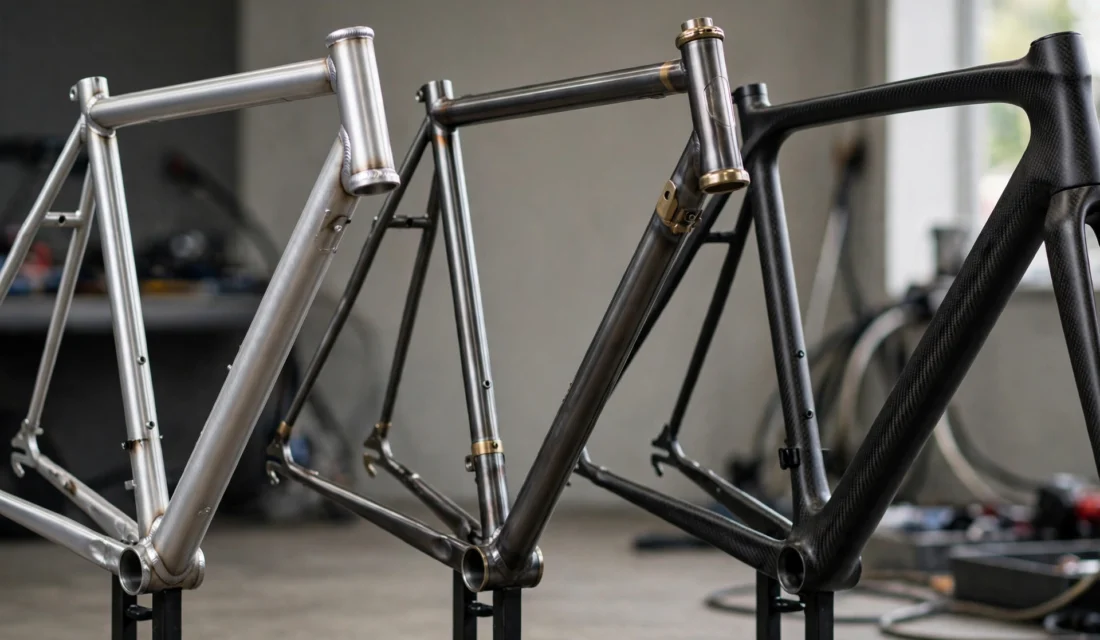
No material is best for everyone. Carbon is lightest, steel is famously comfortable, titanium lasts for decades, and aluminium gives most riders the best value. Judge each one against your weight, roads, budget and how long you plan to keep the bike.
| Material | Typical frame weight | Ride feel | Durability | Best for |
|---|---|---|---|---|
| Aluminium | 1.4–1.9 kg | Firm and lively | Strong, rust-resistant | Commuters and first good bikes |
| Carbon fibre | 0.8–1.2 kg | Smooth and stiff where it counts | Strong, but check crash damage | Racing and long, fast rides |
| Steel | 2.0–2.8 kg | Comfortable and forgiving | Very repairable, can rust if neglected | Touring and everyday comfort |
| Titanium | 1.3–1.7 kg | Smooth, lively, refined | Excellent corrosion resistance | A long-term, premium purchase |
- Aluminium: The sensible default. Modern hydroformed tubes and wider tyres have softened the old harsh ride, and replacement parts are easy to find.
- Carbon fibre: The lightest choice and the easiest to tune for stiffness in one place and comfort in another. It costs more, and a hard crash should always be inspected by a professional.
- Steel: Heavier, but many riders love its calm ride on rough roads. It suits loaded touring, where a small weight penalty matters less than comfort and repairability.
- Titanium: Combines low weight with a smooth ride and no rust worries. Prices are high, so buy it when you are sure of your size and riding style.

Price guide, in plain terms: Expect aluminium complete bikes to start lowest, steel in the middle for good frames, carbon higher, and titanium highest. A better groupset, wheels and fit on an aluminium bike often beat a basic carbon bike with poor parts.
Also check tyre clearance. A frame that accepts 32 mm or wider tyres gives you more comfort and grip than a narrow race frame, especially on rough roads, gravel and wet streets.

Osluken Bike Repair Stand, 176 LBS Heavy Duty Portable Bicycle Mechanic Maintenance Workstand with Tool Tray
Hold the bike steady while you measure and check frame fit.
What you will need
| Item | What it is for |
|---|---|
| Tape measure | Inseam, reach and saddle height |
| Hardback book or spirit level | A level inseam measurement |
| Flat shoes and cycling shorts | A realistic riding position |
| A helper or a wall | Steady balance while measuring |
| The maker’s size chart | The final check before ordering |
Measure your fit, step by step
1. Measure your inseam
Stand barefoot against a wall, feet about 15 cm apart. Place a hardback book firmly against your crotch, level with the floor, and mark the wall at the top of the book. Measure from the floor to that mark. Repeat twice and use the average.
For a road bike, multiply inseam in centimetres by 0.67 as a rough frame-size guide. For example, an 84 cm inseam gives about 56 cm. Use this only as a starting size, then confirm it with reach and a test ride.
2. Check reach, not just height
Reach is how far you stretch to the bars. Sit on the bike with your hands on the hoods or grips. Your elbows should have a slight bend, your shoulders should feel relaxed, and you should see the front hub roughly behind the bars.
If you feel stretched, a shorter stem or a smaller frame may help. If you feel cramped, a longer stem or a larger frame may help. Small changes matter: a 10 mm stem change can transform comfort.
3. Set saddle height as a starting point
With the heel on the pedal at the bottom of the stroke, your leg should be straight without rocking your hips. Then, with the ball of your foot on the pedal, you should have a slight knee bend of about 25 to 35 degrees.
For a detailed saddle routine, see our step-by-step saddle guide linked at the end of this article. Saddle height is easy to change, but frame size is not, so never buy a wrong frame hoping the saddle will fix it.
4. Test ride with a checklist, not a feeling alone
Ride for at least 15 minutes, on a route with a hill, a turn and a stop. Short car-park loops hide back pain, hand numbness and a stretched reach. Take the same route for every bike you compare.
During the ride, check five things: can you stop and put a foot down calmly, do your knees track straight, are your hands relaxed, is your neck comfortable, and can you look over your shoulder without wobbling? A no on two or more points usually means the wrong size.
5. Decide on material last
Once two or three sizes feel right, this bike frame size and material guide suggests comparing materials on the same type of ride. Ask how much the complete bike weighs, what tyre width it accepts, whether the frame has rack and mudguard mounts, and what the warranty covers.
For commuting, mounts and durability often beat a 300 g weight saving. For racing, stiffness and aerodynamics matter more. For touring, comfort, tyre clearance and repairability matter most of all.
6. Check the small numbers before you pay
- Stack and reach: Stack is vertical height to the bars, reach is horizontal distance. Compare these, not just the labelled size.
- Standover height: Confirm the clearance table above, in your normal shoes.
- Top-tube length: A long top tube suits long arms; a short one suits a shorter torso.
- Seatpost exposed: Very little exposed post can mean the frame is too large; a huge amount can mean it is too small.
- Crank length: Common lengths are 165 mm, 170 mm, 172.5 mm and 175 mm. Shorter cranks often suit shorter riders.

CXWXC Bike Workstand with Adjustable, Bicycle Repair Stand for Maintenance Folding and Lightweight (Champagne-3)
A folding stand for home checks, cleaning and small adjustments.
Quick fit checklist
| Check | Pass mark |
|---|---|
| Standover clearance | Meets the table for your bike type |
| Saddle height | Slight knee bend, no hip rocking |
| Reach | Slight elbow bend, relaxed shoulders |
| Braking and stopping | Confident stop and foot down, every time |
| 15-minute ride | No numb hands, sore neck or knee pain |
Common mistakes to avoid
- Buying by height alone: Height charts are a start, but inseam and reach decide comfort.
- Choosing a frame to grow into: A bike that is too large now is unsafe now, not a bargain for later.
- Paying for carbon before fit: Material is wasted money if the bars are too far away.
- Ignoring tyre clearance: Narrow clearance limits comfort, grip and winter riding.
- Skipping the test ride: Numbers help, but only a ride shows how the bike really feels.
- Forgetting the warranty: Ask what crash, manufacturing and frame damage cover, and for how many years.
Frequently asked questions
What frame size do I need if I am between sizes?
Try both sizes. Many riders prefer the smaller size for agility and a shorter reach, while taller or longer-torso riders may prefer the larger size. A stem change of 10 to 20 mm can fine-tune either choice. That is the approach this bike frame size and material guide recommends.
Is carbon always better than aluminium?
No. Carbon is lighter and can be tuned for comfort and stiffness, but a well-made aluminium bike in the right size is often more practical, cheaper to replace and easier to live with.
Does frame weight matter for commuting?
Only a little. For a 5 km commute, reliability, mudguard mounts, tyre clearance and a comfortable position matter far more than saving 500 g on the frame.
Can a bike shop adjust a slightly wrong size?
Yes, within limits. Stem length, saddle position, handlebar width and crank length can fine-tune fit. They cannot safely turn a clearly large frame into a small one, or the reverse.
Is steel too heavy for modern riding?
Not for most riders. A steel frame may add 0.5 to 1.5 kg over aluminium, but its comfort and durability make it a strong choice for touring, commuting and relaxed road riding.
How do I know if a used carbon frame is safe?
Look for cracks, deep scratches, creaking and any crash history. If you are unsure, ask a professional mechanic to inspect it before you pay, because hidden damage is hard to judge from photos alone.
Related guides
Explore the Parts, Maintenance and Fixing Hub and browse more posts in the Frame category. For the next fit step, read How to Adjust Bike Saddle Height and Position, Step by Step, and for roadside safety see How to Fix a Flat Tyre on the Road. For home measuring and repairs, see The Hidden Gems of Electric Bike Work Stands.