

Straight answer: For most beginners, a folding e-bike is better. It is lighter to lift, easier to store, and simpler to take on a train or into a flat, the three things new riders struggle with most. A fat tyre e-bike is better only if your daily route is mostly loose, soft, or unpaved ground, where its wide tyres grip and keep you steady. Paved streets: choose the folding e-bike. Rough ground: choose the fat tyre e-bike.
In this folding e-bike vs fat tyre e-bike comparison, the gap is smaller than the names suggest. Many folding e-bikes already have fat tyres. You are really choosing size and weight: a small, light bike you can carry, or a bigger, heavier bike that floats over rough ground.
Both types need the same pre-ride checks: tyres at the printed pressure, brakes that stop both wheels, and a battery charged indoors. Do those before every ride, and either bike will look after a beginner. For the full set of beginner guides, start at our E-Bikes Hub.
Introduction
Beginners are really asking which bike is easier to live with. A folding e-bike is built to shrink: the frame hinges, the handlebars drop, and the whole bike fits under a desk, in a car boot, or in a hallway. A fat tyre e-bike is built to grip: wide tyres, usually about 4 inches across, spread your weight over soft ground.
Your first e-bike should make riding feel easy, not add chores. If you have to wrestle your bike up the stairs every night, or find nowhere to keep it, you will ride less. If your route is gravel, grass, or a rutted lane, a bike that slips will put you off just as fast.
If you mostly ride to work or the shops on paved roads, see our comparison of the commuter e-bike vs the folding e-bike, and if winter is your concern, the folding e-bike vs step-through e-bike guide. The rest of this guide keeps it simple: what each bike does well, where each one trips up a beginner, and how to test both before you spend anything.
Folding E-Bike vs Fat Tyre E-Bike: The Comparison
It comes down to your route and your storage.
| Attribute | Folding E-Bike | Fat Tyre E-Bike | What to watch |
|---|---|---|---|
| Weight and lifting | Lighter, smaller folded | Heavier, bulkier to lift | Lift it before you buy |
| Storage and carrying | Folds for a flat, a boot, a train | Full-size; needs a shed | Measure first |
| Balance at low speed | Small wheels feel twitchy | Wide tyres feel steady | Test slow turns, not speed |
| Grip on loose ground | Narrower tyres slip on gravel | Wide tyres grip gravel and mud | Judge by your worst surface |
| Comfort on rough ground | Bumps reach you more | Wide tyres soak up bumps | Ask your back |
| Range per charge | Lighter bike, less help | Wide tyres, more help | Check range first |
| Maintenance | Folding joints need checks | Wide tyres cost more to replace | Check spares first |
| Best first rider | Flat, train, and road riders | Rough-track and trail riders | Match bike to route |
When the Answer Changes
These flip the verdict.
- Your route is mostly loose ground. If the first mile is gravel or a rutted track, the fat tyre wins, even if the rest is paved.
- You carry it daily. If you lift the bike onto a train or up stairs every day, weight matters more than grip.
- You have nowhere to keep a full-size bike. A folded bike fits in a hallway or under a desk; a fat tyre bike needs a shed.
- You are tall or carry a heavy load. A bigger frame and wider tyres can feel more stable, so test a fat tyre bike first.
- Your budget is tight. A fat tyre bike’s wide tyres cost more to replace, so check spares first.
Test the Two Types Before You Buy
Run this test on both types.
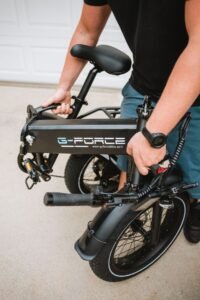
- Fold the bike and unfold it again, without help. Note how long it takes and if the catches feel secure.
- Lift the folded bike onto a step and into a car boot. A struggle now means worse every day.
- Ride your normal route gently. Note where the wheels slip: corners, gravel, wet leaves.
- On a quiet, flat stretch, brake gently, rear first, then front. Repeat until it feels natural.
- Ride slowly in a straight line, then turn in a tight circle. Note how steady it feels at walking pace.
- Ride the same route with a full battery and watch the charge at the end.
What a fail looks like
| Symptom | Cause | Fix |
|---|---|---|
| Twitchy at low speed | Small wheels, quick steering | Keep your speed low and look ahead |
| Wheel slides on gravel | Too much speed | Slow down; try the low end of the printed range |
| Folding catch will not lock | Catch dirty or not closed | Clean it and close it firmly |
| Battery drops fast | Heavy bike, high assist | Use the lowest assist |
Myth: Fat tyres make any bike safe for a beginner.
Fact: Wide tyres help on soft ground, but they do not fix bad brakes, a bike that is too big, or too much speed on a corner. Balance and braking matter more than tyre width.
Before you test: Wear a helmet, fit lights, and choose a quiet street. Keep your speed low, both hands on the bars, and the lowest assist until the bike feels familiar.

48V 20.8Ah battery, 30+ MPH, up to 80 miles of range.
The Beginner-Friendly Way to Choose
What you will need
- A tape measure and your storage space
- A tyre pressure gauge and pump
- Your normal route, walked first
- A helmet and lights, front and rear
- The manual for the catches and battery
The method
- Walk your route first. Note the surfaces: tarmac, gravel, or mud.
- Measure your storage space, car boot, and train space.
- Fold the e-bike. Time it, lift it, carry it up a step.
- Check the tyres: read the pressure on the sidewall and set it with a gauge.
- Ride the folding e-bike on your route. Note the weight, steering, and grip.
- Ride the fat tyre e-bike on the same route. Note the comfort, grip, and effort.
- Check the battery: charge it indoors and note the range.
- Sleep on it, then choose the easier bike to live with.
Keep it simple: If a bike is hard to lift, hard to fold, or hard to store on day one, it will still be hard on day one hundred. Choose the easy one.
Warning: Never ride a folding e-bike with a catch that is not fully locked. Never set a tyre below the minimum pressure printed on the sidewall.

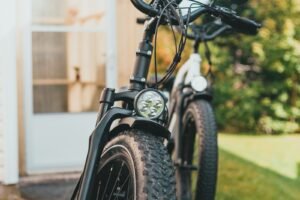
Up to 25 MPH and 60+ miles, with a 48V 13Ah battery and 26-inch fat tyres.
When the Damage Is Already Done
Bought the wrong type? Work down this list.
- Folding e-bike, loose route. Fit the widest tyres your frame allows, use the low end of the printed pressure range, and walk the worst stretches.
- Fat tyre e-bike, paved route. Raise the pressure to the high end, use the lowest assist, and expect the tyres to wear faster.
- Too heavy to carry. Take the battery off before you lift it, and use a ramp or a second pair of hands for stairs.
- Nowhere to store it. A folding e-bike goes under a desk or in a hallway; a fat tyre bike may need a shed.
- Range is shorter than expected. Store the battery indoors, charge it indoors, and plan shorter trips until you know its true range on your route. See our guide to making your e-bike battery last longer.

A fat-tyre commuter e-bike with a removable battery for daily rides.
The Safe Alternative: Start with the Other Type
Do not force the wrong bike to do a job it cannot do. If one type slips or will not fit, the other is the fix.
- Check the other bike first: tyres, brakes, lights, and battery.
- Ride your shortest, quietest route first.
- Practise folding and locking the catches.
- Practise lifting it onto a step or into a car boot first.
- Ride your full route on a dry day before you trust it wet.
- When neither bike is safe, on ice or in a storm, walk or take the bus.
Still choosing? Compare the folding e-bike with a step-through e-bike, a commuter e-bike, and the fat tyre e-bikes in our Sondors fat tire e-bike round-up.
What to Do Next, in Order
- Walk your route; note surfaces and storage.
- Run the six-step test on both types.
- Fold, lift, and store each bike first.
- Set the tyres and brakes; charge the battery indoors.
- Loose ground? Try a fat tyre bike first.
- Recheck brakes and tyres in a week.
Never Do These Things
- Never ride with a folding catch unlocked.
- Never set a tyre below the printed minimum. Low pressure can pinch it.
- Never brake hard on a loose corner. Slow down first.
- Never leave the battery out in the cold. Cold cuts range.
- Never ignore a new noise or wobble. Check the wheels and brakes first.
In short
For most beginners on paved streets, the folding e-bike is better: lighter, easier to carry, and simpler to store. The fat tyre e-bike wins only on loose or rough ground. Test both and pick the easier one.
The essentials
- Folding e-bike for flats, trains, and paved roads; fat tyre e-bike for rough.
- Lift, fold, and store each bike before you buy.
- Wide tyres help on soft ground, but not bad brakes or speed.
- Set tyre pressure to the printed range.
- Wrong bike? Change tyres, pressure, and route first.
More Questions, Answered
Which is better for beginners, a folding e-bike or a fat tyre e-bike?
A folding e-bike, for most beginners. It is lighter, easier to store, and simpler to carry. A fat tyre e-bike wins only on loose or unpaved ground.
Are fat tyre e-bikes good for beginners?
Yes, if your route is rough. The wide tyres feel steady and grip loose ground. On paved roads they are heavier, slower, and cost more.
Are folding e-bikes hard to ride?
They can feel twitchy at first because the wheels are smaller. Most riders adjust in a few short rides.
Can I take a folding e-bike on a train?
Usually, yes, when it is folded and in a bag or covered. Check your train company’s rules first.
Do fat tyre e-bikes use more battery?
Yes, a little. Wide tyres and a heavier bike need more help, so range is shorter than on a lighter bike.
Additional Details
Name: Folding E-Bike vs Fat Tyre E-Bike: Which Is Better for Beginners?
Description: Folding e-bike vs fat tyre e-bike: which is better for beginners? Compare weight, stability, storage and cost, then test both on your own street before you buy.
Published: November 9, 2026


