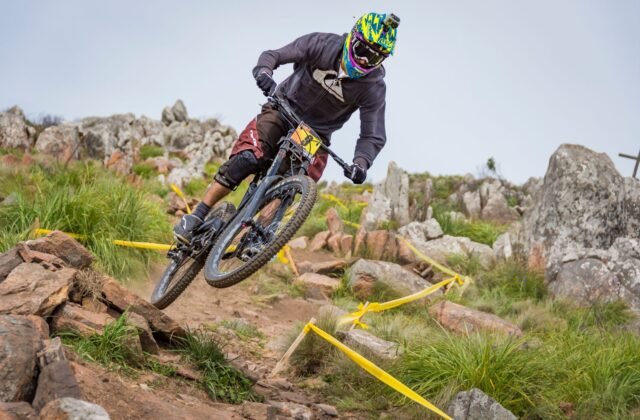
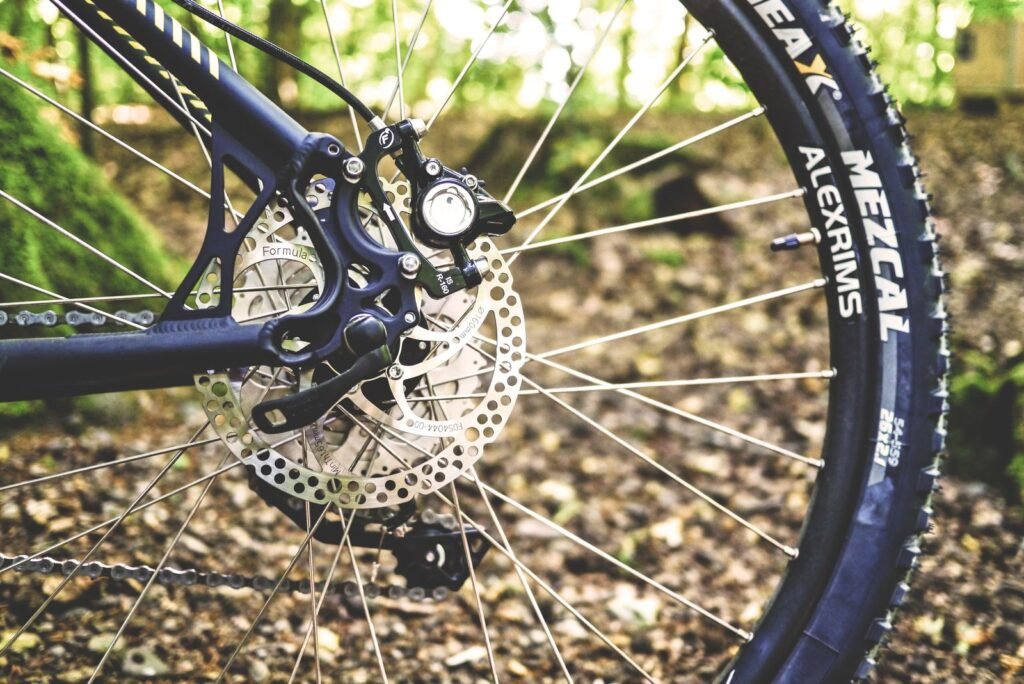
Straight answer: In wet weather, the full-suspension mountain bike is usually the better choice on rough, muddy trails. Its rear suspension keeps the rear wheel on the ground over wet roots and ruts, so you keep grip and control where a cross country bike skips and slides. On smooth, wet fire roads and climbs, the cross country mountain bike is the better choice — it is lighter, stiffer and more efficient, and its rigid rear puts your power straight into the trail.
Full suspension mountain bike vs cross country mountain bike: on a dry trail the two look similar. Add rain, mud and wet roots, and they behave very differently. The question is not which bike is faster in general, but which one keeps grip and control when the trail turns slippery. This comparison answers that question for wet weather only.
The two bikes are built for different jobs. A full-suspension bike has a fork and a rear shock, so both wheels can follow rough ground. A cross-country (XC) bike is built light and efficient, usually with a short-travel fork and no rear shock, so it climbs fast and covers distance with less effort. In the wet, that suspension difference decides how much grip each wheel finds.
Both bikes sit in our Mountain Bikes Hub. The comparison below, and the 20-minute wet-trail test further down, will show which side suits your trails — and what to change if you already bought the wrong one.
Full Suspension Mountain Bike vs Cross Country Mountain Bike in Wet Weather: The Core Comparison
The table compares the two on what decides a wet ride. Read the last column first: it says what to check on your own trails before you buy.
| Attribute | Full Suspension Mountain Bike | Cross Country Mountain Bike | What to watch |
|---|---|---|---|
| What it is | Fork and rear shock; both wheels move with the trail | Light, efficient bike built for distance and climbing; short-travel fork, often no rear shock | Check the rear: a shock means full suspension |
| Grip on wet roots | Rear wheel stays on the ground and holds its line | Rear wheel skips over roots and loses contact | Watch the rear wheel on your wettest section |
| Grip in mud | Suspension keeps the tyre pressed into the mud for traction | Lighter bike cuts through mud, but the rear can spin on climbs | Tyre tread matters more than suspension in deep mud |
| Climbing in the wet | Rear shock can bob and waste power on smooth climbs | Direct power and less weight make steep, wet climbs easier | Lock out the rear shock on smooth climbs |
| Descending in the wet | More planted and forgiving on rough, wet descents | Faster on smooth wet trails, nervous on rough ones | Speed follows grip, not bravery |
| Braking in the wet | Stable under braking because both wheels stay in contact | Rear wheel can lock and slide when it unloads over bumps | Test the brakes before every wet ride |
When the Answer Changes
These four things flip the verdict.
- Smooth wet fire road or rough muddy singletrack. On a smooth, wet fire road the cross-country bike is faster and cheaper; add mud, roots and ruts and the full-suspension bike takes over.
- The overlap: a cross-country bike with more travel. Some XC bikes now have longer-travel forks and a little rear suspension, which closes the comfort gap on rough, wet ground.
- Tyres beat frames. A cross-country bike on mud tyres will out-grip a full-suspension bike on dry-weather tyres in the wet, so check the tread and the pressure first.
- Rain intensity and trail type. In light rain on firm trails the XC bike loses little; in heavy rain on soft, rutted trails the full-suspension bike’s extra grip matters most.
Test Both Bikes on a Wet Trail: A 20-Minute Decision Ride
Ride the same wet loop on both bikes, back to back, and let the trail decide. It takes about 20 minutes, and it tells you more than any specification list.
- Pick your wettest loop: a short trail with one muddy climb and one wet descent.
- Set the tyre pressure the same on both bikes, and match the saddle height.
- Ride the loop on the full-suspension bike first. Note where the rear wheel stays planted.
- Swap to the cross-country bike and ride the same loop at the same effort. On the muddiest climb, note whether the rear wheel spins.
- Keep the bike that was faster on your wettest section and more confident on the descent.
What a fail looks like
| Symptom | Cause | Fix |
|---|---|---|
| Rear wheel spins on a wet climb | Too high a gear or worn tread | Shift down before the climb; fit mud tyres |
| Rear wheel skips over wet roots | Rigid rear and high tyre pressure | Drop the pressure a little; let the rear shock absorb the roots |
Myth: A full-suspension bike is always better in the wet.
Fact: On smooth, wet ground a cross-country bike is lighter and just as fast; the full-suspension advantage shows on rough, muddy trails.
Myth: A cross-country bike cannot handle mud.
Fact: With mud tyres and lower pressure a cross-country bike grips well; it loses ground on rough, wet descents.
Before you test: Wear a helmet, pump the tyres to the pressure on the sidewall, and test the brakes before you roll.

How to Set Up Either Bike for Wet Weather
Either bike rides far better in the wet with a basic setup. Do this before your first wet ride.
What you will need
- A floor pump with a pressure gauge
- Mud or wet-weather tyres with open tread
- A multi-tool with Allen keys
- Chain lube made for wet conditions
The method
- Fit wet-weather tyres with open tread, and check that they clear the frame.
- Set the tyre pressure a little lower than your dry setting for more grip, but never below the minimum printed on the sidewall.
- Set the saddle height so your leg is almost straight at the bottom of the pedal stroke.
- On a full-suspension bike, set the rear shock sag and lock it out on smooth climbs.
- Lube the chain with wet lube, wipe off the excess, and check the brakes.
- Ride your wet test loop, changing one thing at a time until the bike feels right.
A note about pressure. Lower pressure gives a bigger tyre contact patch and more grip in the wet, but too little lets the tyre squirm and risks a pinch flat.
Warning: never ride a wet descent with brakes you have not tested. Do a short roll on flat ground first; if the brakes feel weak or grabby, stop and check them.
When the Damage Is Already Done
Bought the wrong bike for wet weather? Each of these has a fix. Start with the tyres, not a new bike.
- I bought a full-suspension bike, but my trails are mostly smooth and wet. Lock out the rear shock on climbs and run the tyres at the top of their pressure range.
- I bought a cross-country bike, but my trails turn to mud. Fit wider mud tyres at lower pressure and stand on rough ground. If the rear wheel still skips on every root, a full-suspension frame is the next step, not a new tyre.
- My brakes are weak after wet rides. Clean the rotor or rim, check the pads for glazing, and replace pads worn thin. For the brake check, see our disc brake vs rim brake after rain guide.
- My drivetrain grinds after every wet ride. Wash the bike after muddy rides, dry the chain, and re-lube with wet lube.

The Safe Alternative: Start with a Cross Country Mountain Bike
If you are not sure your trails are wet and rough enough for a full-suspension bike, a cross-country bike is the safe first move. It is lighter, cheaper to keep, and easier to sell on if you change your mind. See also our hardtail vs cross-country and full suspension vs trail comparisons.
- Work out your wettest trail: how muddy is the roughest section you ride every week?
- Buy the cross-country bike with the best tyres and brakes your budget allows.
- Fit mud tyres, set the pressure, and ride it for a month on your real trails.
- If wet descents still beat you up, add wider tyres and lower the pressure first.
- If that is not enough, you now know from riding, not guessing, that your next bike is a full-suspension one.
What to Do Next, in Order
- List the trails you ride most, and name the wettest section on each.
- Do the 20-minute wet-trail test on that section, on both bikes.
- Compare grip, control and braking in mud.
- Set up the winner with mud tyres and wet lube before your next rainy ride.
- Pick by your wettest trail first and your budget second.
Never Do This in Wet Weather
- Never ride a wet trail on worn, shiny tyres. Worn tread cannot grip wet roots or mud.
- Never brake hard on wet wooden bridges or painted surfaces. They are slicker than the trail, and a locked wheel slides instead of stopping.
- Never ride through standing water you cannot see through. It can hide a hole or a sharp rock that will stop the wheel dead.
- Never put the bike away muddy. Dried mud grinds the drivetrain.
- Never skip the test roll. A short roll on flat ground shows whether the brakes work before the first descent.
In short
In short, a full-suspension mountain bike is usually the better wet-weather bike on rough, muddy trails: its rear suspension keeps the rear wheel in contact with the ground, so you keep grip where a cross-country bike skips. On smooth, wet fire roads and climbs, the cross-country bike is the better choice — lighter, stiffer and more efficient. Mud tyres and pressure matter more than the frame, so test both before you decide.
The essentials
- Full suspension has a fork and a rear shock; a cross-country bike is built light and efficient for distance and climbing.
- The cross-country bike wins on smooth wet ground and climbs; the full-suspension bike wins on rough, muddy trails.
- In mud, tyres and pressure matter more than the frame.
- Test both on your wettest trail, and test the brakes before every wet ride.
More Questions, Answered
Is a full-suspension mountain bike better than a cross-country bike in the rain?
Usually, on rough trails: the rear shock keeps the tyre in contact through mud and over wet roots, so you keep grip and braking. On smooth, wet ground the cross-country bike is just as fast and lighter.
Can a cross-country bike have rear suspension?
Yes. Cross-country describes the riding style, not the suspension: some XC bikes have a little rear suspension, and full-suspension bikes can be built for XC racing.
What tyre pressure should I use in wet weather?
A little lower than your dry setting, so the tyre grips more of the trail. Stay inside the range on the sidewall.
Additional Details
- Name: Full Suspension Mountain Bike vs Cross Country Mountain Bike: Which Is Better for Wet weather?
- Description: Full suspension mountain bike vs cross country mountain bike in wet weather: compare grip, braking and control in rain and mud, then pick the right one.
- Published: November 10, 2026