Introduction
Charging is the highest-risk part of owning an e-bike battery, because a wrong charger, a damaged cell or a blocked escape route can turn a routine charge into a fire. Most incidents are preventable with a few consistent habits.
This guide focuses only on safe charging steps, charger matching and safety checks. For long-term battery life, storage and transport, see the companion guides linked at the end, so this article does not repeat them in detail.
Safe charging: quick comparison
| Choice | Safe | Unsafe |
|---|---|---|
| Charger | Original or exact-match replacement | Wrong voltage, connector or polarity |
| Location | Hard floor, ventilated, near smoke alarm | Bed, sofa, hallway exit, damp garage |
| Timing | Daytime, checked regularly | Overnight, unattended, under a blanket |
| Battery condition | Cool, dry, undamaged, normal smell | Swollen, cracked, hot, burnt smell |
What you will need
- Your e-bike manual and the battery label, showing voltage, capacity and connector type
- The original charger, or a replacement that matches voltage, current, connector and polarity exactly
- A dry, hard, non-flammable charging surface, away from exits and flammable items
- A working smoke alarm in the charging room and a clear escape route
- A clean, dry cloth for checking connectors, and a timer or reminder for charge checks
Step 1: Inspect the battery and charger before every charge
Check the battery case for swelling, cracks, dents or a loose mount, and check the charger cable for cuts, fraying, melted spots or a loose plug. Smell the battery area: a sweet, chemical or burnt smell is a warning sign. If anything is damaged, do not charge it. Move it outside, away from buildings, only if you can do so safely, and contact the manufacturer or a repairer.
Let a battery that has just been ridden, or brought in from cold weather, rest until it reaches room temperature. Charging a very hot or very cold battery can damage cells. Wipe connectors dry, and never charge a wet battery or charger. Keep children and pets away from the charging area.
- Swollen, cracked or dented: do not charge, seek advice.
- Wet, hot or smelling odd: let it cool and dry, then reassess.
- Damaged cable or plug: replace the charger, do not tape it and continue.
- After a crash or drop: have the battery checked before charging again.
Step 2: Match the charger exactly
Charger matching is not about a plug that fits. Voltage must match the battery system, for example a 48-volt battery needs a charger made for that system, and the connector, polarity and charging current must also match the manual. A charger for a different voltage can overcharge cells, while a poor-quality generic charger may lack the safety cut-off your battery expects.
Read the labels on both the battery and the charger, and compare them line by line. If you need a replacement, buy the original part or a replacement that the manufacturer or a qualified dealer confirms as an exact match, including approvals and safety standards listed in the manual. Keep the old charger label or a photo of it, so you can compare it accurately.

| Match check | Must agree |
|---|---|
| Battery system voltage | Charger output voltage for that system |
| Connector shape and polarity | Exact fit, no forcing or adapters |
| Charging current | Within manual limit |
Step 3: Set up a safe charging place
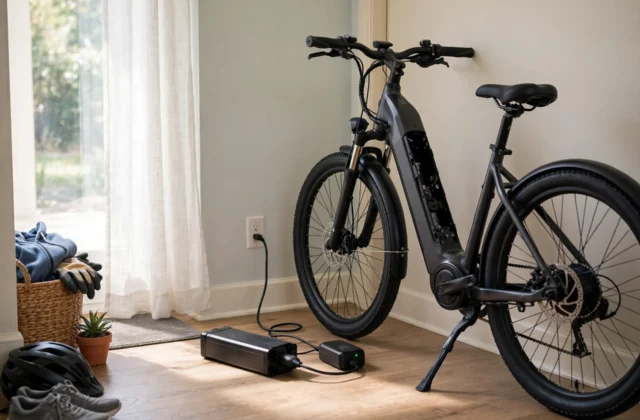
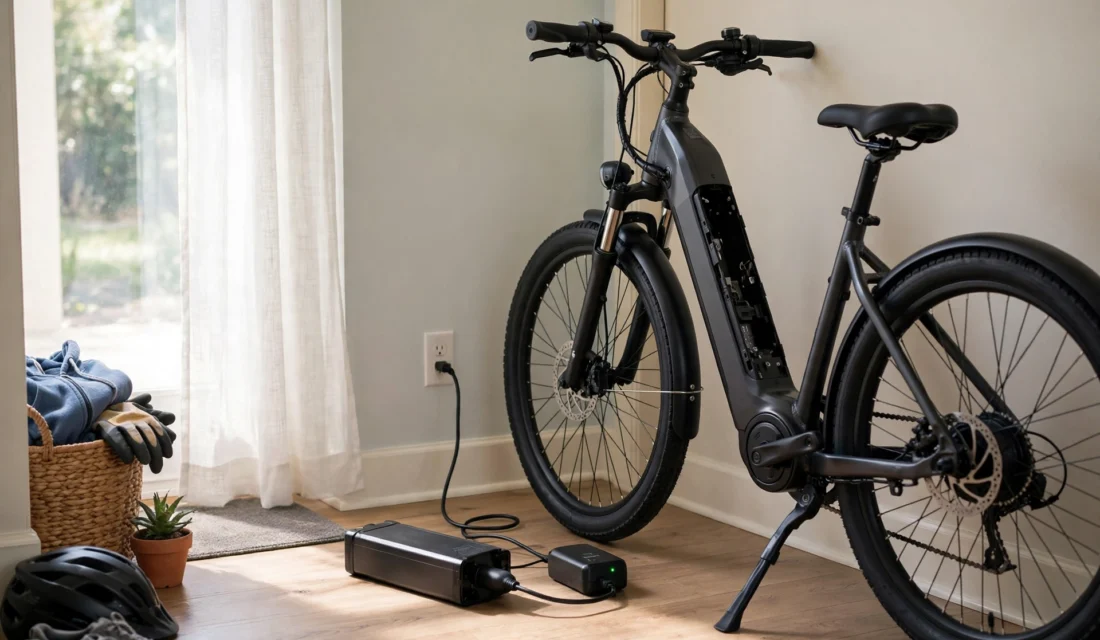
Choose a room with a working smoke alarm, a hard floor, and good airflow around the battery and charger. Keep the battery away from bedding, curtains, paper, fuel and other flammable items, and never block a hallway, doorway or fire exit with a charging bike or battery. Do not cover the battery or charger with cloth, bags or boxes, because trapped heat is a fire risk.
Use a wall socket in good condition, not a damaged extension lead or a multi-adapter overloaded with heaters and other high-power items. Keep the charger where air can flow around it, and do not charge in a damp shed, bathroom or anywhere water can splash onto the equipment.
Step 4: Connect and start charging in the right order
Follow the manual order for your model. Many manufacturers say to connect the charger to the battery first, then plug the charger into the wall, and to reverse that order when unplugging. If the manual gives a different order, follow the manual, because connector and charger designs vary.

Push connectors fully home, without forcing them. A loose connector can arc, overheat or give a false full-charge signal. Check the charger indicator light: it should show charging, then change when full, as described in the manual. If the light flashes oddly, the charger feels very hot, or charging stops and starts repeatedly, unplug it and check the connections and manual troubleshooting steps.
- Connect in manual order, fully and without force.
- Check the indicator light against the manual.
- Do not use a charger that smells burnt or buzzes loudly.
- Keep the cable where it will not be tripped over or pinched.
Step 5: Monitor, stop and disconnect safely
Stay nearby, at least for the first part of charging, and check regularly for heat, smell or unusual sounds. A charger and battery will feel warm, but not so hot that you cannot touch them comfortably. Unplug promptly when charging is complete, and do not leave a battery on charge for days, even if the charger claims to stop automatically.
Disconnect in the manual order, usually wall first, then battery, and store the charger where its cable is not kinked or crushed. If a battery ever swells, smokes or catches fire, do not try to move it with bare hands or use water on a lithium fire unless you are trained and it is safe to do so. Leave the area, call emergency services, and follow local fire guidance.
Step 6: Build a safe charging routine
Charge at a regular time when you are awake and at home, in the same safe place, and keep a simple log if you notice slower charging, shorter range or extra heat. Those changes can be early signs of battery ageing or a fault, and a log helps a repairer diagnose them. Re-check the charger and battery labels after any replacement, and never mix chargers between bikes unless they are confirmed as exact matches.
Teach everyone in the household the same rules: no charging on beds, no covering batteries, no damaged chargers, and no charging in escape routes. Children should not handle battery charging without adult supervision, and batteries should not be charged in bedrooms.
| Safe charging checklist | Done |
|---|---|
| Battery and charger inspected, no damage | ☐ |
| Charger voltage, connector and polarity match | ☐ |
| Hard surface, ventilated, smoke alarm present | ☐ |
| Unplugged promptly when full, cable stored safely | ☐ |

Common mistakes to avoid
- Using any charger whose plug fits, without checking voltage and polarity.
- Charging overnight in a bedroom or hallway, where a fire blocks escape.
- Covering the battery to hide it, which traps heat.
- Charging a damaged, swollen or crash-affected battery to see if it still works.
- Leaving a battery on charge for days after it is full.
Related guides: E Bike Hub, E Bike category, How to Make Your E-Bike Battery Last Longer, E-Bike Battery Care Companion.
Frequently asked questions
Can I use a different brand charger if the plug fits? Only if voltage, connector, polarity and current match exactly and the manufacturer or dealer confirms it. A plug that fits does not prove a charger is safe for your battery.
Is it safe to charge an e-bike battery overnight? It is safer to charge while you are awake and nearby, in a ventilated room with a smoke alarm. Overnight charging increases risk if a fault develops while you are asleep.
How hot should a battery get while charging? Warm is normal, very hot is not. If you cannot touch it comfortably, or it smells odd, unplug it and have it checked before charging again.
Can I charge a battery indoors? Yes, in a dry, ventilated room on a hard surface, away from flammable items and exits, with a smoke alarm. Do not charge in a bedroom, on a bed, or in a damp place.
What should I do if my battery swells? Do not charge it, do not puncture it, and do not put it in household waste. Move it outside only if safe, keep it away from flammable items, and contact the manufacturer or a qualified repairer.
Should I charge to 100 percent every time? Follow the manual. Many manufacturers allow full charging, but leaving a battery at full charge for long periods, or charging it constantly, is covered in the companion battery guides linked above.