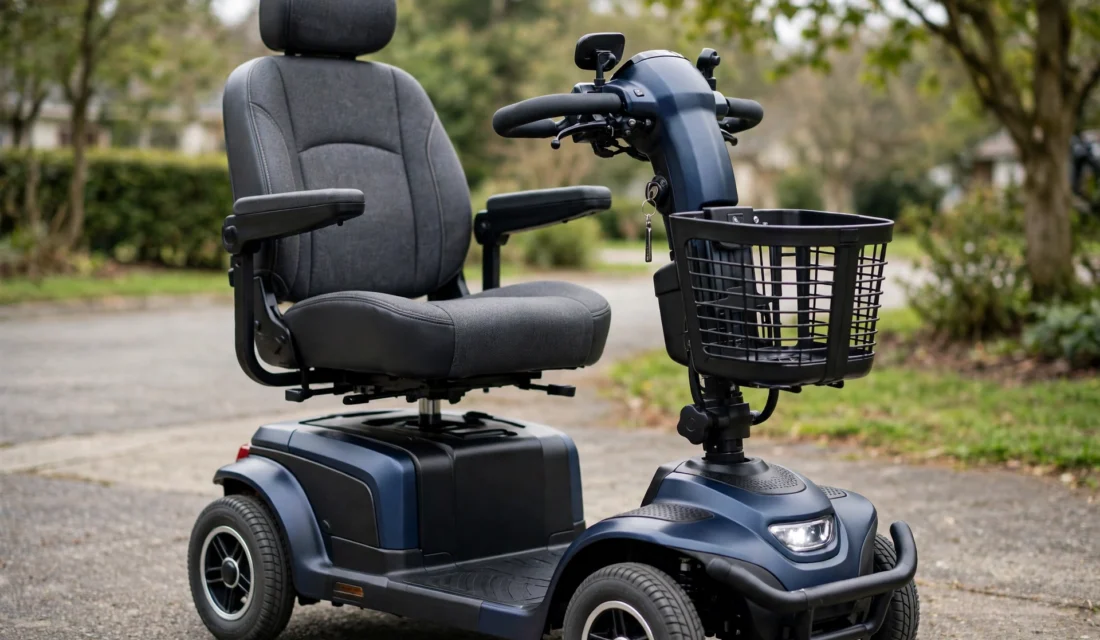
Short answer: Choose a mobility scooter by where you will use it: 3 wheels for tight indoor spaces, 4 wheels for outdoor stability, and a folding model if you need car transport. Match weight capacity, range and seat comfort to your daily trips.
Introduction
A mobility scooter restores independence. It turns a short trip to the shops, a park visit or a family outing from a struggle into something you can enjoy.
The wrong scooter, though, can be hard to steer, uncomfortable after an hour, or too heavy to transport. Size and use matter more than top speed.
This how to choose a mobility scooter guide compares mobility scooter types, covers weight, range and comfort, and walks through choosing, testing and living with one safely.
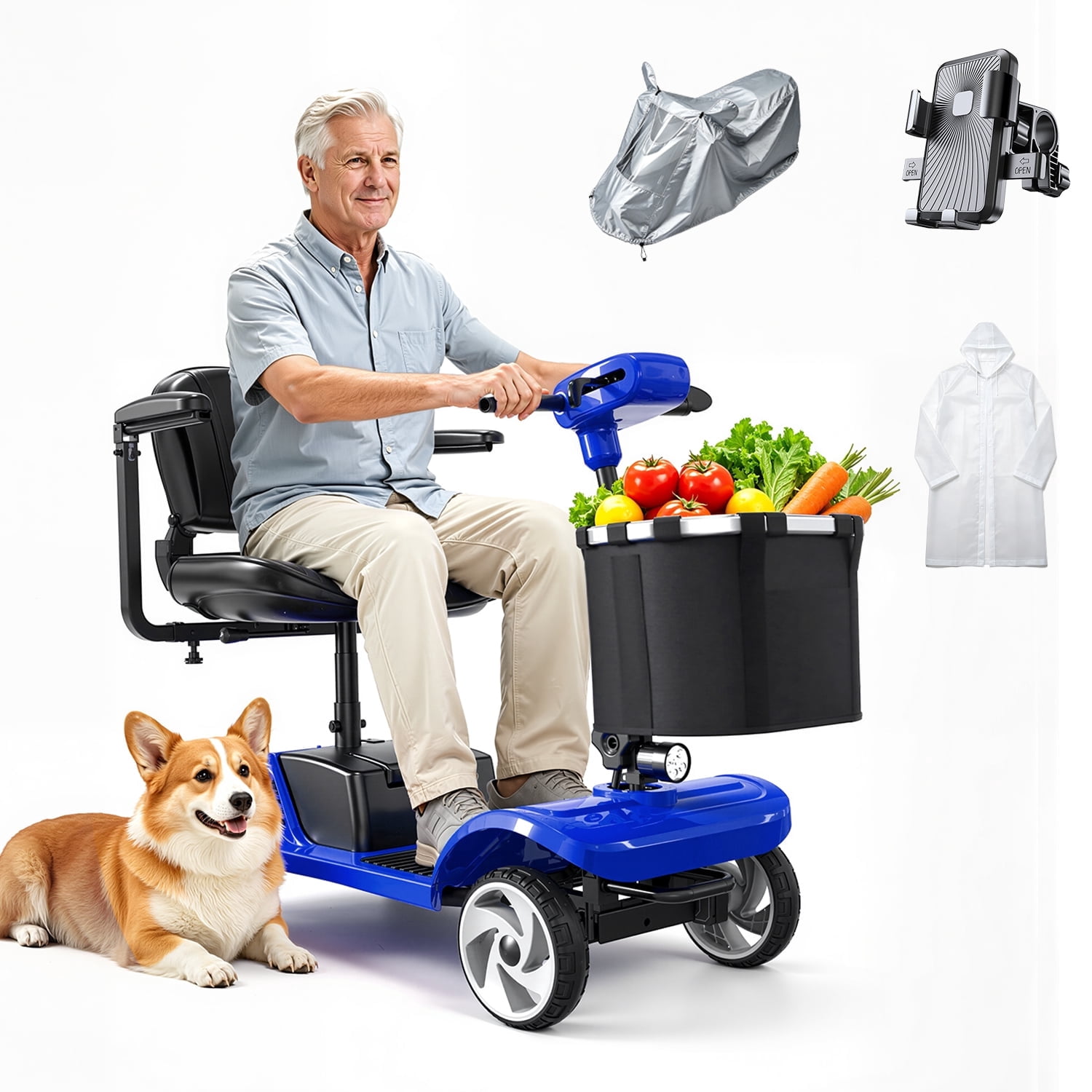
Start with your daily life, not a specification sheet. Where do you go most often, how far is it, and what surfaces will you cross? Answers to those three questions narrow the choice quickly.
Mobility scooters compared
| Scooter type | Wheels | Typical range | Best for |
|---|---|---|---|
| 3-wheel travel scooter | 3 | 10–20 km | Indoors, shops, tight turns |
| 4-wheel outdoor scooter | 4 | 20–40 km | Pavements, parks, uneven ground |
| Folding portable scooter | 3 or 4 | 10–20 km | Car boots, travel, holidays |
| Heavy-duty scooter | 4 | 25–45 km | Higher weight capacity, longer trips |
Turning and stability: 3-wheel scooters turn in a smaller circle, which helps in shops and at home. 4-wheel scooters are more stable on slopes, kerbs and grass, and are usually the safer outdoor choice.
| Your main use | Weight capacity to look for | Range to look for |
|---|---|---|
| Local shops, under 3 km | Your weight plus 20 kg | At least 15 km |
| Daily outings, 5–10 km | Your weight plus 25 kg | At least 25 km |
| Long days out, over 10 km | Your weight plus 30 kg | At least 35 km |
Safety first: Never exceed the weight limit, and always test braking on a gentle slope before a busy road. A scooter that feels tippy in a shop will feel worse on a kerb.
Seat, controls and comfort features
- Swivel seat: A seat that turns makes getting on and off much easier, especially beside a car or table.
- Adjustable seat and tiller: Look for height, armrest and tiller adjustments. Your knees, back and hands should all feel relaxed.
- Speed control: A simple dial or lever with a slow indoor setting helps in shops and crowds.
- Lights and indicators: Front and rear lights, plus indicators on larger models, help at dusk and at road crossings.
- Basket and storage: A front basket or under-seat storage carries shopping without unbalancing the scooter.
- Anti-tip wheels: Small rear wheels reduce tipping risk on slopes and kerbs. Check they are fitted on outdoor models.
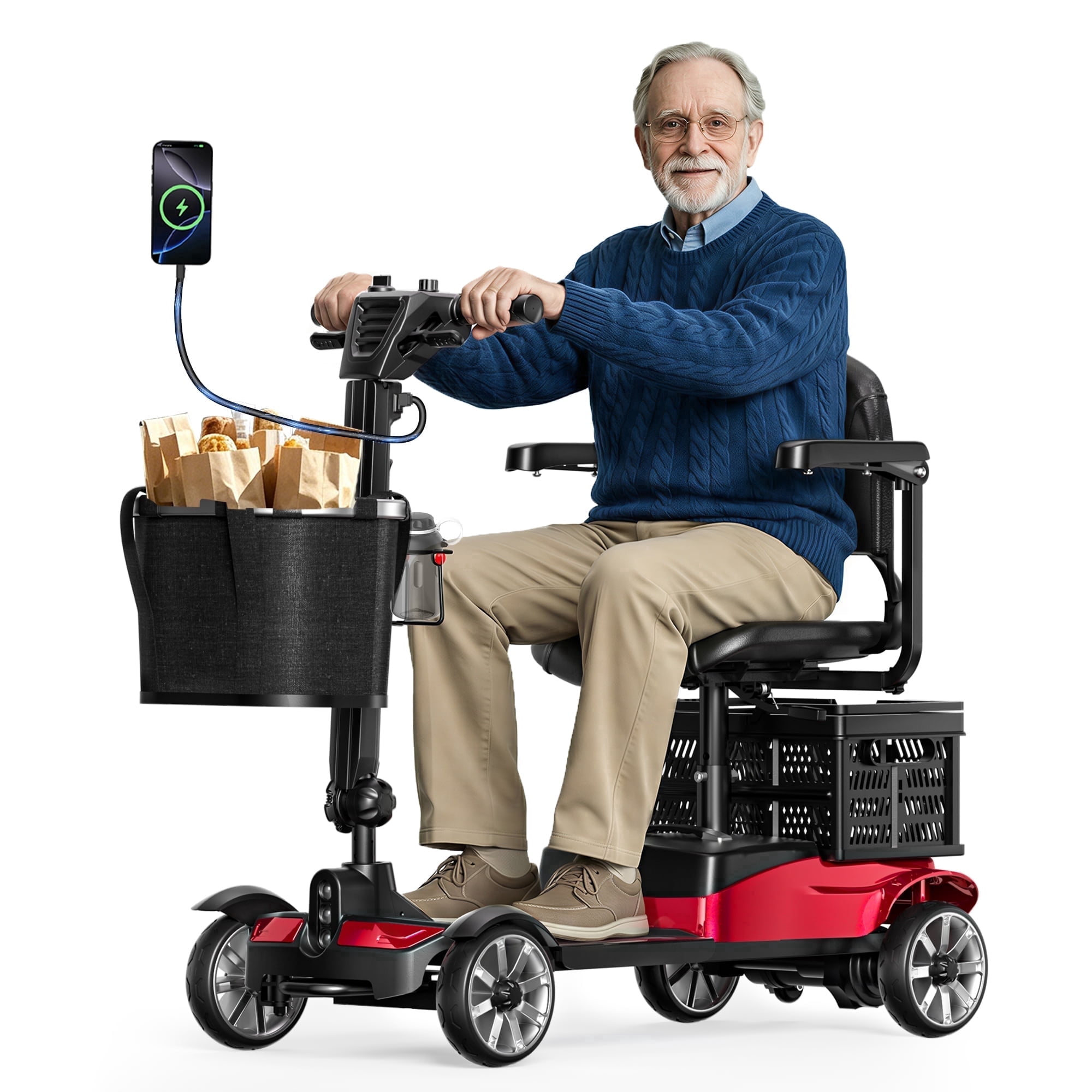
Comfort is not a luxury on a mobility scooter. If you sit for an hour or more each day, a padded, well-shaped seat and a tiller you can reach without stretching will protect your back and shoulders.

3 Wheel Mobility Scooters for Adults, Electric Powered Mobile Wheelchair Medical Aid, Folding Collapsible Compact for Travel, Seniors, Adults, Long Range Battery with Charger Basket Included (Blue)
A folding 3-wheel scooter for travel and everyday trips.
What you will need
| Item | What it is for |
|---|---|
| Charger and spare key | Daily charging and backup access |
| Weather cover | Protecting the seat and controls in rain |
| Lock | Securing the scooter outside shops |
| High-visibility vest or flag | Being seen at crossings and in car parks |
| Phone holder | Hands-free navigation on new routes |
Choose and test, step by step
1. List your daily trips
Write down your five most common trips: distance, surface and where you park. If most trips are indoors or in shops, a 3-wheel or folding model wins. If most are outdoors on pavements, choose 4 wheels.
Measure your doorways, lift and car boot. A scooter that does not fit through your front door or into your car is not practical, however good it feels in a showroom.
2. Check weight, seat and reach
Sit on the scooter for at least 15 minutes. Your feet should rest flat, your back should be supported, and the tiller should be within easy reach without leaning forward.
Check the weight capacity with your coat, bag and shopping added. A margin of 20 to 30 kg protects range, braking and motor life.
3. Test drive like a real trip
Drive over a kerb cut, a slope and a tight turn. Brake from a slow speed and check the stop is smooth, not jerky. Try reversing in a small space, because shops and lifts often need it.
Ask about battery range in real conditions. Cold weather, hills and a heavier load all reduce range, so choose a model rated above your longest regular trip.
4. Check transport and storage
If you travel by car, fold or dismantle the scooter and test loading it into the boot. Note the heaviest single piece: many people can lift 15 kg, but fewer can lift 25 kg comfortably.
At home, check charging access. The scooter needs a dry spot near a power point, with room to get on and off safely. A hallway that blocks a fire exit is not a suitable store.
5. Learn safe outdoor riding
- Use dropped kerbs: Always cross roads at dropped kerbs and crossings. High kerbs can tip a scooter or damage wheels.
- Slow on slopes: Go down slopes slowly, straight on, and avoid turning sharply on a gradient.
- Watch for hazards: Wet leaves, gravel, potholes and drain covers can unsettle a scooter. Slow down and keep both hands on the tiller.
- Be visible: Lights, bright clothing and a flag help drivers see you, especially at car park exits.
- Keep to pavements: Where local rules allow, stay on pavements and shared paths, and give walkers room.
6. Care for the battery
Charge after each day of use, and do not leave the battery flat for weeks. Most mobility scooter batteries last 1 to 3 years with regular charging.
Check tyres monthly for wear and correct pressure, and wipe the scooter clean after wet rides. A yearly service check by a dealer catches brake, bearing and battery problems early.

Hoverfly T3 Folding Powered Mobility Scooter for Seniors, Portable 3-Wheel E-Scooter with Seat, 13-Mile Range Safe LiFePO4 Battery, 264 lbs Load and Solid 8-inch Tires, Fits in Car Trunks for Daily Rides Blue
A folding portable scooter that fits in car trunks for daily rides.
Buyer checklist
| Check | Pass mark |
|---|---|
| Weight capacity | Above your weight plus bag and shopping |
| Range | Above your longest regular trip |
| Seat comfort | Comfortable after 15 minutes sitting |
| Turning circle | Fits your home, lift and shops |
| Transport | Fits your car boot or storage space |
Common buying mistakes
- Choosing by speed alone: A faster scooter is not better if it is uncomfortable or hard to turn.
- Ignoring weight capacity: Overloading shortens battery life, weakens braking and can void a warranty.
- Skipping a test drive: Seat comfort and tiller reach cannot be judged from photos alone.
- Forgetting storage: A scooter that cannot be charged or stored safely at home becomes a daily problem.
- Buying too small for outdoor use: A light travel scooter may struggle on grass, slopes and long pavements.
- Not checking local rules: Pavement use, road use and speed limits vary. Check before you buy.
Frequently asked questions
What is the difference between 3-wheel and 4-wheel mobility scooters?
3-wheel scooters turn tighter and suit indoor and shop use. 4-wheel scooters are more stable outdoors on slopes, kerbs and uneven ground.
How far can a mobility scooter go on one charge?
Most travel scooters cover 10 to 20 km, while larger outdoor models cover 25 to 45 km. Hills, cold weather and heavier loads reduce real range.
Can a mobility scooter fit in a car?
Folding and dismantling models are designed for car boots, but check the folded size and the heaviest piece against your car and your lifting ability.
Do I need a licence for a mobility scooter?
In most places, no licence is needed for pavement scooters, but rules vary by country and by scooter class. Check local rules before road use.
How long does a mobility scooter battery last?
With regular charging, most batteries last 1 to 3 years. Charge after use and avoid leaving the battery flat for long periods.
Can I use a mobility scooter in the rain?
Light rain is fine for most models, but avoid deep water and slippery surfaces. Dry the scooter and cover the seat afterwards.
Related guides
Explore the Scooters Hub and browse more posts in the Scooter category. For lightweight options, see 5 Lightweight 3 Wheel Mobility Scooters and 5 Foldable Adult Scooters. For roadside basics, read How to Fix a Flat Tyre on the Road.
A final thought
The best mobility scooter is the one you feel confident using every day. It should fit your home, your car and your favourite routes, and it should feel comfortable after an hour, not just in a five-minute showroom test.
Take your time, test more than one model, and ask for help from family, a dealer or a local mobility service if you need it. A careful choice now means years of easier, more independent trips.