Straight answer: In hardtail mountain bike vs all-mountain bike for mud, the all-mountain bike is the better choice. Its rear suspension keeps the back tyre pressed into soft, rutted ground, so it holds grip on climbs and on steep, wet descents, where a hardtail can skip and spin. A hardtail is lighter and quicker to clean, and it wins on smooth, wet fire roads — but on rough, muddy singletrack, traction matters more than weight.
Mud is the one trail condition that exposes the difference between these two bikes in minutes. A hardtail has suspension only at the front; its rear wheel is bolted to a rigid frame, so on wet roots and ruts the back tyre often loses contact. An all-mountain bike has suspension at both ends, so the rear wheel can move with the ground while the frame stays steady.
This guide compares the two bikes for mud only. The verdict comes first, then a side-by-side comparison, the situations that flip the answer, and a short mud test you can run on either bike. It sits in the Mountain Bikes Hub and the Mountain Bike guides.
The short version: rough, muddy, steep trails favour the all-mountain bike; smooth, wet fire roads favour the hardtail. For nearby comparisons, see our Hardtail Mountain Bike vs Trail Mountain Bike guide and our Hardtail Mountain Bike vs Full Suspension Mountain Bike guide.
Hardtail Mountain Bike vs All-Mountain Bike in Mud: The Comparison
The table below compares the two bikes only where mud changes the outcome.
| Attribute | Hardtail Mountain Bike | All-Mountain Bike | What to watch |
|---|---|---|---|
| Suspension | Front fork only; rear wheel fixed to the frame. | Front and rear suspension. | A locked-out fork hides it. |
| Grip on wet roots and ruts | Rear tyre skips over roots, then grips in bursts. | Rear tyre stays in contact longer. | Watch the rear wheel hop. |
| Climbing in mud | Lighter uphill; spinning is the limit. | Heavier, but the rear tyre drives more. | Deep mud favours suspension. |
| Descending in mud | Fast on smooth descents; skittish on steep, rutted ones. | Controlled on steep, wet descents. | Brake before the ruts. |
| Tyres and mud clearance | More clearance; mud sheds faster. | Wider tyres; mud packs around the shock. | Clear packed mud early. |
| Cleaning and upkeep | Quicker to wash; fewer pivots to trap mud. | Slower to wash; mud collects on pivots and the shock. | A muddy season costs more. |
When the Answer Changes
The verdict above holds for rough, muddy singletrack. Change one of these variables and it can flip.
- Smooth, wet fire roads. On smooth, wet gravel there is nothing for suspension to do. The hardtail is lighter, pedals better and is the faster, simpler choice.
- Wet roots and rock gardens. Roots and rocks under mud are the all-mountain bike’s best case: each root is a bump the rear suspension absorbs, so the tyre keeps driving, while on a hardtail each root is a kick that can unload the rear tyre.
- Your tyres and pressure. Tread and pressure matter as much as suspension. A wide, open tread clears mud better, and a slightly lower pressure gives a longer contact patch. Our guide to checking and setting tyre pressure shows how to check yours.
- How steep the trail is. On flat mud, the hardtail’s weight advantage counts. On steep, wet descents, the all-mountain bike’s rear suspension keeps the wheel on the ground where braking works. Braking itself matters too — see Disc Brake vs Rim Brake: Which Is Better After Rain?

Test Both Bikes in Mud Before You Decide
A ten-minute test on your own trail tells you more than any comparison table. Run the same loop on each bike, with the same tyres and pressure, and score what you feel.
- Pick one muddy loop. Choose 10 to 15 minutes of your usual trail, with a climb and a descent, and ride the same loop on both bikes.
- Set the same tyre pressure on both bikes, and check it before each lap, so pressure does not decide the test.
- Ride the climb seated, then standing, and note where the rear wheel spins — on wet roots, on soft mud, or nowhere.
- Ride the descent at a speed you can stop from, and note whether the rear wheel skips over ruts or stays on the ground.
- Wash both bikes the way you would after a normal ride, and time it. The difference is part of the answer, if you ride in mud every week.
What a fail looks like
| Symptom | Cause | Fix |
|---|---|---|
| Rear wheel spins on every climb | Rear tyre is unloading over roots, or pressure is too high. | Lower pressure a little, stay seated longer, and try a tread that clears mud. |
| Bike slides sideways on wet descents | Braking too late, or the rear wheel is skipping. | Brake before the ruts, keep weight low and back, and slow down earlier. |
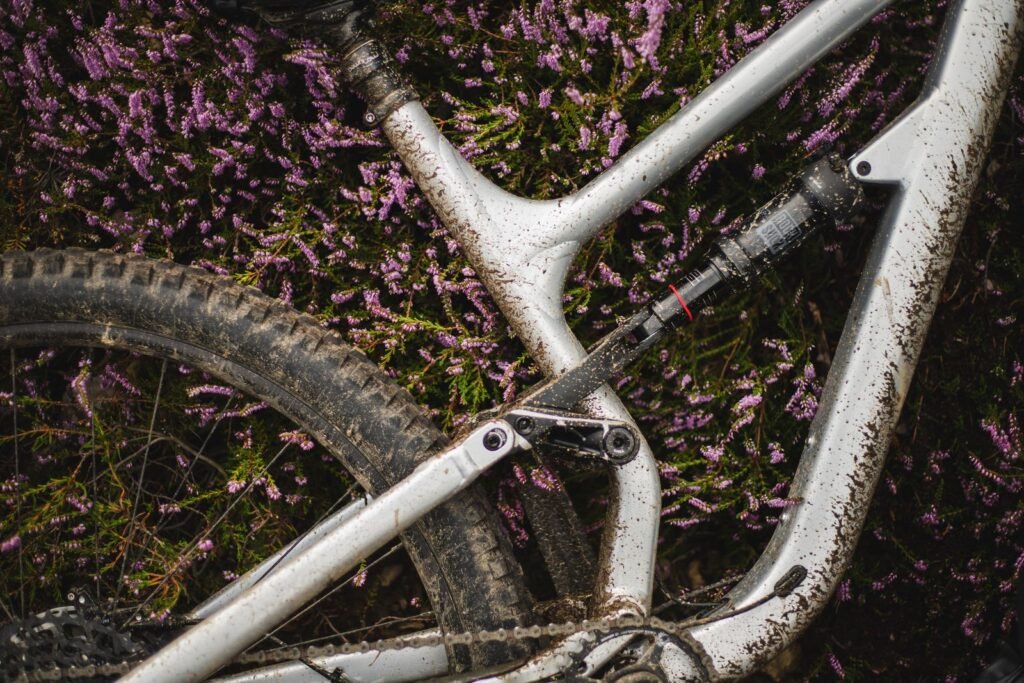
| Mud packs around the rear shock | All-mountain linkages collect mud in sticky conditions. | Stop and clear it by hand; do not let it dry on pivots. |
Myth: A hardtail always climbs better in mud because it is lighter. Fact: On smooth mud, yes — but on rutted, rooty climbs, the all-mountain bike’s rear suspension keeps the tyre driving, and that traction is worth more than the weight saving.
Before you test: Walk the loop first. Mud hides holes, and a first descent on an unfamiliar wet trail is how riders get hurt. Check your brakes, wear gloves and a helmet, and ride the test at a speed you can stop from.
How to Ride a Mountain Bike in Deep Mud
Whether you buy the hardtail or the all-mountain bike, mud riding is a skill, and this method works for both.
What you will need
- A bucket of warm soapy water and a stiff brush
- A chain cleaner or an old toothbrush
- A dry rag and chain lubricant
- A tyre pressure gauge, or a pump with a gauge
- Gloves, because muddy work is messy
The method
- Ride with a lower gear than usual, and stay seated on climbs so your weight keeps the rear tyre pressed down.
- Keep your weight low and your elbows loose, and let the bike move under you instead of fighting it.
- Brake in short, even pulls on both wheels, and never grab the front brake on a wet root.
- When the wheels stop turning, get off and walk. Pushing through deep mud damages rims and derailleurs less than pedalling through it.
- After the ride, wash the bike while the mud is still wet, working from the top down, and use the brush on the drivetrain and around the brakes. Then dry the chain and pivots, lubricate the chain, and check the brakes.
Do not use a pressure washer on your bike. The jet drives mud and water into bearings, pivots and the bottom bracket, and the damage shows up weeks later as grinding and play.

When the Damage Is Already Done
Choose the wrong bike for the mud you ride most, and you will feel it every wet weekend.
- Your hardtail spins on every muddy climb. Fit a wider, more open tread, drop the pressure slightly, and stay seated longer. If it still spins, your trails are the all-mountain bike’s home ground, and no tyre will fully close the gap.
- Your all-mountain bike feels slow on flat, wet trails. Lock out the rear suspension on smooth sections and check the tyre pressure. The bike is built for rough ground, not for speed on fire roads.
- You bought the wrong bike and the trail is not going to change. Sell or trade it while it is still clean and rideable, and test the other type on your own trail before you buy again.

The Safe Alternative: An All-Mountain Bike
An all-mountain bike is the safe alternative if your trails are rough, steep and muddy more often than they are smooth. It is heavier and more expensive to maintain, but it keeps its grip when the trail is at its worst. The closest verified mountain-style bikes on this site are mountain e-bikes, and the same test applies to them.
- Pick a trail you already ride in the wet, ideally one with a steep, muddy descent.
- Borrow or rent an all-mountain bike for that one ride — not for a car-park test.
- Ride your normal loop, and note where the rear wheel stays on the ground and where you brake less.
- Wash it the same way you wash your own bike, and decide whether the extra cleaning time is worth the extra control.
What to Do Next, in Order
- Walk your muddiest trail and decide whether it is mostly smooth, or mostly rutted and steep.
- Set your tyre pressure, and check it with a gauge before the test.
- Ride both types on the same loop, using the test above.
- Score grip, control and cleaning time — not speed.
- Buy the bike that wins on the trail you ride most, and plan on the cleaning time that comes with it.
Never Do These in Mud
- Never grab the front brake on a wet root. The wheel locks, the tyre slides, and you go down.
- Never ride a trail you have not walked when it is wet. Mud hides ruts, holes and rocks.
- Never let mud dry on pivots, linkages or the chain. Dried mud grinds, and it is far harder to clean.
In short
For most riders on muddy trails, the all-mountain bike is the better choice, because rear suspension keeps the back tyre in contact with soft, rutted ground, and traction decides a muddy ride more than weight does. The hardtail is the better choice where mud is shallow and trails are smooth: it is lighter, simpler and quicker to clean. Test both on your own trail, and let the cleaning time be part of the decision.
The essentials
- All-mountain bikes grip better on rough, muddy singletrack; hardtails win on smooth, wet fire roads.
- Rear suspension keeps the back tyre driving on wet roots — the main reason the all-mountain bike wins in mud.
- Lower tyre pressure and an open tread help both bikes, on both types of trail.
More Questions, Answered
Which is better in mud, a hardtail or an all-mountain bike?
For rough, muddy trails, the all-mountain bike. Its rear suspension keeps the rear tyre in contact with the ground, so it grips better on climbs and stays controlled on wet descents. For smooth, wet trails, the hardtail — it is lighter and easier to clean.
Is a hardtail good for muddy trails?
Yes, on the right mud. A hardtail handles shallow mud on smooth trails well, and its open rear end sheds mud faster. On steep, rutted, rooty mud it struggles, because the rear wheel skips instead of driving.
Can I make my hardtail grip better in mud?
A lot better, but not completely. A wider tyre with an open tread, slightly lower pressure, and staying seated on climbs all help. If the rear wheel still spins on every rooty climb, the trail — not the tyre — is asking for rear suspension.
Additional Details
Name: Hardtail Mountain Bike vs All-Mountain Bike: Which Is Better for Mud?
Description: Hardtail mountain bike vs all-mountain bike in mud: which grips, climbs and descends better? Compare suspension, tyres, weight and cleaning before you buy.
Published: November 10, 2026