Road e-bike vs mid-drive e-bike: for carrying loads, the mid-drive usually wins. It drives through the gears, so it holds speed on hills with a load, starts smoothly, and uses its battery better on a hilly route. A road e-bike wins only when the load is light and the route is flat and smooth – then its lighter frame and narrow tyres make the ride faster and easier.
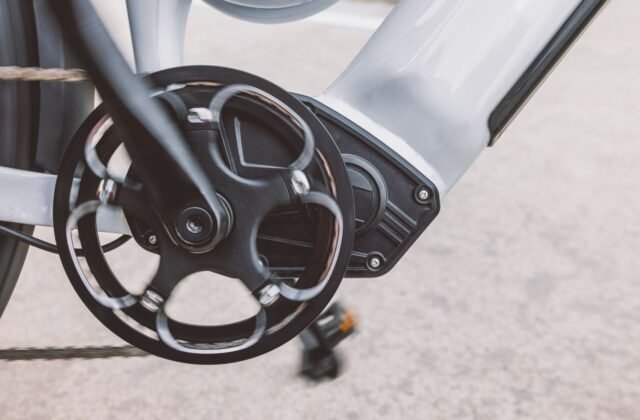
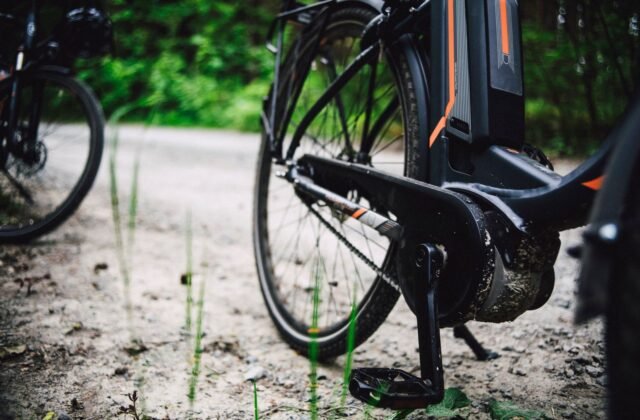
The two are not the same kind of choice. A road e-bike is a shape and a use: a light bike with narrow tyres, built for smooth tarmac. A mid-drive e-bike is a motor position: the motor sits at the crank and drives the chain. A road e-bike can have a mid-drive motor, so check the motor and the rack before you judge either one by its shape.
Carrying loads changes how an e-bike feels. A bag that is easy to lift can still make the front wheel wander, the brakes work harder, and the bike feel top-heavy at a junction. That is why the bike that feels fastest empty is not always the bike that carries best. This guide compares a road e-bike with a mid-drive e-bike for the same job – carrying loads on real rides – and ends with a short test you can run before you buy. More guides are in the E-Bikes hub, including our fat tyre vs road e-bike and commuter vs mid-drive e-bike guides.
A road e-bike keeps the bike light, so less charge is wasted on smooth roads. A mid-drive motor keeps the motor in its best gear, so a hill with a load feels more like a hill without one.
Road E-Bike vs Mid-Drive E-Bike: The Core Comparison
| Attribute | Road E-Bike | Mid-Drive E-Bike | What to Watch |
|---|---|---|---|
| What it is | Light bike, narrow tyres, for smooth roads | Motor at the crank, driving the chain and gears | Shape or motor? Check both. |
| Climbing with a load | Steady on flat, slows on hills | Strong – the motor uses the gears | Test your steepest hill loaded. |
| Starting with a load | Quick on flat, needs a push on a hill | Smooth – low gears help from a standstill | Stop and start on a slope. |
| Battery use | Good on smooth, flat roads | Better use of charge on hills | A heavy load shortens range. |
| Carrying space | Rack only, if fitted; few mounts | Depends on the base bike | Measure what you carry first. |
| Weight and handling | Light, quick to steer, easy to lift | Heavier at the crank, balanced | Lift it loaded. |
| Upkeep | Tyres, brakes, and pads wear | Chain and gears wear faster | Service what takes the load. |
| Best for loads | Light loads, flat smooth roads | Heavy or hilly loads | Buy for the load. |

When the Answer Changes
The verdict above is for a typical loaded ride. Change one thing about your route or your load, and it can flip.
- Your load is light. A laptop and a light shopping bag favour the road e-bike, which is faster on flat ground.
- Your route has one steep hill. This is the mid-drive case: with gears and a load, it keeps its speed where a lighter bike strains. See our fat tyre vs mid-drive e-bike guide for the same hill test.
- Your route is long and flat. A road e-bike loses little here and rolls further on smooth tarmac.
- You carry a child or a weekly shop. A heavy, regular load favours the mid-drive, and a bigger load still may need a cargo bike. Our cargo vs mid-drive e-bike guide covers that case.
- Your roads are rough. Kerbs and gravel suit wider tyres. Neither side here is best for rough ground.
Test It Before You Buy: A 15-Minute Load Test
Do not buy either bike from a photo. A short test with your real load tells you more than any spec sheet. Run both bikes the same way, on the same loop.
- Pack your usual load. Use the same bags, shopping, or work kit you actually carry.
- Fit the rack and straps first. The rack must be tight, the straps short, and the load clear of the wheel.
- Ride your steepest hill at a normal pace. Note whether the motor keeps its speed or strains.
- Stop and start on the hill, then turn at low speed. A bike that restarts smoothly with a load suits your route.
- Ride the same loop on the other bike. The one that feels easier with the load is the one to buy.
What a Fail Looks Like
| Symptom | Cause | Fix |
|---|---|---|
| Motor strains on the first hill | The gear range does not suit the load | Choose a mid-drive bike |
| Bike feels unstable when loaded | The load is high or behind the rear axle | Move the load low and strap it tight |
| Chain slips under load | The motor drives the chain in a high gear | Shift down, and check the chain |
Myth: A lighter road e-bike always carries better. Fact: Light weight helps on flat ground, but on hills gearing matters more. A mid-drive motor that uses the gears can climb better with a load than a lighter bike whose motor cannot.
Before you test: Check the brakes, tyre pressure, and chain, and charge the battery fully. Wear a helmet, keep your lights on, and test in a quiet car park or quiet street first, not in traffic.

The Method: How to Set Up a Bike for Carrying Loads
Whichever side you choose, set the bike up for your load, your route, and your body, then test it loaded.
What You Will Need
- A helmet and lights
- A strong lock
- A pump with a gauge, a spare tube, and tyre levers
- A rack and panniers, or a basket that fits your frame
- Chain lube and a multi-tool
The Method
- Set the saddle so your knee has a slight bend at the bottom of the pedal stroke, then tighten the clamp.
- Set the tyre pressure for a loaded bike, following the range on the tyre sidewall, and check it weekly.
- Fit the rack low and tight, with heavy items near the centre. Tighten every bolt and check it clears the tyre and brake.
- Check both brakes, the chain, the gears, and the axle nuts before you ride. On a mid-drive bike, look at the chain first.
- Test ride loaded at low speed in a quiet place: stop, start, turn, and park before you take it into traffic.
Note: On a mid-drive bike, ease off the pedals for a moment when you change gear, and do not shift under full power. It keeps the chain and gears working longer.
Warning: Never strap a load to the handlebars, or to a rack that is not made for it. A load that moves can throw the bike off balance in a turn.
When the Damage Is Already Done
If you already bought the wrong one, do not write the bike off. Most of these problems have a cheap fix.
- Road bike, hilly route. Reduce the load and take a flatter route if there is one. If it still strains, a mid-drive kit or bike is the fix.
- Mid-drive bike, need to carry more. Fit a rear rack and panniers, within the rack limit. For a bigger load, a small trailer is cheaper than a new bike.
- Battery drains too fast. Carry less, use a lower assist level on flat ground, and charge fully before you ride.
- Load sways or wobbles. Lower the load, centre it, tighten the straps, and check the rack bolts.
The Safe Alternative: A Road E-Bike
If a mid-drive bike wins for your route, a road e-bike is the safe alternative when your load is light and your roads are smooth. It is the simpler, lighter choice: easy to lift, easy to park, and quick on flat tarmac.
It suits riders who value speed and simplicity over hill-climbing power. If you ride smooth roads and carry a light bag, start here – for example, the HOVERFLY OUREA 26 inch Electric Bike for Adults, with a 750W peak motor, up to 20 MPH and 40 miles per charge.
- Write down your normal load and your steepest hill. The one that limits you more decides the side.
- Test ride a road e-bike with the same load, on the same loop, and compare how it feels on the hill.
- Check the rack mounts and tyre clearance before you buy. Some road frames have few mounts.
- Add the lock, lights, and rack to the price, then buy the bike that fits your load and your route.

What to Do Next, in Order
- Weigh and measure your normal load: bags, shopping, or work kit.
- Ride your route and note the steepest hill and the parking at each end.
- Test ride a road e-bike and a mid-drive e-bike with the load, on the same loop.
- Choose the side that fits the limit: the load, or the hills.
- Add the lock, lights, rack, and panniers to the price before you buy.
Never Do This After Buying an E-Bike for Carrying Loads
- Never ride with a loose rack, bag, or pannier. A load that moves can throw the bike off balance in a turn.
- Never carry a load higher than the saddle. A high load makes any bike hard to steer.
- Never shift under full power on a mid-drive bike. Ease off for a moment, shift, then pedal again.
- Never wash the motor area with a pressure washer. Water in the motor or battery contacts causes faults that are hard to dry out.
- Never leave the battery flat for weeks. Charge it and store it dry.
In Short
For carrying loads, a mid-drive e-bike is the better choice for most riders: it climbs better with a load and starts smoothly on a hill. A road e-bike is better when the load is light and the route is flat and smooth.
The Essentials
- Mid-drive wins for heavy or hilly loads; a road e-bike wins for light loads on flat, smooth roads.
- A road e-bike is a shape and a use; a mid-drive is a motor position – a bike can be both.
- Test both bikes loaded, on your own route, before you buy.
- Keep the load low and tight, set the tyres for a loaded bike, and ease off when you shift on a mid-drive.
More Questions, Answered
Can a road e-bike have a mid-drive motor?
Yes. Road is a frame shape and a use, and mid-drive is a motor position, so a road e-bike can have a mid-drive motor. That mix is often the best of both for a hilly, loaded road ride.
Is a mid-drive e-bike better for hills with a load?
In general, yes. A mid-drive motor drives through the gears, so it can hold a good gear on a hill with a load.
Can I carry groceries on a road e-bike?
Yes, with a rear rack and panniers, as long as you stay within the rack limit. A light weekly shop suits it well.
Additional Details
Name: Road E-Bike vs Mid-Drive E-Bike: Which Is Better for Carrying loads?
Description: Road e-bike vs mid-drive e-bike: which is better for carrying loads? Compare climbing, load space, range and upkeep, then test both loaded before you buy.
Published: November 10, 2026