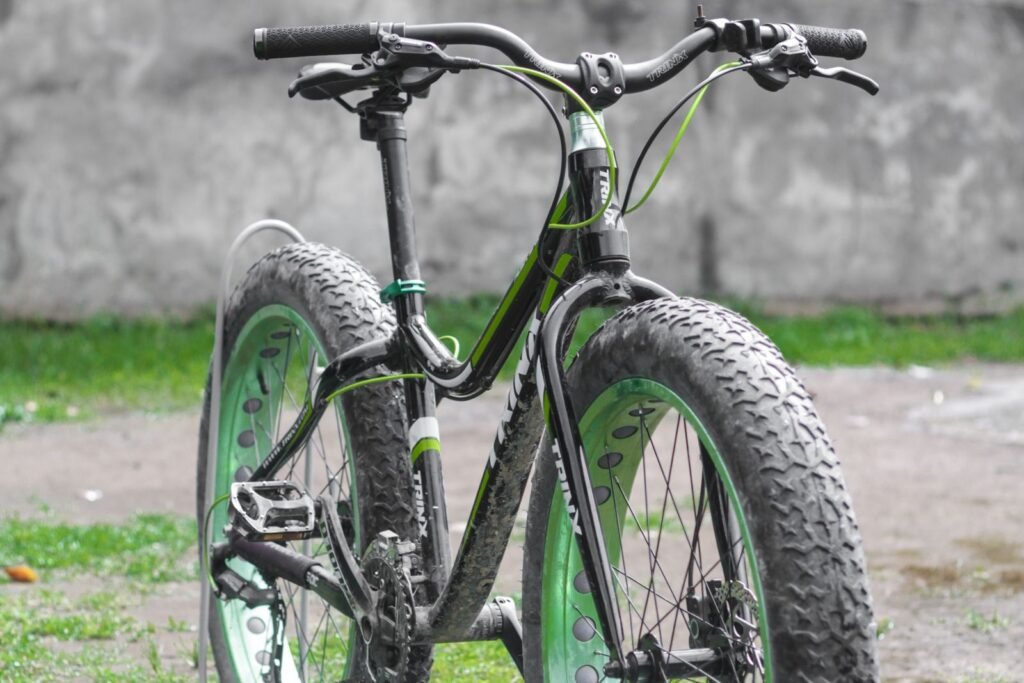
Straight answer: For most beginners, in the hardtail mountain bike vs fat mountain bike choice, the hardtail is the better first mountain bike. It is lighter, cheaper, and easier to pedal on the mixed trails most beginners actually ride, and it rolls faster on firm ground. A fat bike only wins when your riding is mostly on sand, snow, or very soft mud: its tyres are about 4 inches wide, so they float over soft ground instead of sinking into it.
The two bikes overlap more than the names suggest. Many hardtails now ship with wide 2.6-inch tyres, and a fat bike pumped near the top of its range is fine on a smooth path.
A hardtail is a mountain bike with suspension in the fork only and a rigid rear end. A fat mountain bike is defined by its tyres: very wide, low-pressure tyres that spread your weight over a large patch of ground. Both are sold as beginner-friendly trail bikes, and both sit in our Mountain Bikes Hub.
The choice decides how much effort each ride takes and how much grip you have. This guide compares the two side by side, then gives you a 20-minute test that settles the question on your own trails. If you are still choosing a first trail bike, read our guide to mountain bikes for beginners first.
Hardtail Mountain Bike vs Fat Mountain Bike: The Core Comparison
The table compares the two on what decides a beginner ride. Read the last column first: it says what to check before you buy.
| Attribute | Hardtail Mountain Bike | Fat Mountain Bike | What to watch |
|---|---|---|---|
| Suspension | Fork only; rigid rear end | Usually rigid | Check the fork moves smoothly |
| Tyre width | Usually 2.2-2.6 inches | Usually 3.8-5 inches | Measure the tyre, not the label |
| Weight | Lighter and easier to pedal uphill | Heavier, because of the wide tyres | Lift the bike before you buy it |
| Grip on soft ground | Sinks and slips on sand, snow, and mud | Floats over sand, snow, and soft mud | Test on the softest patch of your trail |
| Speed on firm trails | Faster on climbs and flat sections | Slower on firm ground; the wide tyres drag | Ride the same loop on both |
| Comfort | You feel the bumps through the rigid rear end | Wide, soft tyres soak up small bumps | Try a rooty section on both |
| Upkeep | Standard parts; most shops stock the sizes | Wide tubes and tyres are a special order in many shops | Ask your local shop first |
| Best first bike | Most beginners on mixed trails | Beginners on mostly sand, snow, or soft mud | Buy for the trails you ride every week |

When the Answer Changes
The hardtail wins most of the time, but these three things flip the verdict.
- Soft ground most days: If your regular trails are beach sand, deep snow, or mud that never dries, the fat bike’s float is worth more than the hardtail’s speed. Our step-through vs fat tyre comparison shows the same trade.
- Smooth, dry, and short: If your rides are short loops on dry, packed trails, the hardtail is faster, cheaper to run, and easier to carry. The fat bike adds effort for no gain.
- Your first winter: If you plan to ride through snow, a fat bike keeps you riding when a hardtail slides. A hardtail with winter tyres is a compromise, not a match.
Test Both Bikes on One Trail: A 20-Minute Decision Ride
Ride the same loop on both bikes, back to back, and let the trail decide. It takes about 20 minutes.
- Pick your loop: a short trail with one climb, one soft patch, and one descent.
- Set the tyre pressure the same on both bikes – follow our guide to checking and setting bike tyre pressure – and match the saddle height.
- Ride the loop on the hardtail first. Note where the rear wheel slips or skips.
- Swap to the fat bike and ride the same loop. On the soft patch, note whether you spin out or keep traction.
- Keep the bike that felt better on your worst section, not on the smoothest one.
What a fail looks like
| Symptom | Cause | Fix |
|---|---|---|
| Rear wheel spins on a climb | Too high a gear or worn tread | Shift down; fit mud tyres |
| Rear wheel slips on a descent | Rigid rear end; high tyre pressure | Lower the pressure a little |
| You are exhausted after 20 minutes | Bike too heavy for your trails | Choose the lighter bike |
Myth: A fat bike is always better for beginners because it is more stable. Fact: It is steadier on soft ground, but its weight makes it harder to pedal, steer, and stop on firm trails, where most beginners actually ride.
Before you test: Wear a helmet, pump the tyres to the pressure on the sidewall, and test the brakes before you roll. Use a quiet trail, not a road, and walk any section you cannot see through. Read our disc brake vs rim brake guide if your brakes feel weak in the wet.

How to Set Up Either Bike the Same Way
Either bike rides far better with a basic setup. Do this before your first proper ride.
What you will need
- A floor pump with a pressure gauge
- A multi-tool with Allen keys
- Chain lube made for wet conditions
- Mud tyres with open tread
The method
- Fit mud tyres with open tread and check the clearance.
- Set the tyre pressure a little lower than your dry setting for more grip, but never below the minimum.
- Set the saddle so your leg is almost straight at the bottom of the pedal stroke.
- On a hardtail, set the front suspension so the fork moves when you push your weight forward; on a fat bike, check both tyres hold pressure.
- Lube the chain with wet lube, wipe off the excess, and check the brakes.
- Ride your test loop, and change one thing at a time until the bike feels right.
A note about pressure: Lower pressure gives a bigger contact patch and more grip on soft ground, but too little lets the tyre squirm and risks a pinch flat. Change a little at a time.
Warning: Never ride a descent with brakes you have not tested. Do a short roll on flat ground first; if the brakes feel weak, walk the bike until you find the cause.
When the Damage Is Already Done
Bought the wrong bike? Each of these has a fix.
- I bought a hardtail, but my trails are soft and I keep slipping: Fit wider tyres with open tread and run them near the bottom of their range. If soft ground is the rule, a fat bike is the fix.
- I bought a fat bike, but my trails are mostly firm and I feel slow: Run the tyres near the top of their pressure range and fit the narrowest tyres that fit your rims. On smooth ground, a hardtail is lighter and cheaper to run – see our hardtail vs full suspension comparison.
- My brakes are weak after wet rides: Clean the rotor or rim, check the pads for glazing, and replace worn pads. For the brake check, see our disc brake vs rim brake guide.

The Safe Alternative: Start with the Fat Bike
If you are not sure your trails are soft enough for a fat bike – or firm enough for a hardtail – the fat bike is the safe first buy when soft ground is common. It teaches you to ride loose ground, and it keeps you upright when a hardtail slips.
- Work out your softest trail: how much sand, snow, or mud does your usual ride have?
- Buy the lightest frame and the narrowest fat tyres your budget allows.
- Fit mud tyres and ride it for a month on your real trails.
- If firm trails still beat you up, add a hardtail later – you will know from riding, not guessing.
What to Do Next, in Order
- List the trails you ride every week and mark which are soft.
- Ride both bikes on the same loop, as above.
- Pick the bike that wins on your worst section.
- Set the tyre pressure and fit mud tyres.
- Ride it for a month before changing anything.
- If the bike still fights you, read our hardtail vs trail comparison and our 27.5 comparison.
Never Do This
- Never buy on tyre width alone: a 5-inch tyre on a trail you never ride soft is weight you carry for nothing.
- Never ride a fat bike with tyres below the sidewall minimum: the tyre will squirm and pinch on the first root.
- Never skip the test ride: two bikes with the same label can feel very different.
- Never judge a bike in the car park: a bike that feels fine on tarmac can be miserable on mud.
- Never fit the widest tyre that fits: mud packs into a tight frame fast.
- Never ignore the weight: if you cannot lift it onto the rack, you will ride it less.
In short
For most beginners, the hardtail is the better first mountain bike: lighter, cheaper to run, and faster on the firm, mixed trails most people ride. The fat bike wins only when your trails are mostly sand, snow, or deep mud. Ride both on the same loop and let your worst section decide.
The essentials
- The hardtail is lighter, cheaper to run, and faster on firm trails.
- The fat bike floats on soft ground, but costs effort on firm ground.
- Tyre pressure matters more than the frame: set it before you judge a bike.
- Test both bikes on the same loop and pick the winner on your worst section.
- Buy for the trails you ride every week, not the ones you dream about.
More Questions, Answered
Is a fat bike good for a beginner?
Yes, if your trails are mostly soft. On sand, snow, and deep mud it is the easiest bike to ride, because the wide tyres keep you moving. On firm trails it is heavy and slow.
Is a hardtail good for sand or snow?
Not really. A hardtail’s narrower tyres sink and spin on soft ground. If sand or snow is your normal riding, a fat bike is the right tool. If it is only an occasional section, mud tyres and lower pressure will get you through.
Which is cheaper to own, a hardtail or a fat bike?
Usually the hardtail. Standard tyre and tube sizes are stocked by most shops, and the bike itself is usually lighter and simpler. Fat tyres, tubes, and rims are wider and costlier.
Do fat bikes climb hills well?
They climb steadily if the ground is soft, because the tyres grip. On a firm climb they feel heavy, and the extra drag makes the same climb harder work than on a hardtail.
Can I use a fat bike on the road?
You can, but it is slow work: the wide tyres drag on tarmac and wear fast. If most of your riding is on the road, a hardtail is the better choice.
Additional Details
Name: Hardtail Mountain Bike vs Fat Mountain Bike: Which Is Better for Beginners?
Description: Hardtail mountain bike vs fat mountain bike: which is better for beginners? Compare weight, grip, comfort and cost, then test both on one trail before you buy.
Word count: 1966
Published: November 10, 2026