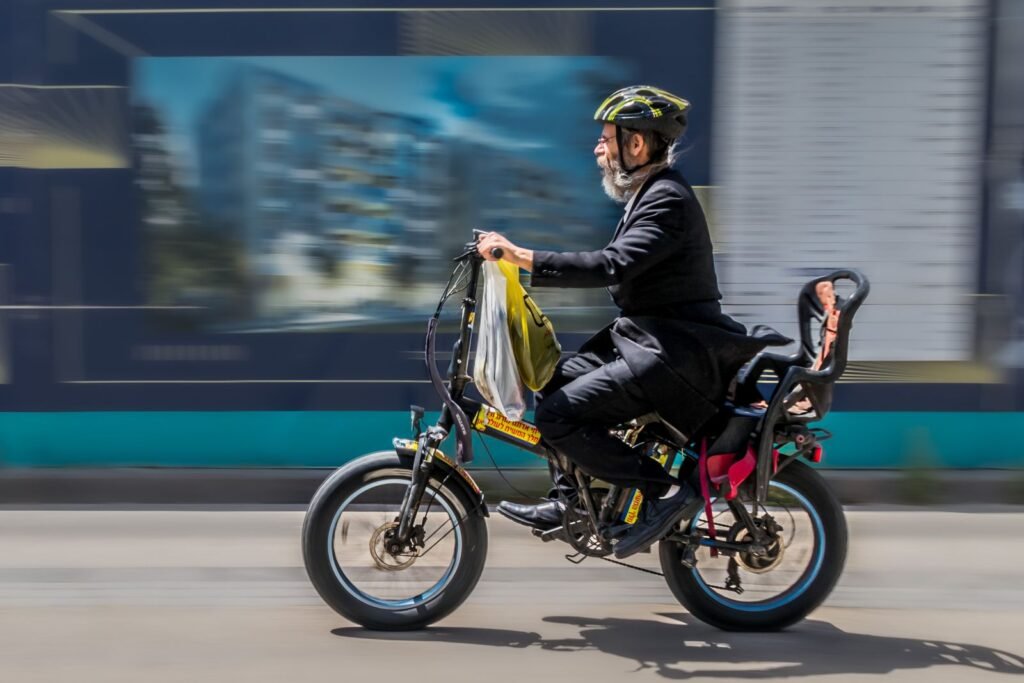
Older rider on an electric bike in daylight. Photo: tal molcho / Pexels
Straight answer: For most seniors, a pedal-assist e-bike is the better choice. It adds motor help only while you pedal, so you still ride — but hills and headwinds stop being the reason a ride ends early. Its upright position, step-through frame and steady low-speed help are easier on knees, wrists and balance than a road e-bike. A road e-bike wins only for a fit senior who rides smooth, paved roads, wants speed, and can hold a low position and lift the bike without help.
A road e-bike and a pedal-assist e-bike are not the same kind of choice. A road e-bike is a shape: a light frame, drop bars and narrow tyres built for smooth tarmac and speed. A pedal-assist e-bike is a drive type: the motor helps only while you pedal, and stops helping when you stop pedalling. Many bikes are both, so check the tyres, the riding position and where the motor sits first.
That overlap is why the choice matters for seniors. After 60, the things that end a ride are rarely speed. They are mounting the bike, holding a low position, starting from a stop, and lifting the bike onto a rack or up steps. This guide compares the two for senior riders only. It takes the E-Bikes Hub approach: judge your own bike on your own roads, not on a showroom floor.
Below you will find the side-by-side comparison, the five things that can flip the verdict, a 20-minute test to run before you buy, how to set either bike up for a senior rider, and what to do if you already bought the wrong one. If commuting is your main use, read the fat-tyre e-bike vs pedal-assist e-bike guide as well.

Road e-bike vs pedal-assist e-bike for seniors
| Attribute | Road e-bike | Pedal-assist e-bike | What to watch |
|---|---|---|---|
| Riding position | Low and forward, weight on your hands and wrists | Upright, with a wide view of the road | An upright position helps you spot hazards and eases neck and wrist strain. |
| Mounting and dismounting | Swing a leg over a high top tube | Step-through frames let you step on and off | Choose a step-through frame if your hips or knees limit your swing. |
| Help on hills | Light, so it climbs well if you are fit — the motor is small | Motor help while you pedal, often with several assist levels | Raise the assist before a hill, not halfway up it. |
| Starting from a stop | Needs a strong first pedal stroke to get going | Gentle, steady help from the first pedal stroke | Test a stop and a start on a slight slope. |
| Low-speed stability | Can feel twitchy at walking pace | Steadier at walking pace, in traffic and on paths | Test slow turns, not just top speed. |
| Weight and lifting | Light, easier to carry up steps | Heavier, because of the motor and battery | Lift it as you would after a ride, before you buy. |
| Braking and stopping | Same brakes, but a light bike stops quickly | Heavier, so give yourself more stopping distance | Test braking on a quiet, dry stretch. |
When the answer changes
Five variables can flip the verdict. If the verdict changes when you read one, trust the variable, not the general rule.
- Your fitness and joints: If you ride often, have strong knees and no wrist or neck pain, a road e-bike stays a fair choice. If mounting, starting or holding a low position hurts, the pedal-assist bike wins.
- Your route: A flat, smooth, paved route favours the road bike’s speed. Hills, headwinds, rough paths and frequent stops favour pedal assist.
- Your balance: If slow turns, stops and starts feel wobbly, choose the steadier bike. Confidence at low speed matters more than top speed.
- Carrying and storage: If you lift the bike onto a rack or up steps, a light road bike is easier — unless the assist matters more to you than the weight.
In short, the pedal-assist bike wins for most seniors — unless you are fit, your roads are smooth and flat, and you can lift and hold a low bike without help. See the road e-bike vs hub-motor e-bike guide for winter riding.

Test before you decide
Test it on your real route, in your riding clothes, for 20 minutes.
- Mount and dismount three times without help. If you wobble, the frame is wrong.
- Ride a quiet street first. Start, stop, turn both ways and ride slowly.
- Climb a short hill from a standing start, then stop and start again.
- Ride your real route at your normal pace, with your bag and layers.
- Lift the bike as you would at home: onto a rack, up a step, into a car.
What a fail looks like
| Symptom | Cause | Fix |
|---|---|---|
| Mounting feels unsafe | Top tube too high | Choose a step-through frame. |
| Hands and wrists go numb | Low, forward position | Raise the bars, or choose an upright bike. |
| Legs ache on the first hill | Assist too low, or gear too high | Start in a low gear; raise the assist early. |
| Braking feels long and skiddy | Heavy bike, worn pads, too much speed | Slow down earlier and brake with both brakes. |
Myth vs Fact:
Myth: A pedal-assist e-bike does the pedalling for you. Fact: The motor helps only while you pedal.
Myth: A road e-bike is always faster for seniors. Fact: It is faster only on smooth, flat roads.
Myth: A heavier pedal-assist bike is harder to ride. Fact: The motor cancels most of the extra weight while you ride.
Before you test: Wear a helmet, check the brakes, tyre pressure and bolts first, and choose a quiet route. Never test an unfamiliar bike in busy traffic, in the dark, or in the rain.
How to set up either bike for a senior rider
Set it up for your body, not for speed.
What you will need
- A pump and a pressure gauge
- A multi-tool for saddle and bar height
- A helmet that fits, and gloves
- Lights, front and rear
- Mudguards, if your bike has mounts
The method
- Set the saddle so you can touch the ground with the balls of your feet at a stop.
- Raise the bars until your wrists and neck feel easy. A shorter stem helps a lot.
- Set the assist low for flat ground, and learn the controls before a hill.
- Fit lights and mudguards first, before any other accessory.
- Ride a short, quiet test, then adjust the saddle and bars in small steps.
Note: A step-through frame is not a compromise. It is the simplest way to mount and dismount safely.
Warning: Do not ride with a saddle so high that you cannot reach the ground at a stop. A tip-over at a standstill can hurt a hip or a wrist.
When the damage is already done
If you already bought a road e-bike and it hurts, work through this list first.
- Your back and shoulders ache: Raise the bars, fit a shorter stem, and take breaks.
- Your knees hurt on hills: Use lower gears, raise the assist, and spin rather than push.
- Mounting scares you: Lower the saddle for mounting, and choose a step-through frame next time.
- You cannot lift it: Remove the battery before lifting, and store the bike where you do not have to carry it.
- Nothing fits, and the rides keep getting shorter: That is the sign to change bikes. A pedal-assist bike with an upright position will carry the same rides with far less strain. See the commuter e-bike vs road e-bike comparison and the fat-tyre e-bike vs hub-motor e-bike guide for seniors.

The pedal-assist e-bike as a safe alternative
There is one honest case for switching: your rides are daily, your roads are mixed, and you value arriving steady over arriving fast. For city riding, the road e-bike vs hybrid e-bike guide covers the same upright-versus-fast choice on urban roads.
- Choose a pedal-assist bike with a step-through frame, upright bars and tyres wide enough for your paths.
- Start on the lowest assist, and raise it only when the road rises or the wind picks up.
- Fit mudguards, lights and a rack first, before any other accessory.
- Ride your real route at your normal pace, and note the spots that still feel hard.
What to do next, in order
- Ride your usual route, in your riding clothes, on the bike you have now.
- Note where mounting, hills, stops or lifting feel hard.
- Set up the saddle and bars for an upright, easy position.
- Test a pedal-assist bike with a step-through frame on the same route.
- If it still feels hard, ask a bike shop to check the fit before you buy.
Never do this as a senior rider
- Never ride with a saddle you cannot reach the ground from at a stop. A tip-over standing still can hurt a hip or a wrist.
- Never start a ride with a flat battery. Check the charge before you leave, and charge indoors.
- Never test a new bike in busy traffic. Test it first on a quiet street, in daylight.
- Never brake hard with the front brake alone. Brake gently, with both brakes, and earlier than usual.
- Never skip the helmet because the ride is short. Most falls happen close to home, at low speed.
In short
For most seniors, a pedal-assist e-bike is the better choice: it helps only while you pedal, keeps you upright, mounts easily with a step-through frame and stays steady at low speed. A road e-bike is the better choice only for a fit senior on smooth, paved roads who can hold a low position and lift a light bike — and even then, test it on your real route first.
The essentials
- For most seniors, a pedal-assist e-bike is the better choice; a road e-bike wins only on smooth, flat roads.
- A road e-bike is a shape — light frame, drop bars, narrow tyres. A pedal-assist e-bike is a drive — motor help while you pedal.
- Choose a step-through frame if mounting or dismounting feels unsafe.
- Test slow turns, hill starts and lifting before you buy.
- Charge the battery indoors at room temperature, and check the charge before every ride.
More Questions, Answered
Is a pedal-assist e-bike good for seniors?
Yes. It helps only while you pedal, so you still ride and get exercise, while hills and headwinds stop cutting rides short.
Is a road e-bike too hard for seniors?
Not always. A fit senior on smooth, paved roads can enjoy one, but the low, forward position can strain wrists, neck and balance. Test it on your real route first.
What is the difference between a road e-bike and a pedal-assist e-bike?
A road e-bike is a shape built for speed on tarmac. A pedal-assist e-bike is a drive type in which the motor helps only while you pedal. Many bikes are both.
How heavy is too heavy for a senior?
If you cannot lift the bike onto a rack or up a step safely, it is too heavy for you. Remove the battery first to lighten it.
Additional Details
- Name: Road E-Bike vs Pedal Assist E-Bike: Which Is Better for Seniors?
- Description: Road e-bike vs pedal assist e-bike for seniors: which is easier to mount, ride and lift? Compare position, hill help and weight, then run the 20-minute test.
- Published: November 10, 2026