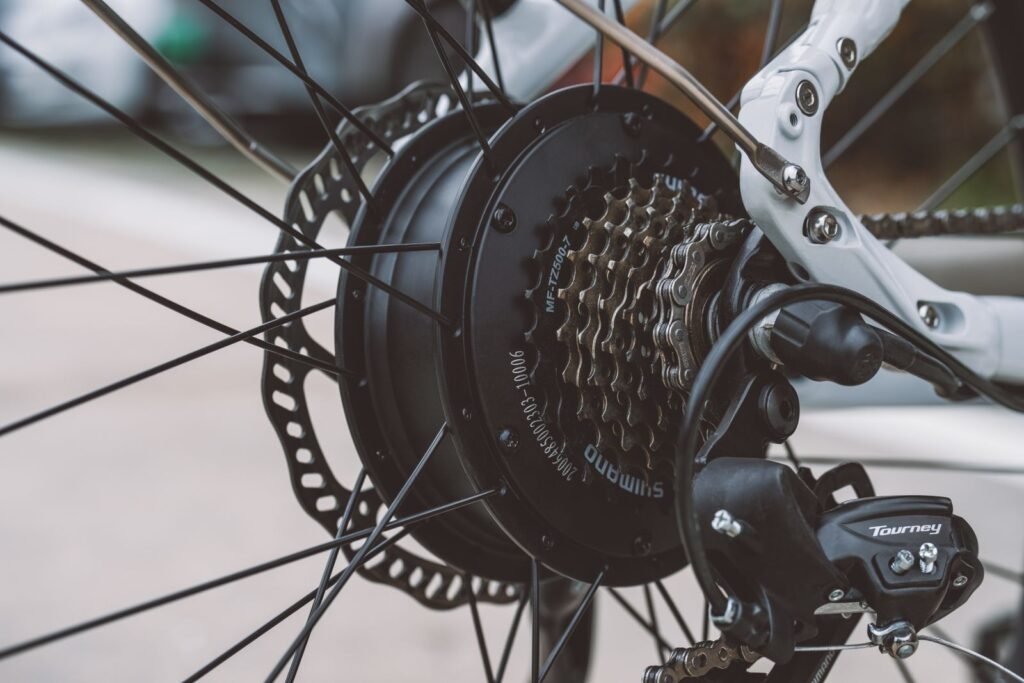
A close-up of a hub motor in a rear wheel, with the cassette and disc brake, in daylight. Photo: Motor TruckRun – Pexels.
Straight answer: In the hybrid e-bike vs hub motor e-bike choice, the hybrid e-bike is the better buy for most commuters. It is the complete package for daily riding: an upright position, flat bars, wider tyres and mounts for a rack and mudguards. Most hybrids already use a hub motor, so you get the easy drive too. A hub motor is not a bike type, it is only the drive. Choose the hybrid frame first, then a hub motor inside it.
Introduction
A hybrid e-bike and a hub motor e-bike sound like two different machines, but they are not the same kind of thing. A hybrid describes the bike: upright bars, a comfortable saddle, wider tyres and fittings for a rack and mudguards. A hub motor describes the drive: the motor sits in the centre of the wheel and pushes it directly. Most hybrids sold for commuting already have a hub motor.
The confusion matters, because it changes what to compare. Judging a hybrid only by its motor misses the frame and the position that decide how a commute feels. The question is which combination suits your route.
This guide compares the two side by side for commuting. For the wider picture, see the E-Bikes Hub and the comparison of road e-bikes and hub motor e-bikes.
Hybrid E-Bike vs Hub Motor E-Bike for Commuting: The Comparison
The table below compares what actually matters on a daily commute. Remember the key point: the hybrid is the bike, the hub motor is the drive, and most commuting hybrids already combine the two.
| Attribute | Hybrid E-Bike | Hub Motor E-Bike | What to watch |
|---|---|---|---|
| What it is | A bike style: upright frame, flat bars | A drive type: motor in the wheel hub | Are you buying a frame or a motor? |
| Riding position | Upright, head up, easy to see in traffic | Depends on the frame it is fitted to | Test the position, not the badge |
| Motor feel | Usually a hub motor: smooth, quiet, simple | A direct push from the wheel, not the chain | Try a stop and start at a junction |
| Hills | Low gears help on short, steep climbs | A steady push, but a heavy hub fades on long climbs | Ride your own hill |
| Weight and carrying | Built for loads: rack, mudguards, wide tyres | Motor weight at the wheel changes the balance | Lift it, then ride it loaded |
| Maintenance | Simple frame parts, most are standard | Few drive parts, but a rear puncture is a bigger job | Check how the wheel comes off |
| Range on a commute | Uses power steadily in stop-start traffic | Flat routes suit it best, hills and wind use more | Judge range by your route |
| Cost | You pay for the whole commuting package | You pay for the motor, the frame may need extras | Add up the extras first |
| Best for | Daily commuting, traffic, rough streets, carrying a bag | Easy, quiet assist on flat to rolling routes | Pick the frame first, then the motor |
When the Answer Changes
The hybrid is the right answer for most commutes, but not for every one. These are the variables that flip the verdict.
- Your route is long and smooth. A road-style frame with a hub motor may be quicker, if you are happy leaning forward.
- Your route is one long hill. Gears and weight matter more than the motor’s name, so test the climb yourself.
- You carry heavy loads or a child seat. The hybrid’s rack mounts and steady steering win, a hub motor alone carries nothing.
- You must carry the bike upstairs or onto a train. Weight decides, and a lighter hybrid may beat a heavy hub-motor bike.
- Your streets are rough or wet. Wider tyres and mudguards decide the verdict, not the motor.
In short, the hybrid wins the commute because it is a commuting bike first. The hub motor is the best drive to put inside it. For a closer look at the hybrid side, read the road e-bike vs hybrid e-bike comparison for city riding.
Test Both E-Bikes Before You Buy
Do this five-step test on both types, on the same day, on your real route.
- Take each bike over your real commute. Use the same lights, hill and rough patch.
- Stop and start five times. Pull away, stop, pull away again.
- Ride the rough patch. If one rattles your hands and neck, that is your answer.
- Ride with your bag or shopping. A bike that feels fine empty can feel very different loaded.
- Check the fit. After 20 minutes, note your neck, wrists and back.
What a fail looks like
| Symptom | Cause | Fix |
|---|---|---|
| Neck or wrist pain after a short ride | Too low and stretched | Raise the bars or choose the hybrid |
| Punctures on city roads | Tyres too narrow for potholes | Fit wider tyres, or choose the hybrid |
| Slow, heavy pull away from lights | Heavy hub, low assist at low speed | Use a higher assist level from a stop |
| Rear wheel will not come out easily | Motor cable and axle nuts block it | Ask the shop to show you first |
Myth: A hub motor makes any bike a commuter.
Fact: The motor adds power, not comfort. Position, bars and tyres decide comfort.
Before you test: Test on flat ground away from traffic first, and learn the brakes and assist levels before you join traffic. Wear a helmet, check the battery and tyres, and never test on a busy road if you cannot stop confidently.

A 26-inch hybrid-style e-bike with a 500W brushless motor, 20 MPH top speed, and up to 37 miles pedal-assist range.
How to Choose Between a Hybrid E-Bike and a Hub Motor E-Bike
Use this method before you pay. It stops the most common mistake: buying the motor and only later finding the frame does not fit.
What you will need
- Your real route, written down (distance, lights, hills, rough patches)
- A helmet and a way to note how each bike feels
- A bag or load you carry every day
- One hybrid and one hub-motor bike in your size
The method
- Write down your route. Distance, lights, hills and rough patches, before you look at any bike.
- Shortlist one of each in your size. Keep the assist the same, so the test is fair.
- Test both on your route. Score comfort, control and speed separately.
- Check rack and mudguard mounts, tyre clearance and battery removal.
- Check the fit, returns policy and service before you pay.
- Ride the winner for a month. Adjust the fit before you change parts.
Note: Do not buy a bike you have not ridden on your own route. A shop car park hides the hill, the potholes and the lights that decide whether you ride it every day.
E-bikes: Switch the power off before you work on the bike, and check the battery and your manual first. In the US, Class 3 models assist up to 28 mph, other places limit assist to a lower speed, check yours.

1000W peak motor, up to 25 MPH, and 40+ miles per charge.
When the Damage Is Already Done
If you already bought the wrong one, do not write the bike off. Match the problem to the fix.
- Your hybrid hurts your neck and wrists. Raise the bars and fit a shorter stem. If it still hurts after a proper fit, the frame is too stretched.
- Your hub-motor bike rattles over potholes. Fit the widest tyres the frame allows.
- Your hub motor feels slow on a long, smooth commute. Use the right assist level and pump the tyres up.
- You bought the wrong size. A wrong size is not fixed by parts. Return or sell it, do not rebuild it.
- Your bike has no rack or mudguard mounts. Clip-on guards can help for a while, but a frame without mounts will never carry a load like a hybrid. For a closer comparison, read the electric mountain bike vs hybrid e-bike and step-through e-bike vs hybrid e-bike guides.

750W peak motor, up to 20 MPH and 40 miles per charge.
The Safe Alternative: Start with a Hub Motor E-Bike
If you are not sure, the hub motor e-bike is the safe alternative. It is the easier bike to live with in a city.
The method
- Choose a hub motor e-bike in your size, with flat bars, tyres of at least 35 mm, and rack and mudguard mounts.
- Ride it for a month on your real commute, with your real load.
- If you finish the month wanting more speed, a road e-bike is your next bike.
- If you finish the month comfortable and riding most days, you already have the right bike.
A hub motor e-bike you ride every day beats a faster bike that stays in the hallway. For a closer comparison, read the commuter e-bike vs hybrid e-bike guide.
What to Do Next, in Order
- Write down your route, your distance and your load.
- Test a hybrid e-bike and a hub motor e-bike on that route with the five-step test.
- Score comfort, control and speed, and buy the winner.
- Ride it for a month, then adjust the fit before you change any parts.
- If it still hurts or stays too slow, use the damage list above.
Never Do This When Choosing a Commuter E-Bike
- Never buy without riding it on your own route. A car park test hides the real ride.
- Never choose by motor power alone. The motor adds power, not comfort.
- Never ride a bike that hurts for more than a few minutes. Pain means the fit or type is wrong.
- Never ignore the returns policy. If you cannot return it, a wrong choice is permanent.
- Never ride without a helmet, lights and a lock.
In short
For most commuting, a hybrid e-bike is better: more comfortable, easier to control in traffic, kinder on rough streets and better at carrying loads. A hub motor is the best drive inside it. Test both on your real route, and if you are not sure, start with the hybrid.
The essentials
- A hybrid is better for most commuting, a hub motor is the drive, not the bike.
- Flat bars and wider tyres make a hybrid easier in traffic and kinder on rough streets.
- A hub motor drives the wheel directly, so wheel work takes longer.
- Test both on your real route, with your real load, before you buy.
More Questions, Answered
Is a hybrid e-bike or a hub motor e-bike better for commuting?
For most commutes, the hybrid. It is more comfortable, easier to control at low speed and better at carrying loads. The best set-up is usually a hybrid frame with a hub motor inside it.
Is a hybrid e-bike slower than a hub motor e-bike?
On smooth, open roads, a road-style bike can be quicker, because the upright position catches more wind. In a city with lights and rough streets, the gap is much smaller.
Can a hybrid e-bike handle hills?
Yes, for short, steep city hills, because its low gears help at low speed. Test your own hill before you decide.
Additional Details
Name: Hybrid E-Bike vs Hub Motor E-Bike: Which Is Better for Commuting?
Description: Hybrid e-bike vs hub motor e-bike for commuting: compare comfort, motor feel, hills, maintenance and cost, then choose the right bike for your daily ride.
Published: November 10, 2026